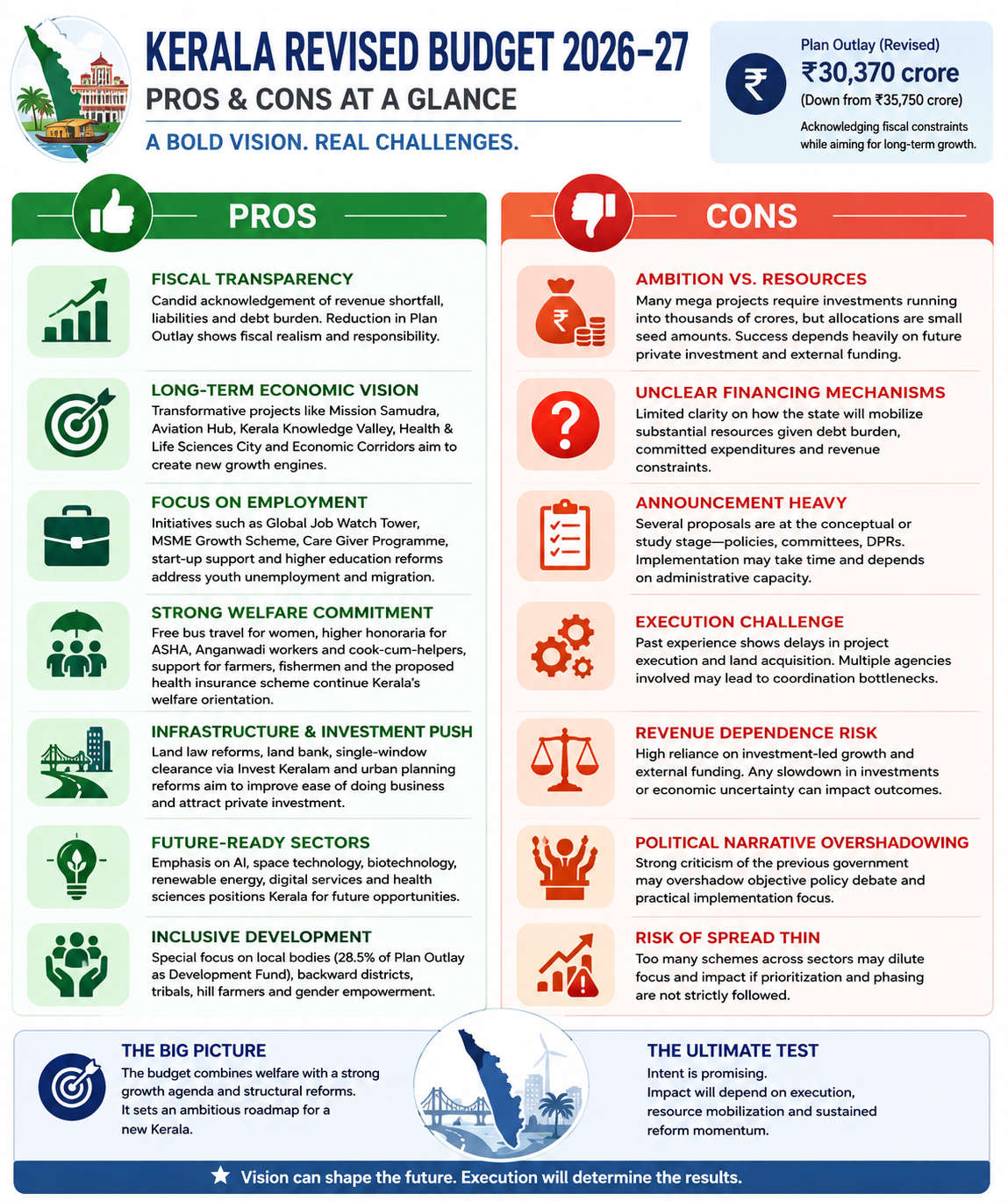
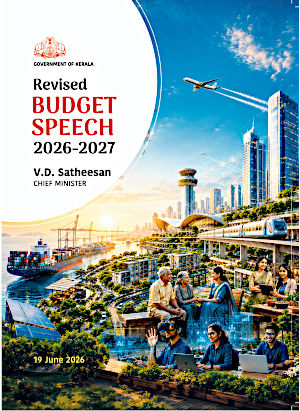
The revised Budget for 2026-27, presented to the Assembly by Chief Minister V. D. Satheesan on June 19, 2026, aims ambitious reforms with fiscal realism. Though the Chief Minister aims to rebuild the economy through innovation, transparency, and social equity, success will hinge on disciplined implementation and sustained revenue recovery.
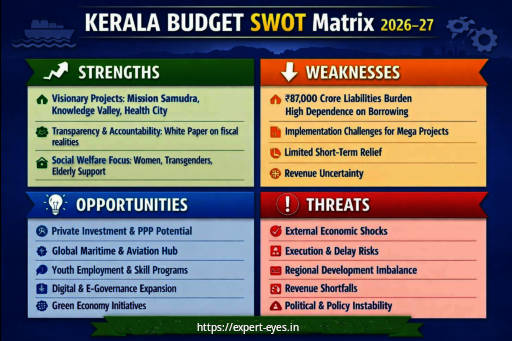
Mr. Satheesan is planning a major infrastructure push through projects such as Mission Samudra, Aviation Hub, Southern Kerala Economic Corridor, and Health & Life Sciences City. These are long-term projects which would need continued steering through a tough financial pathway. The Budget inherits ₹87,000 crore in liabilities and faces limited fiscal space for new spending.
Though the White paper on Finances had identified the problem areas, the Budget has not come with enough measures to address the problems. The Chief Minister is clearly in no position to propose new taxes. So, financial recovery will largely depend on buoyancy in taxes and recovery. The precarious and even hilarious situation can be gauged by the proposal to offer 50 per cent discount on payment of e-challans. It is not a secret that the previous government used e-challans as a revenue-raising measure with policemen travelling on two wheelers with handheld cameras to book several persons in one go. Now, Mr. Satheesan is trying to recover at least 50 per cent of the unpaid traffic fines which had piling up. Imagine how difficult it is going to be for him to fund mega projects.
The Chief Minister has proposed that fair values for property registration will be revised to net in more revenues. However, this will not prevent tax evasion. Fair values, of course, should reflect market valuation. The best thing to do is to bring fair values as close as possible to the market value and reduce the tax rates. This will eliminate black money and tax evasion connected to black money.
Proposals to make public sector units profitable, hive off loss making units, and promote as many as 10000 MSME units are old wine in new bottle. These were initiatives that the Industries Minister P. K. Kunhalikutty had tried with little success during his previous terms as industries minister. His efforts to bring large-scale investments to the State too had been a failure. Whether he will succeed this time around is doubtful. In fact, the basic problem to be addressed here is corruption at all levels, if the government wants PSUs to be successful and State to be investor friendly. The paltry Rs. 10 crore allocation for AI appears to be meaningless.
However, there are rays of hope in the Budget. Projects like Kerala Knowledge Valley and Wayanad Tribal University aim to make Kerala a global education destination which is achievable if there is a will to put the right persons in charge. Satheesan is a person willing to read and be educated. So, his vision on maritime Kerala could succeed and Kerala could become something like Singapore. But large‑scale projects require efficient execution and private‑sector participation to avoid delays. While visionary, many of his initiatives are long term; immediate economic stimulus measures are modest.
Initiatives for elderly welfare, caregiver schemes, and targeted assistance under One Kerala Karuthal Mission strengthen inclusivity. However, ominously, the Budget still had to speak of caring for the endosulfan victims, even decades under LDF and UDF administration.
Green and sustainable outlook can be seen in emphasis on renewable energy, silver economy, and eco‑friendly infrastructure. Proposals like that for Tribal University will be keenly watched as to its end-results.
If even a substantial portion of the proposed structural reforms and investment projects materialize, the budget could mark a significant shift in Kerala’s development trajectory. However, the ultimate test will be execution rather than intent.