Orders of Kerala SIC help Election Commission to deny RTI requests for electronic data

Orders of the Kerala State Information Commission have been aiding Election Commission of India in denying RTI requests for electronically processable data on elections in the State since 2021. This was in contrast to stand taken by the Information Commission in 2020.

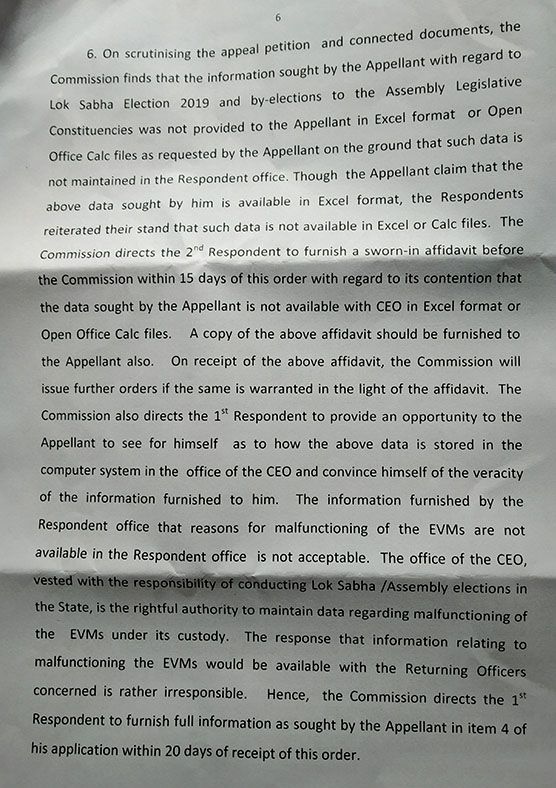
Vinson M. Paul, then Chief Information Commissioner of Kerala, in an order dated 29/5/2020, had asked the State Public Information Officer in the Office (SPIO) of Chief Electoral Officer (CEO) of Kerala to furnish a sworn-in- affidavit that the data sought under RTI Act on the 2019 Lok Sabha Elections was not available in Excel or Calc format. The SIO did not file an affidavit.

The Commissioner had also directed the SPIO to provide an opportunity to the Appellant (Roy Mathew) to see for himself as to how the data is stored in the the computer system in the office of the CEO and convince himself (sic) of the veracity of the information furnished to him.
Mr. Paul also observed that the contention of the respondents that the reasons for malfunctioning of the EVMs are not available in the Office was not acceptable and ordered them to be furnished to the applicant.

The visit to the CEO by the appellant got delayed over COVID and finally when the computer system was examined, it became clear that the electronic data was accessible to authorised persons in the CEO and could be downloaded in standard electronic formats. Following this, some data was provided.

However, Chief Information Commissioner, Vishwas Mehta, who succeeded Mr. Paul did not insist on the SPIO filing the affidavit and accepted a report that certain data was available only in PDF format. In his final order, Mr. Mehta disposed of the petition citing also the contention of the ECI that database of IT applications such as ERO-Net, ENCORE etc. fall under the intellectual property rights of the Election Commission, therefore the same is exempted from disclosure under RTI Act, 2005.

In response to another request for data of Kerala Assembly elections in 2021 in standard electronic format, the SPIO had again maintained that it fell under the intellectual property of Election Commission of India.

During hearing of appeal petition in the matter before Kerala Information Commission, Commissioner Sreekumar M. suggested that the files could have been provided in the printed format. On January 6, 2025, he ordered that since the SPIO had provided “timely response”, copies of documents in public domain be given to the appellant within 15 days after levying the requisite cost for same.

On February 1, 2025, the SPIO send the appellant a list of documents available with the CEO (apparently only those in public domain) and asking him to remit Rs. 83103 towards costs for supplying the information in print form. The list was not in tune with the request made and did not cover all the items requested.

Under the RTI Act, merely providing a timely response without providing all the information sought does not exempt the Information Officer from the obligation to provide the information free of charge if the response was incomplete or unsatisfactory. Besides, all information with public authorities, other than those expressly excluded from disclosure under the Act, needs to be furnished against RTI requests.

Essentially, a timely response is only one aspect of compliance. The core obligation is to provide the requested information fully and accurately, subject to the exemptions outlined in the Act. The Sate Information Commission is not insisting on that and is arbitrarily restricting the scope of the Act without authority.

This has emboldened the CEO. In response to first appeal relating to requests for information on polling in electronic format, the Appellate Authority C. Sharmila said that Electoral Registration Officer should be approached for information on deletion of names from the voters list and reasons thereof.

(This was despite previous assertions by Chief Information Commissioners Vinson M. Paul and H. Rajveen that the CEO, vested with the responsibility of conducting elections in the State, was the rightful authority to compile and maintain data on the elections).

She also maintained that database of IT applications of Election Commission fell under intellectual property and ECI does not provide data to the public on reason for replacement of electronic voting machines (during polling).

The Election Commission and the State Information Commission ought to reconsider its stand in view of the Supreme Court interim order on intensive revision of voters list in Bihar.

The operative part of the order in para seven limits documents required to be provided under the RTI Act to those in the public domain. (This is when RTI requests are not usually made for documents in public domain.) It also contravenes Section 7(6) of the RTI Act that mandates furnishing of information free of charge if there has been a delay of more than 30 days. Here “timely response” by SPIO is indicated as reason for ordering costs. Besides, the request for providing data in electronic format is circumvented.

Much ado about data privacy of voters list

Operation Twins

The CPI (M) has accused Opposition Leader Ramesh Chennithala of leaking data on voters and publishing them on a server located in Singapore. However, the accusation does not hold water in the face off facts.

Mr. Chennithala had published data on 4.34 lakh persons in the voters’ lists for the upcoming Kerala Assembly Elections, whose photos appear under different names in the same constituency or other constituencies or whose names appear more than once in the lists, on the site operationtwins.com. Voters’ lists are data in the public domain, so no leak has taken place.

Voters list is not sensitive data under the IT Act and Rules unlike health information which is defined as sensitive (recall the controversy over Springler).   Information Technology (Reasonable Security Practices and procedures and sensitive personal data or information) Rules, 2011 also has a proviso to Section 3 that says that “any information that is freely available or accessible in public domain or furnished under the Right to Information Act, 2005, or any other law for the time being in force  shall  not  be  regarded  as  sensitive  personal  data  or  information  for  the  purposes  of  these rules”.

It is true that the Web server is located in Singapore. However, that does not alter the legal position. Voters list is data officially published under the law and accessible in public domain.

The only thing that you can accuse the Opposition Leader is that there are some errors in his list of bogus voters. Besides, he was not honest enough to include some duplicate entries of Congress candidates and their relatives in the list. Possibly because of limitations of photo matching, the names of twins have been flagged as duplicate entries, with operation twins thus causing some heartburn to real twins. While a chunk of data point to fraud, other duplicate entries could be the result of failure of the officials to delete previous entries when voter requests change of address or corrections.  It is clear that sufficient diligence had not been shown by electoral officers.

Mr. Chennithala has chosen to register a domain with commercial extension for the site and keeping the registrant information private. He could have chosen extensions (top level domains) like .in or .org.in. But it is a matter that hinge on availability/personal choice/ignorance. The person who registered the site probably did not register the site in the name of Mr. Chennithala and wanted to keep his name private.

It may also be noted that the accusations against Mr. Chennithala comes when there is demand for publishing of more data relating to electoral process internationally by organisations like the Open Election Data Initiative. So, Mr. Chennithala’s initiative is setting up a site to expose electoral malpractices is laudatory.

In fact, Mr. Chennithala has been raising a number of allegations against the LDF government. If even a fraction of them are correct, that do not bode well for the State. If the LDF is re-elected to power, the government would be at the mercy of Central agencies. This can give rise to deals between the CPI (M) and the BJP or even instability of the government.

However, this may not be a problem for Chief Minister Pinarai Vijayan to manage for he has already taken a few leaves from Modi’s note book to retain power and pelf.

Duplicate entries in voters list is a massive fraud

Lakhs of duplicate names and fake entries in the voters list for Legislative Assembly elections in Kerala is a massive fraud on the people of the State.

The initial estimates are that the number of duplicate entries, which can be used for voting by impersonation, is above four lakhs. There is also the allegation that migrant workers had been enlisted without following procedure and checking their status properly.

It is surprising that the electoral officers had not cared to check for duplicate entries at least in the same constituency not to speak of duplicate entries across constituencies. This is when computer technologies these days make it easy to find duplicate entries, though Malayalam script and variations may make it a little difficult than in English.

The existence of large number of duplicate entries came to public knowledge when Opposition Leader Ramesh Chennithala raised the issue and accused the ruling front of complicity. Apparently, he had been assisted by someone skilled in analysis and comparing of large chunks of data.

It is not surprising that the things have come to such a pass, given the lackadaisical manner in which the Office of the Chief Electoral Officer (CEO), Kerala, handled data. This had not started in recent years. As back as in the nineties, total votes polled and the sum of the votes polled by individual candidates did not tally in certain cases. In one of the election reportage, published by the ECI, the numbers did not tally in more than 25 constituencies. Though this was brought to the notice of the CEO, he did not correct them and they still remain as the official tally. By 1996, computers came into use in compiling data and the figures. Data, which could not be validated, were artificially tallied by adjusting invalid and uncounted votes.

In the 2016 Assembly elections, some data in the Constituency data summary, officially released by the Election Commission (especially that of electors and votes polled), do not match with the detailed results published by ECI. There were also variations with detailed results published on the Web at the time of announcement of results.

The CEO’s Office has been reluctant to release computer-processable data, which can be used for data validation, despite an order by the State Information Commission under the RTI Act. (The accompanying image shows the operative part of the order of the Commission dated May 29 last year which is yet to be complied with). These were symptoms of deeper malady.

Despite all the improvement of communication facilities, the CEO office often has not been able to come out with correct percentage of polling on the polling day itself. The number of electors supplied before and after polling often varied as last minute enrollments and deletions were not either properly updated or were plainly incorrect.

Now, it is going to be an uphill task for the election officials to delete lakhs of duplicate and fake entries and furnish the count. There is also the issue of bogus or multiple electoral identity cards issued in the name of the same person.  It is not going to be easy to find them and destroy them.  This raises the prospect of miscarriage of the electoral verdict.

Though the irregularities could not have happened to this scale without the connivance of officials, a proper inquiry is yet to be conducted. So far action had been taken against only one official though many need to be removed from playing any role in the elections. Meanwhile Mr. Chennithala has approached the High Court seeking action.

SIC order
Operative part of the SIC order on RTI request for election data.

Information Commission orders release of video footage of polling in Kerala

The Election Commission of India and its electoral officers have been forgoing openness and transparency in the electoral process, thus undermining democratic elections in Kerala and probably elsewhere in the country. A recent order of the State Information Commission may help to restore at least some degree of transparency.

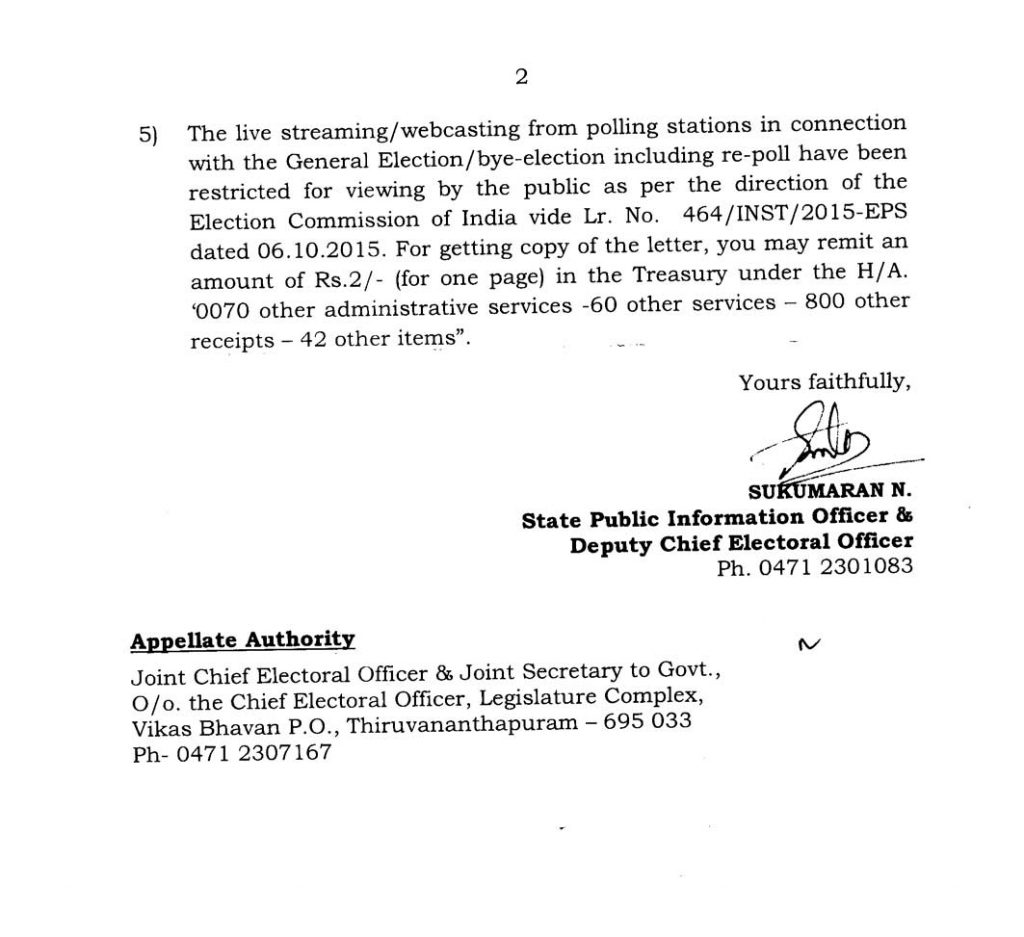
Access to Webcasting to candidates, agents and public during the Lok Sabha polls last year had resulted in detection of several cases of impersonation and bogus voting. However, when repoll were held, the Chief Electoral Officer (CEO) of Kerala restricted viewing of Webcasts to ‘election machinery’ citing a letter from the Election Commission issued in 2015. This impeded concurrent social auditing of the election process.

The letter said that the Commission had decided that henceforth, webcasting in polling stations will be restricted to viewing only by the election machinery in keeping with the spirit of Rule 93(1) of the Conduct of Election Rules, 1961.[ The rule actually deals with production and inspection of election papers. It specifies that used ballot papers, counterfoils et cetera and sealed control units of EVMs should not be opened or allowed to be inspected by any person or authority except under orders of a competent court. This a clause aimed at maintaining the secrecy of balloting. There is no reference to Webcasting or video footage in this clause. How the Commission could take a decision to deny real time access to web footage under this clause and how it could be in the spirit of the Rule is anybody’s guess.

Even if the decision is valid, it did not cover requests for footage under the RTI Act. However, when Advocate D. B. Binu sought the CCTV/Webcasting footage from polling booths that recorded polling percentage of more than 90%, the State Public Information Officer (SPIO) in the Office of the CEO did not release the information. He initially said that a clarification was being sought from the Commission in view of the restriction imposed by the Commission on public access. Later, he claimed that “the final list of polling booths where webcasting was done was being finalised” (sic). He added that no separate details in the manner of polling booths where 90 % and above polling was recorded was kept in that office. The appellate authority dismissed first appeal saying that the Office was awaiting clarification/permission from Election Commission of India on providing such video footage to the public.

This was when there was no provision under RTI Act giving power to the SPIO to get clarification/permission from the Commission. Moreover, the Handbook for Returning Officers had provision that copy of the video footage should be made available on payment of Rs. 50 (fees as per Right to Information Rules, 2012). Hence, the clarification sought was clearly a delaying tactics by SPIO and a clear violation of RTI Act.

The State Information Commission, in a recent order, has now directed the footage to the released. Allowing an appeal from Mr. Binu, Chief Information Commissioner Vinson M. Paul noted that the contention of the Respondent’s office that it was awaiting clarification from the Election Commission of India was not tenable under the RTI Act. Information sought tinder the Act can be denied only under Section 8 or 9 of the Act. Similarly, the argument that the Respondent office did not maintain details of polling booths, which recorded more than 90% polling, was not valid as the CEO’s office is the repository of all such information.

In response to another RTI application from the writer of this blog, the SPIO is maintaining that the reasons for malfunctioning of the electronic voting machines are not available in the CEO’s Office. As many as 434 balloting units, 391 control units and 1041 VVPATs were replaced in Kerala during Lok Sabha polls. The number of BUs and CUs replaced during the by-polls were 15 each. As many as 56 VVPATs were also replaced.

About a month after the by-elections to the Assembly in September/October 2019, the SPIO maintained that the returning officers were yet to finalise data on the polls except in the case of Pala constituency. Though the data were later released on first appeal, it was provided only in PDF format though the request was for data in excel or similar format that could be easily used for calculations.

If what the SPIO said was true, how the returning officers declared the by-poll results and Election Commission notified the winners without finalising the data?

The appeal before the State Information Commission in this case is pending.

Copy of reply from State Public Information Officer, CEO’s Office, on RTI request for election data
Reply from State Public Information Officer, CEO’s Office, on RTI request for election data- Page 2

Performance of Members of Parliament 2014 – 2019

P. K. Biju meeting voters

Did you know that CPI (M) member P. K. Biju (Alathur) was among the top ten performers of the outgoing Lok Sabha in terms of participation in debates, but the topper beats him by a score more than six times higher?

Congress member K. V. Thomas, who did not get a seat this time, and actor Innocent (CPI-M independent), who is contesting again from Chalakudy, were the poorest performers among members who served the full term from Kerala.

Topper Bhairon Prasad Mishra (BJP) from Uttar Pradesh attended all sittings of the House and participated in 2095 debates.  You may even wonder whether the Sabha had so many debates, considering the poor participation by many of our elected representatives. The average participation was about 67 debates nationally and 142.5 for members from Kerala.

Biju participated in 326 debates followed by RSP’s N. K. Premachandran (300) and Independent Joice George (290).  On the other hand, Thomas and Innocent participated only in 42 debates each. P. K. Kunhalikutty (Muslim League) has the lowest score of nine from Kerala. It may be noted here that he was in the House only for about two years, having been elected in a by-election from Malappuram in April 2017. If we extrapolate his performance for five years, it is still the lowest from Kerala.

The outgoing Lok Sabaha has as many as 32 members who did not participate in any of the debates. They included post graduates and doctorate degree holders. They also included former Chief Ministers Shibu Soren (Jharkhand) and Kamal Nath (Madhya Pradesh) besides actor Shatrughan Sinha.

The oldest member in Lok Sabha, L. K. Advani of BJP, participated in only one debate in  a span of five years. So was the youngest member Pravin Kumar Nishad of Samajwadi Party from Uttar Pradesh who incidentally is a professional graduate.

Supriya Sule of Nationalist Congress Party from Maharastra topped in terms of the questions she had asked the government in the House.  She had asked as many as 1181 questions during the five-year term.  Nishikant Dubey of BJP from Jharkhand presented the highest number of private members’ bills in the House— 48 against average of 2.3 bills nationally.

The following MPs had 100 per cent attendance in the House, besides Bhairon Prasad Mishra.

Kulamani Samal Odisha Jagatsinghpur Biju Janata Dal Professional Graduate 100%
Ramesh Chander Kaushik Haryana Sonipat Bharatiya
Janata Party
Professional Graduate 100%
Bhairon Prasad Mishra Uttar Pradesh Banda Bharatiya
Janata Party
Inter/ Higher Secondary 100%
Gopal Chinayya Shetty Maharashtra Mumbai-North Bharatiya Janata Party Under Matric 100%

Attendance is not marked for Ministers. Niranjan Jyoti from Uttar Pradesh had 100 per cent attendance till she became a Minister in August 2014.

Full set of sortable data at
http://www.keralaassembly.org/lok/sabha/2019/performance_2019.php4

Hat trick by Oommen Chandy

Sabarinath with CM

K. S. Sabarinath (Right) with Oommen Chandy

It was a hat-trick victory for Kerala Chief Minister Oommen Chandy and the ruling Front in Aruvikkara Assembly constituency on Tuesday. The United Democratic Front (UDF) had won by-elections earlier at Neyyattinkara and Piravom after Mr. Chandy came to power in 2011.

The result indicates that Mr. Chandy’s mass contact strategy is still working though some might be disappointed by the unchanging face of bureaucracy. It also shows that the corruption charges against the government did not have the impact that the Opposition hoped for. The failure of the candidate put up by UDF dissident P. C. George to garner even one per cent of the votes perhaps underlines this.

The UDF had cleverly fielded a new face in the election instead of a seasoned politician. Now, almost every citizen know that politicians routinely take money from businessmen including bar and quarry owners for doing favours. But UDF candidate K. S. Sabarinadhan could not be grouped with them as he has not been in politics before.

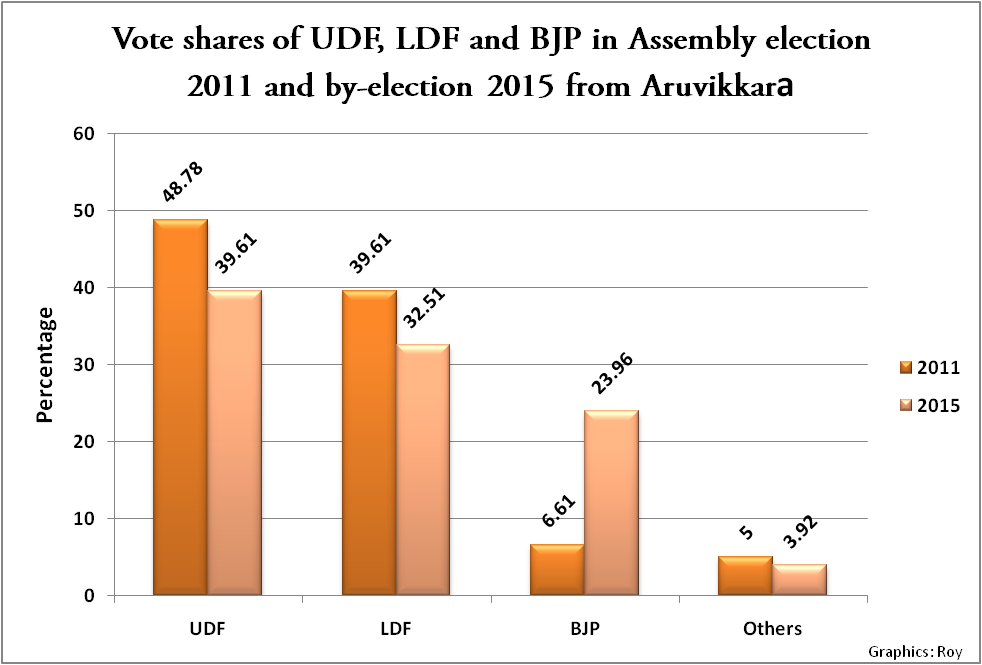
Vote sharesHowever, it is notable that opposition parties, including BJP, and NOTA carried away a vote share of 56.87 per cent while UDF’s vote share dropped by 9.17 percentage points (from 48.78% to 39.61%.). The Opposition Left Democratic Front (LDF) suffered a loss of 7.1 percentage points (from 39.61% to 32.51%). NOTA polled one per cent of the votes. The vote share of BJP increased by nearly four-fold from 6.61 per cent to 23.96 per cent.

It showed that BJP could extend the advances it made in Thiruvananthapuram at least partially to neighbouring constituencies provided that it has the right candidate and political climate. BJP’s O. Rajagopal had won 33.3 per cent of the votes in the Lok Sabha polls from Thiruvananthapuram constituency in 2014. Now, he has won 23.96 per cent votes from a neighbouring Assembly segment.

This does not mean that BJP can duplicate the performance in the Assembly elections in 2016. It simply lacks candidates of the stature of Mr. Rajagopal to be fielded in other constituencies. It is also notable that Mr. Rajagopal’s popularity is not as strong as in Thriuvananthapuram in Aruvikkara. His appeal may have also diminished compared to the time of Modi wave and loss of popularity of Shashi Tharoor (who defeated him in Thiruvananthapuram).

However, the BJP’s performance is a clear warning to both the UDF and LDF. They will lose votes if people find an alternative, perhaps even NOTA, if they take the voters for granted. People are also not ignoring issues like development. The UDF lost a lead in Aruvikkara panchayat of Aruvikkara constituency over issues of local development. It won because BJP took away votes of LDF also. by-electionRelated Post:
Crucial battle for Oommen Chandy in Kerala

Crucial battle for Oommen Chandy in Kerala

The by-election from Aruvikkara constituency in Kerala is a crucial battle for Ommen Chandy government, beleaguered by corruption charges.
Chief Minister Oommen Chandy has taken it upon himself to win the election by fielding a novice. He has already addressed or interacted directly with half of the electorate in the constituency.

by-election

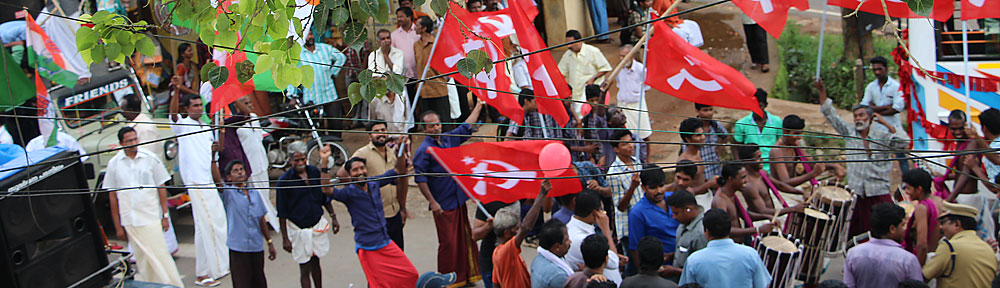
Finale of by-election campaign in Aruvikkara constituency in Kerala. Photos: Roy Mathew

A victory in Aruvikkara will enable Mr. Chandy to claim that his government still has people’s support. The ruling Front will be winning the third by-election after coming to power in 2011. (It had earlier won by-elections from Neyyattinkara and Piravom).

A defeat would show that support for government has slipped. This would encourage his detractors and he will face increasing pressure over corruption, questionable associations and misdemeanors of his Ministers and his own office. Though challenge to Mr. Chandy’s Chief- Ministership is not as strong as before, a defeat in the by-election can spell serious trouble for Mr. Chandy.

The campaigning is throwing out characteristics of a neck to neck race. However, the chances of the ruling Front (UDF) or Opposition Front (LDF) making a significant advance at the finish line could not be ruled out. The UDF candidate K. S. Sabarinathan, being a novice, has the advantage of being unblemished. The LDF candidate M. Vijayakumar, on the other hand, has to carry his own baggage. He faces an unusual situation of a counter affidavit having filed against his affidavit given as part of his nomination papers.

electionThis may be first time that a counter gets filed against an affidavit filed by a candidate. This could now become a trend in future elections.
The BJP candidate O. Rajagopal is sure to carry away a notable number of votes from the UDF and LDF kitty. He had been runner up in elections from Thiruvananthapuram.

His party’s vote share in Aruvikkara in the Assembly election of 2011 was only less than seven per cent. Mr. Rajagopal, who is popular around Thiruvananthapuram, and his foray into an adjoining area is sure to increase BJP’s votes.

Related links:
Kerala Assembly election database
By-election results: Neyyattinkara and Piravom