
This gallery contains 8 photos.
Author Archives: Roy Mathew
Crucial battle for Oommen Chandy in Kerala
The by-election from Aruvikkara constituency in Kerala is a crucial battle for Ommen Chandy government, beleaguered by corruption charges.
Chief Minister Oommen Chandy has taken it upon himself to win the election by fielding a novice. He has already addressed or interacted directly with half of the electorate in the constituency.

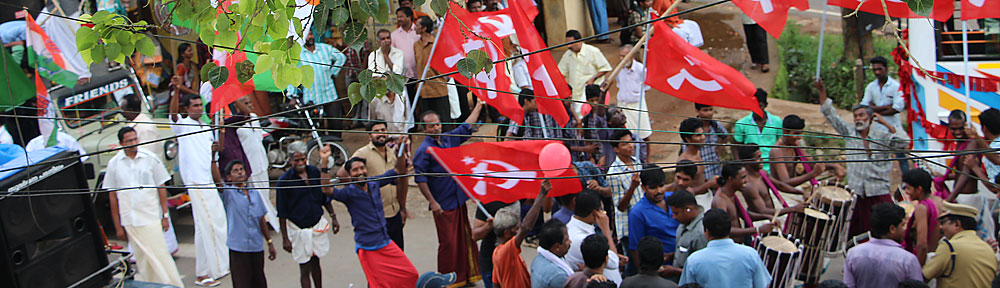
Finale of by-election campaign in Aruvikkara constituency in Kerala. Photos: Roy Mathew
A defeat would show that support for government has slipped. This would encourage his detractors and he will face increasing pressure over corruption, questionable associations and misdemeanors of his Ministers and his own office. Though challenge to Mr. Chandy’s Chief- Ministership is not as strong as before, a defeat in the by-election can spell serious trouble for Mr. Chandy.
The campaigning is throwing out characteristics of a neck to neck race. However, the chances of the ruling Front (UDF) or Opposition Front (LDF) making a significant advance at the finish line could not be ruled out. The UDF candidate K. S. Sabarinathan, being a novice, has the advantage of being unblemished. The LDF candidate M. Vijayakumar, on the other hand, has to carry his own baggage. He faces an unusual situation of a counter affidavit having filed against his affidavit given as part of his nomination papers.
 This may be first time that a counter gets filed against an affidavit filed by a candidate. This could now become a trend in future elections.
The BJP candidate O. Rajagopal is sure to carry away a notable number of votes from the UDF and LDF kitty. He had been runner up in elections from Thiruvananthapuram.
His party’s vote share in Aruvikkara in the Assembly election of 2011 was only less than seven per cent. Mr. Rajagopal, who is popular around Thiruvananthapuram, and his foray into an adjoining area is sure to increase BJP’s votes.
Related links:
Kerala Assembly election database
By-election results: Neyyattinkara and Piravom
Poison in food
If we look at officials records, the banning of Maggi noodles will look as an isolated incident. Maggi was the first instant noodles to be introduced in India in 1982 and the pre-1982 generation had not tasted anything like that before. However, the food item had hardly been examined critically though sometimes perceived as unhealthy having several additives and preservatives in it.
When the dust settles down, Maggi will bounce back. Many Indians would not have even heard of the controversy and they will continue to relish the foreign food. The Maggi incident will not be a lesson for either the authorities or the people. In fact, there are thousands of products in the market which can be worse than Maggi.
The Food Safety and Standards Act was enacted in 2006 with more stringent provisions than the erstwhile Food Adulteration Act. However, during the past nine years, the authorities have not cared to strictly enforce the Act, but for occasional tests and warnings.
The problem is not confirmed to large packaged food manufacturers. Many food items such as vegetables and grains in the market are contaminated or adulterated. Items procured by large manufacturers cannot be free of contaminants and it is not easy to test all the items that go into production. Many smaller operators cannot even afford to do any testing at all.
It has been found that excessive quantities of pesticides are being used in vegetables cultivated in Tamil Nadu and grains in Punjab. Sometime back, all samples of packaged chilly power sold in Kerala were found to
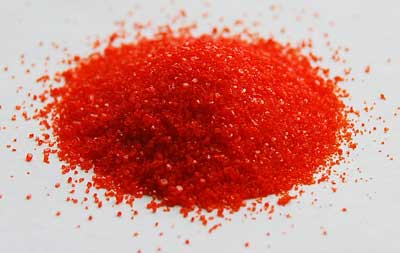
Potassium dichromate used as an adulterant in chilly powder affects resperatory system, liver, kidneys,eyes, skin and blood.
have highly toxic and carcinogenic potassium dichromate in it. Even products of well known brands had it. It turned out that they were procuring chilly powder from North India and was merely packaging and marketing it in Kerala without any testing. (It was more profitable for them to buy the powder than buy the raw material for powdering in Kerala.)
Nothing was heard of prosecution in these cases. And it is not known whether chilly power sold in Kerala still has potassium dichromate. Pesticide residues and contaminants sometimes become undetectable after processing. All these point to the need for stricter food safety enforcement covering the source to final product.
Rahul Gandhi’s ‘war over sea’, a misplaced adventure?
Congress vice president Rahul Gandhi is reportedly planning an outreach programme in Chavakkad in Thrissur district next week to take up the cause of traditional fishermen. The most pressing issue there is described as the woes of fishermen resulting from the Central Government’s decision to impose ban on fishing for 61 days. He is ill-advised to take up this issue as a shorter ban on fishing is not actually in the interests of traditional fishermen.
It may be recalled that the traditional fishermen had launched a series of agitations for three-month ban on bottom trawling during monsoon led by persons like Fr. Thomas Kocheri and Sr. Philomin Mary in the eighties. The mechanised boat owners were strongly opposed to the ban though it was aimed at conservation of fish resources.

Fishermen blocking the highway at Alappuzha in 1985 demanding, among other things, ban on trawling. Photo: Roy Mathew
Congress leader K. Karunakaran was not in favour of the ban and had used police to suppress the agitation when he was the Chief Minister. However, even Congress supporters in the Dheevara Sabha were forced to take a stand in favour of the ban. The agitation led to appointment of various committees to study the issue. Finally, the government decided to have a shorter ban of about 45 days though this was not a scientifically sound decision. Expert committees had called for a longer ban during monsoon to cover the entire breeding season of fishes.
What has changed between now and then is that more of the traditional fishermen have become owners or workers of mechanized fishing boats. The same forces which opposed the ban for quick returns and lobbied with Karunakaran are now behind Mr. Rahul Gandhi’s move. The only difference is that more ‘traditional fishermen’ are now with them. However, this assessment would depend on whether someone is ‘traditional’ by birth or by use of the fishing gears.
Scientifically, the only thing that has changed is confirmation of the fact that all (economically valuable) fishes do not breed during monsoon. Experts in the eighties have either discounted this fact or did not have adequate data to come to a conclusion. This may necessitate deeper look into the recommendation and possibly modification of the ban on a regional basis. More important may be the need to declare marine reserves like wildlife sanctuaries.
A shorter ban will not fully serve the purpose and a two month ban is reasonable considering all the factors. However, stricter enforcement of ban on net types and mesh sizes will be more crucial to conservation of marine resources. Fishlings ought to be allowed to grow to certain sizes before they are harvested.
Related Report:
India opposes ban on pollutants

TO VOTE OR NOT TO VOTE: Delegates to MoP of Stockholm Convention vote on whether to take a vote on listing, by raising flags, in Geneva on Saturday. Photo: Secretariat of BRS Conventions
India has been blocking moves at the Conference of Parties of the Stockholm Convention on Persistent Organic Pollutants to list more chemicals for elimination from worldwide use. This precipitated a division for the first time in the history of the Conference— which used to take decisions by consensus, at Geneva on May 16, 2015.
The vote was for listing of pentachlorophenol, an organochlorine compound used as pesticide and disinfectant, for elimination (which will lead to ban on their production and use by member countries). Residues of the pesticide have been detected in the environment in wildlife and human biomonitoring studies.
Switzerland pressed for a vote on listing of pentachlorophenol after efforts to reach a consensus failed. The Conference first took a vote on whether matter should be decided through division. Then it voted 94 against two in favour of listing with eight abstaining. The decision is not binding on India.
The Conference this time was part of combined meetings of Basel, Rotterdam and Stockholm conventions. India opposed listing of trichlorfon at the Conference of Parties of the Rotterdam Convention on the Prior Informed Consent Procedure for Certain Hazardous Chemicals and Pesticides in International Trade also, leading to deferment of decision for want of consensus. India was the only country to oppose the proposal.
It was after much remonstrance that India agreed to the resolution on elimination of endosulfan in 2011 with riders (specific exemptions that included use on multiple crop-pest complexes). Though the Convention came up with alternatives to endosulfan as decided at its 2011 Conference, India is yet take steps for ratification of the decision through approval of Parliament. This was despite findings of serious harm caused by the pesticide in Kerala and Karnataka, and possibly in West Bengal and Tamil Nadu also.
Observers had alleged that representatives of the pesticide lobby were present in the Indian delegation at the 2011 Conference of Parties to prevent the listing of endosulfan. It is not yet known whether similar situation arose this year also with new government in power. However, it is very clear that India’s opinion at the International fora is dictated by the interests of pesticide companies rather than its population or the world at large.
Regulation is lacking or unenforceable (for want of proper enforcement machinery, laboratories and political will) in India though a substantial portion of the food consumed in the country is contaminated to various levels. Pesticides are often applied unnecessarily and in excess of recommendations in agriculture fields as well as godowns in most States. A national level analysis by government of more than 16000 samples of vegetables, fruits, spices, grains and other food items showed that more than 500 samples had pesticide residues above the limits prescribed by Food Safety Standard Authority of India.
Kerala’s vulnerability to earthquakes: action lacking
Kerala is yet to take steps for reduction of vulnerability from earth quakes though the issue had come to the fore several times during the past two decades.
As many as 45 earthquakes had been recorded in Kerala during the 20th century. On the basis of assessment of about 65 earthquakes recorded in the 19th and 20th centuries, the Centre for Earth Science Studies here had stated that there was possibility of earthquakes of the magnitude of up to 6 on the Richter scale occurring in the State. (Sensitive instruments have recorded around 200 mild tremours in Kerala from 2001 besides a few of magnitude of less than 4.)
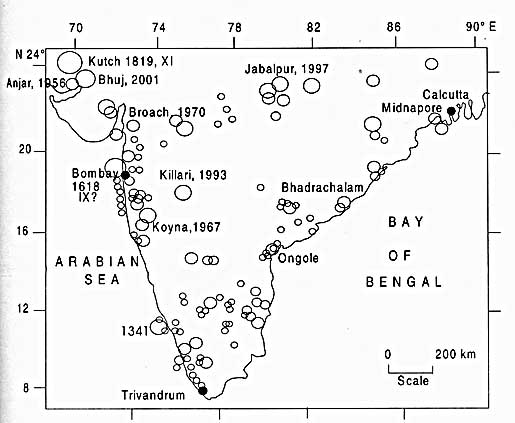
Historic earth quakes: from 19th century to 2001
The most vulnerable areas were in Kochi and Alappuzha where buildings sit on 400-metre-deep alluvial soil. These soil formations could get fluidised in the event of even moderate earthquakes leaving to devastation as hardly any of the buildings there are designed to withstand earthquakes.
The Kerala Assembly Committee on Environment had called for enforcement of national building code as back as in 2001. It had suggested that the strength of buildings in earthquake prone areas should be tested using the services of experts and measures taken to strengthen weak buildings. The quality of materials used for construction of multi-storeyed buildings should be ensured. Use of wood and bamboo should be encouraged in the construction of houses for the poor.
Though BIS standards exist, they are not being followed for building construction. Houses for even tribals were being built with concrete though many tribal communities liked to live in thatched homes. Though a five-year, UNDP-funded earthquake vulnerability reduction project was taken up in Thiruvananthapuram, Kochi and Kozhikode from 2003-04, nothing much was of heard of its results. The disaster management policy, drawn up in 2010, also remains largely on paper.
Now, it is hoped that the expert committee which is considering changes of to Kerala Municipal Rules would look into matters connected to seismic safety. It is high time that Kerala moved to quake-resistant constructions and retrofitting of buildings for safety, especially in risk prone areas of Kochi and Alappuzha.
Governor redeems

Kerala Finance Minister K. M. Mani presenting the Budget for 2015-16 in the Assembly on March 13, 2015 amidst vandalism by Opposition
Kerala Governor P. Sadasivam has at least nominally redeemed the prestige of Kerala legislature by warning legislators about their conduct.
A former Chief Justice of Supreme Court of India, Sadasivam will not have failed to notice the obvious break down of not only Constitutional norms but also gross violation of democratic principles by the Opposition. There is no place for vandalism in legislative bodies in a democracy. However, reaction from opinion leaders was generally muted while the ordinary people on the social media could do nothing more than lampooning the politicians.
The Governor’s remark that the happenings on the floor of the Assembly on Friday (March 13, 2015) may even justify submission of a report by the Governor to the President under Article 356 of the Constitution of India is a rebuke to both the ruling and Opposition fronts. What the Governor hints is the vandalism of the kind in the House amounts to Constitutional break down warranting dissolution of the Assembly.
The Speaker N. Sakthan could not maintain even a semblance of order in the Assembly because of his reluctance of use force. Normal practice in the House is to use the watch and ward to cordon the podium of the Speaker as soon as the Opposition starts disruption of proceedings. On Friday, the Opposition had started their protest even before the House was called into session. Speaker probably hesitated because he was new to the Chair and did not want to start with a direct confrontation with the Opposition and become a direct target of the Opposition in the coming days.
The Opposition leaders had gone to the Governor saying that the presentation of the Budget was not in order, after creating all the disorder. The Governor has indirectly rebuffed them by accepting the Speaker’s stand that the Budget was duly presented. The Speaker could not be seen as conducting the business of the House during the bedlam created by the Opposition who had also practically gheraoed the Speaker and thrown his chair off the podium in gross disregard to the prestige of the House and its privileges. (The procedures adopted in the House for presentation of the Budget could be irregular but could not be challenged in a court of law. The House is the final arbiter of its own procedures).
The Governor, who himself is part of the Assembly as head of the State, has hinted that the further proceedings on the Budget including passing of the demands for grants on account and Appropriation Bill should be done in an orderly fashion. He may not condone total absence of order and decorum.
Moving NGT on Mullaperiyar can boomerang on Kerala
Kerala’s move to approach the National Green Tribunal against raising of the water level in Mullaperiyar dam is likely to boomerang on Kerala.
Environmental arguments similar to those against raising of reservoir level can be raised against lowering the reservoir level also.
In fact, changes to the ecosystem created by the dam and its water will be more pronounced while lowering the water level.
Kerala’s argument is that the raising of water level in the reservoir submerged nearly four decades old vegetation just above 136 feet level in Periyar Tiger Reserve. Lush vegetation including some specialised species have grown in the local environment created by lowering of the water level.
Now, let us look at what will happen if water level is reduced to 132 feet as demanded by Kerala at one point of time, or eventual phased decommissioning of dam. Lowering of the water level will result in the water table going down in many parts of Periyar Tiger Reserve. This would cause a relative drought conditions in many parts of the Sanctuary compared to the present situation and will loss of biodiversity and density of vegetation. The specialised species will not survive in its original location.
Legal position:
Environmental impact argument is something rejected by the Supreme Court in its 2006 verdict itself. However, Kerala tried to raise it again when Tamil Nadu challenged Kerala’s dam safety legislation before Supreme Court. For doing this, it commissioned a scientist from West Bengal, who produced a study report within a matter of weeks. The report had several errors and it was essentially a reproduction of arguments made by KFRI over which Kerala had argued its case earlier. Though these mistakes had been pointed out, Kerala went ahead with producing the author as a witness before the Court. During cross-examination, he admitted he had copied from the KFRI report. This meant that Kerala had no new argument or point to be presented before the Court. Now, Kerala is trying to revive its lost cause by approaching NGT. It is not even considering the fact that Supreme Court is above NGT.
In any case it will be a win-win situation for TN. If the NGT rejects Kerala’s prayer, TN will have another handle. If it upholds Kerala’s argument, TN can use it in future against lowering of the water level or decommissioning of the dam.
Kerala’s argument goes against what the State itself is proposing to do. The new dam it is proposing to build at Mullaperiyar will submerge some areas of Periyar Tiger Reserve. It is also seeking Central clearance for raising the height of Peppera dam near Thiruvananthapuram by at least three metres submerging about 80 acres of forest. Though the area submerged by increased water level in Mullaperiyar dam is larger than these, the forests that would be submerged by the new Mullaperiyar dam or augmentation of Peppara dam are part of ecosystems that are hundreds of years old. Obviously, much more value is to be attached to the latter.
Moreover, Kerala has done the same thing that TN is doing. Water level at Idukki reservoir had remained low for about three decades. Kerala carried out augmentation scheme under Idukki project to improve inflow. None batted an eyelid, when vegetation that grew over the period was submerged by increasing water level. Besides, the area being submerged at Mullaperiyar was leased to TN much before the enactment of environmental laws.
If we really care for environment (instead just using environmental arguments with the wrong belief that it will win a case in which the key issue is safety), we should demand environmental flows downstream of Mullaperiyar dam, abandon the proposal for new dam and seek phased decommissioning of the old dam.
Silver Jubilee of Save Kurinji Campaign

Kurinji in bloom on hill slopes near Munnar in 2014
Tholkapiar sang centuries ago about neelakurinji plants that blossoms like a carpet over the mountain peaks once in 12 years. Today, that plant is part of a threatened ecosystem—the shola grasslands.
In September 1989, a group of nearly 40 men and women set out from Kodaikanal on foot to have a look at the plant and campaign against its destruction. They included members of the Palani Hills Conservation Council, Kodaikanal; Asambu Greens, Trivandrum; and a host of nature lovers and activists. The march led to the formation of the Save Kurinji Campaign Council soon after. This year marks the 25th anniversary of the march. The participants of the march will be gathering again in Kodaikanal on October 2 to commemorate the jubilee. There will also be a meeting in Munnar on October 4.
About Neelakurinji
Neelakurinji (Strobilanthes kunthiana) is a shrub that used to grow abundantly in the shola grasslands of Western Ghats in India. It flowers gregariously once in 12 years. However, on different locations, the flowering may take place in different years. Thus, kurinji has flowered in some areas of Munnar and Kodaikanal from July this year. However, it will flower in places like Rajamalai and other parts of Eravikulam National Park only in 2018. (The last flowering there was in 2006).
Once, kurinji used to cover the entire Nilgiris like a carpet during its flowering season. However, now plantations and dwellings occupy much of their habitat. Destruction of shola forests have also reduced its presence in Munnar and neighbouring areas.
Save Kurinji Campaign
The campaign had actually started in the eighties after K. V. Surendranath (then Member of Kerala Assembly), Dr. Velayudhan Nair, Suresh Elamon, G. Rajkumar and P. K. Uthaman had a rare glimpse of gregarious flowering of kurinji in shola grasslands between Kodaikanal and Munnar, most of which were soon after converted into pine plantations. The campaign was also prompted by destruction of the habitat by fire and encroachments.
After the 1989 march, the campaign continued through the past 25 years. Several marches, exhibitions, talks and programmes were organised. One of the prominent marches was one that was held in 1990 when kurinji was in full bloom at the same locations as they are now. There was also a major march in 2006 and programmes in connection with the formation of Kurinjimala Sanctuary.
The campaign had contributed significantly in crystallising the idea of a sanctuary to protect the kurinji habitat and release of a commemorative stamp on kurinji in 2006. The blooming of neelakurinji and the need to protect its habitat got media attention thanks to the campaign. During 1990 and 2006, thousands of people flocked to Munnar to see the kurinji bloom and a kurinji fest was organised by the Government at Munnar in 2006.
Kurinjimala Sanctuary:
The Kerala Government notified part of the habitat of kurinji (shola forests) as the Kurinjimala Sanctuary in 2006. It comprises of 32 square kilometres in the Kottakamboor and Vattavada villages in Idukki district of Kerala. The declaration of the sanctuary was made by then Minister for Forests Benoy Viswam at the Neelakurinji Fest at Munnar on October 7, 2006.
The sanctuary is contiguous to the Chinnar Wildlife Sanctuary and Anamudi and Pampadum Shola National Parks.
The Government notification said that the sanctuary would ensure the long-term protection of the entire biodiversity of the area, especially Strobilanthes kunthiana and its habitat. Private land holdings having titles in the villages are excluded from the sanctuary area.
Related:
You may also want to read my original report http://kurinji.in/march.html on which this post is partly based.
Mullaperiyar studies are public documents
The Kerala State Information Commission has ordered Kerala Irrigation Department to release study reports and documents, submitted by it before the Supreme Court in the Mullaperiyar case filed by Tamil Nadu, under Right to Information Act. (See earlier post here)
The Department had refused to provide reports including the Dam Break Analysis on the ground that they were documents of “Strategic interests of the State” which were not required to be released under the RTI Act. The Commission did not uphold this contention and points raised by the Department in very detailed 70-page affidavit.
The complaint against the Department’s stand was made to the Commission as back as in March 2012. The hearing was taken up only by the middle of 2013 and was completed by September 2013. However, the Commission took nearly six months to issue the order.

Order of State Information Commission
Earlier posts:
Mullaperiyar: behind the veil
Mullaperiyar dam break analysis: area of submergence
Mullaperiyar: strategic failure of Kerala government
K. T. Thomas and Mullaperiyar
Mullaperiyar: Directive against disclosure of dam break analysis
Mullaperiyar and Kerala’s technical studies
Conclusions of empowered committee of SC in Mullaperiyar case