Kerala Health Care sector needs reform

Kerala has long taken pride in the strength of its public healthcare system. However, incidents during the previous government’s tenure revealed a system under severe strain and often poorly managed. Chronic shortages of funds have plagued public healthcare for years.

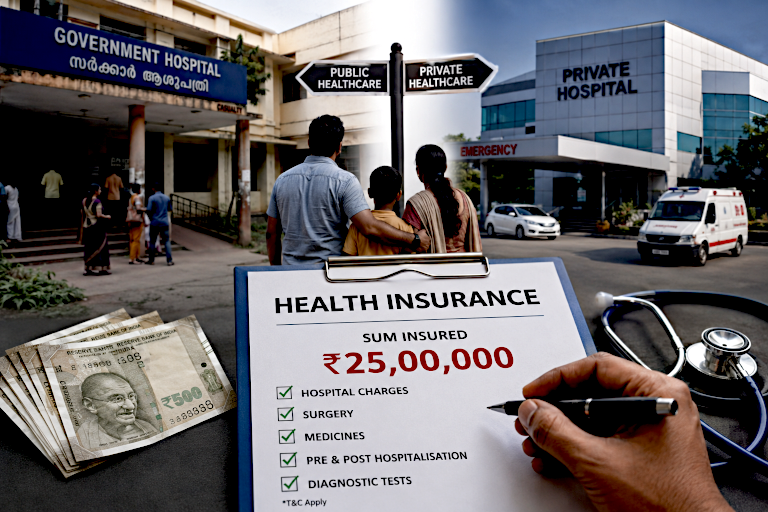
The new UDF government’s proposed alternative — if it can indeed be called one — is an insurance scheme offering coverage of up to ₹25 lakh for every family, though it remains unclear who exactly will be eligible. In effect, the government will be encouraging patients to shift from public hospitals to private ones. Such a move is likely to do more harm than good.
Health care

Private healthcare services are already expensive and, in many cases, exorbitantly priced. As demand increases, costs are bound to rise further. Insurance coverage can also reduce price competition, contributing to spiraling healthcare expenses.

It seems that the multi-national companies had sensed or managed to bring about the shift in health care sector from public to private sector.  They have brought hospitals even in medium towns. Several private hospitals are already notorious offering unnecessary procedures and over-charging patients. Now, the government will be aiding them to expand business.

The government hospitals in the State have best of doctors, nurses and paramedics. On the other hand, doctors who studied in dubious medical colleges in India and abroad find placement in some private hospitals. Poor and less-informed patients are especially vulnerable to being misled in such institutions. While government hospitals may suffer from neglect and shortages of resources, patients there are generally less likely to be subjected to unnecessary procedures and medication. Addressing shortages of funds, infrastructure and staff should therefore be the primary responsibility of the new Kerala Health Minister, K. Muraleedharan. If universal health coverage is indeed the goal, it would make more sense to invest the insurance premium funds directly into strengthening government hospitals.

Insurance-based healthcare may also burden poor and less-educated patients with bureaucratic hurdles. Insurance companies could deny claims, demand prior approvals or insist on complex documentation before treatment is provided. In some cases, patients may even need legal assistance. Anyone familiar with motor vehicle insurance knows that workshops often charge differently for insured and uninsured vehicles. The same pattern is likely to emerge in healthcare billing, ultimately driving up insurance premiums. If the government proceeds with its “Indira guarantee” for health insurance, it may soon find itself facing ever-increasing costs.

Ayurveda and Homeopathy

Kerala’s healthcare landscape is also distinguished by its large number of institutions offering treatment under Ayurveda, Homeopathy and Siddha systems. Medicines used in these traditions produce fewer side effects. At the same time, there is a growing view that some of these systems — particularly Homeopathy — lack a scientific basis.

Ayurveda

Ayurveda continues to attribute disease to imbalances in Vata, Pitta and Kapha — concepts associated with movement, metabolism and structural stability — and does not fully incorporate the modern scientific understanding that germs cause disease. The government should therefore take steps to modernise Ayurveda by integrating contemporary medical knowledge into its curriculum. Even if traditional concepts such as Vata, Pitta and Kapha are retained, modern scientific understanding should be logically connected to them.

Ayurveda, Siddha and Unani cannot easily be dismissed as pseudosciences, since they evolved through centuries of observation, experimentation and inference — methods that broadly align with scientific inquiry. The same cannot be said of Homeopathy. There is no convincing scientific evidence that highly diluted homeopathic remedies are effective beyond the placebo effect. Moreover, many homeopathic medicines have not undergone rigorous testing. Many practitioners are known to mix modern medicines with homeopathic medicines to show results.

The government should therefore commission independent studies to evaluate the efficacy of homeopathic medicines using modern research methods. Until such studies are completed, public expenditure on homeopathic institutions should be curtailed. No new homeopathic dispensaries, hospitals or medical colleges should be established. Medicines used across AYUSH systems should undergo rigorous scrutiny, and any harmful substances should be purged  from the official Materia Medica.

Any attempt to modernise AYUSH systems and their curricula is likely to face opposition from sections of the modern medical establishment. However, it is worth remembering that allopathy itself evolved over time into what is now considered modern medicine.

Care for the elderly: Satheesan sets out plans

A Japanese elder in front of a temple
An elder in front of Japanese temple

Kerala Chief Minister V. D. Satheesan has announced plans to establish a dedicated government department for the elderly to carry out new schemes to support senior citizens. Though he has not given details of the programmes, he mentioned that it would be modeled on the Japanese system.

The main features of the Japanese model are mandatory long-term care insurance (LTCI), public pension scheme, medical care system for older senior citizens and community based integrated care system. These take care of 90 per cent of medical and personal care needs of people aged above 65. Many of the services reach their doorsteps. The elderly will have to get a certificate based on their level of frailty (similar to disability certificates) to obtain full medical and personal care services. Frailty and prefrailty among older people are assessed and steps to prevent progression to frailty.

Japan is the most aged country in the world. Over the last 75 years the percentage of elderly people among the population in the country has jumped from five per cent to nearly 30 per cent (more than 36 million) and is expected to plateau around 40 per cent in another decade or two.

In Kerala, about 17 per cent of the population (approximately 6.5 million) is now above 60 years of age. This is projected to cross 22 per cent by 2036.

One of the major Challenges to the Chief Minister, who also holds the Finance Portfolio, will be to secure funds for the Department and its programmes. Even a developed country like Japan is struggling to find funds for its programmes. Kerala is currently finding it difficult to pay old age pensions which is often in arrears. This puts many older people in great hardship. One thing that Mr. Satheesan should do is to make welfare pensions a priority and make its payment regular. Now, the first treasury restrictions fall on disbursement of welfare pensions. Instead, welfare pensions should have first claim on budgetary funds.

The second issue will be insurance costs. In Japan, LTCI insurance is covered by premiums paid by citizens during their working years and taxes. Insurance premiums are going up. This could ultimately become a problem for Kerala. Already, multinationals are buying up hospitals in Kerala and insurance is spreading its wings. As much of the healthcare comes under insurance umbrella, much of the competition will disappear and costs will keep going up. Government hospitals will be weakened. The State government will have to keep an eye on this while devising the schemes.

A promising alternative lies in strengthening community-based interventions. Mr. Satheesan has been liberal in granting a ₹ 3000-hike in monthly honorariums of Asha workers. He may be planning to use their services for his schemes for older people. His ultimate test will be finding sustainable funding for meaningful, long-term schemes for Kerala’s senior citizens.

Keralam: Yet another White Paper on Finances in the offing

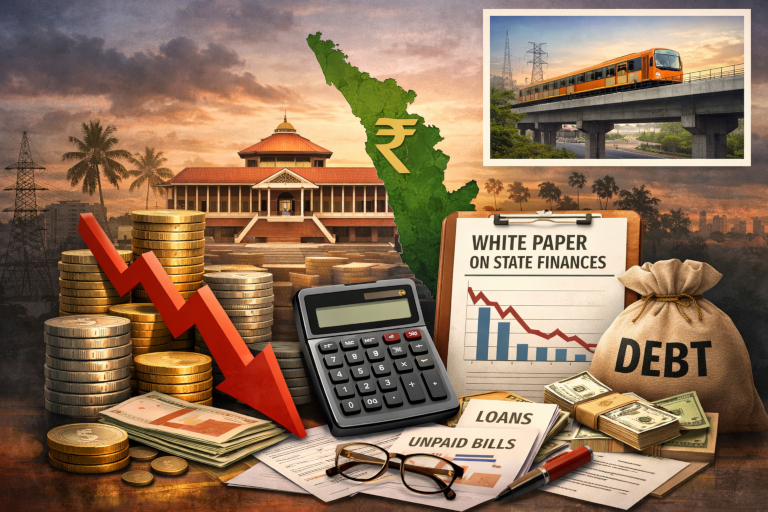
Kerala Cabinet has decided to bring a white paper on the State’s finances. This is expected to present a factual picture of what is widely described as a dire financial situation.

Kerala finances and white paper

Perhaps it was the United Democratic Front (UDF) Government led by A. K. Antony which brought a white paper on State finances for the first time. In one of his early Cabinet briefings in 2001, he lamented that the previous government (Left Democratic Front- LDF) had left the State in a fiscal crisis with no cash balance in the treasury.  Antony was not presenting many details to substantiate his claim which was being contested by the LDF. So, I, who was attending the briefing as a journalist, asked whether his government would bring out a white paper on the State’s finances. He seemed to agree. Some days later a white paper was released. The document listed outstanding payments and liabilities exceeding ₹4,000 crore. This staggering amount included unpaid contractor bills, loans from cooperative banks, and delayed salaries and pensions.

The Antony Government as well as the LDF Government that followed in 2006 did take some measures to improve the financial position of the State. But the results were modest. The UDF again came to power in 2011 and brought a white paper the same year. One of the points listed as gains of the 2001-2006 UDF Government was revenues from Sales Tax/VAT and Motor Vehicle Tax going up by a few percentage points in overall composition of State’s own tax receipts.  The uncovered Budget commitments at the end of LDF rule exceeded ₹ 5000 crore. A major chunk of the revenues as before was going to pay salaries, pensions and interest.

The LDF’s fiscal policy often leaned toward expansive spending, with leaders such as former Finance Minister Thomas Isaac arguing that higher expenditure would spur development. The result of such policies was that State’s debts doubled every five years irrespective of whether the UDF or LDF was in power. After coming to office in 2016, the LDF introduced new mechanisms to mobilize debt outside the Reserve Bank of India’s purview, notably through the Kerala Infrastructure Investment Fund Board (KIIFB). In recent years, the LDF faced criticism for wasteful expenditure—charges the current government now appears keen to highlight. In fact, the LDF too had brought out a white paper back in 2016 with Dr. Isaac as Finance Minister.

The third in the series of white papers by the UDF, that is being proposed now, differs from earlier ones in that the Chief Minister V. D. Satheesan proposes to enlist the services of financial experts from outside the Government too in preparing it. Apparently, the new Chief Minister wants them to suggest corrective measures. Whether he can rein in mounting debts and deficits remains uncertain, but the forthcoming document may offer better insight into options before him.