Kerala’s whitepaper on finance, titled Kerala’s Fiscal Health: A Status Report, is indeed a political statement though Chief Minister V. D. Satheesan, claims otherwise. It contains many valid fiscal concerns, though not a complete or neutral assessment of Kerala’s finances.
The report is useful as a warning document highlighting genuine fiscal vulnerabilities. However, it is not a comprehensive balance-sheet assessment of Kerala’s finances. It focuses far more on liabilities, deficits and institutional weaknesses than on assets created, social returns generated, and the long-term economic value of public investment. A proper assessment require both sides of the ledger.
High debts and sustainability
Kerala, as the report points out, has one of the highest debt-to-GSDP ratios among major states. Committed expenditure (salaries, pensions and interest) consumes a very large share of revenue receipts. Interest payments remain significantly higher than the all-state average while capital expenditure is relatively low compared with many states.
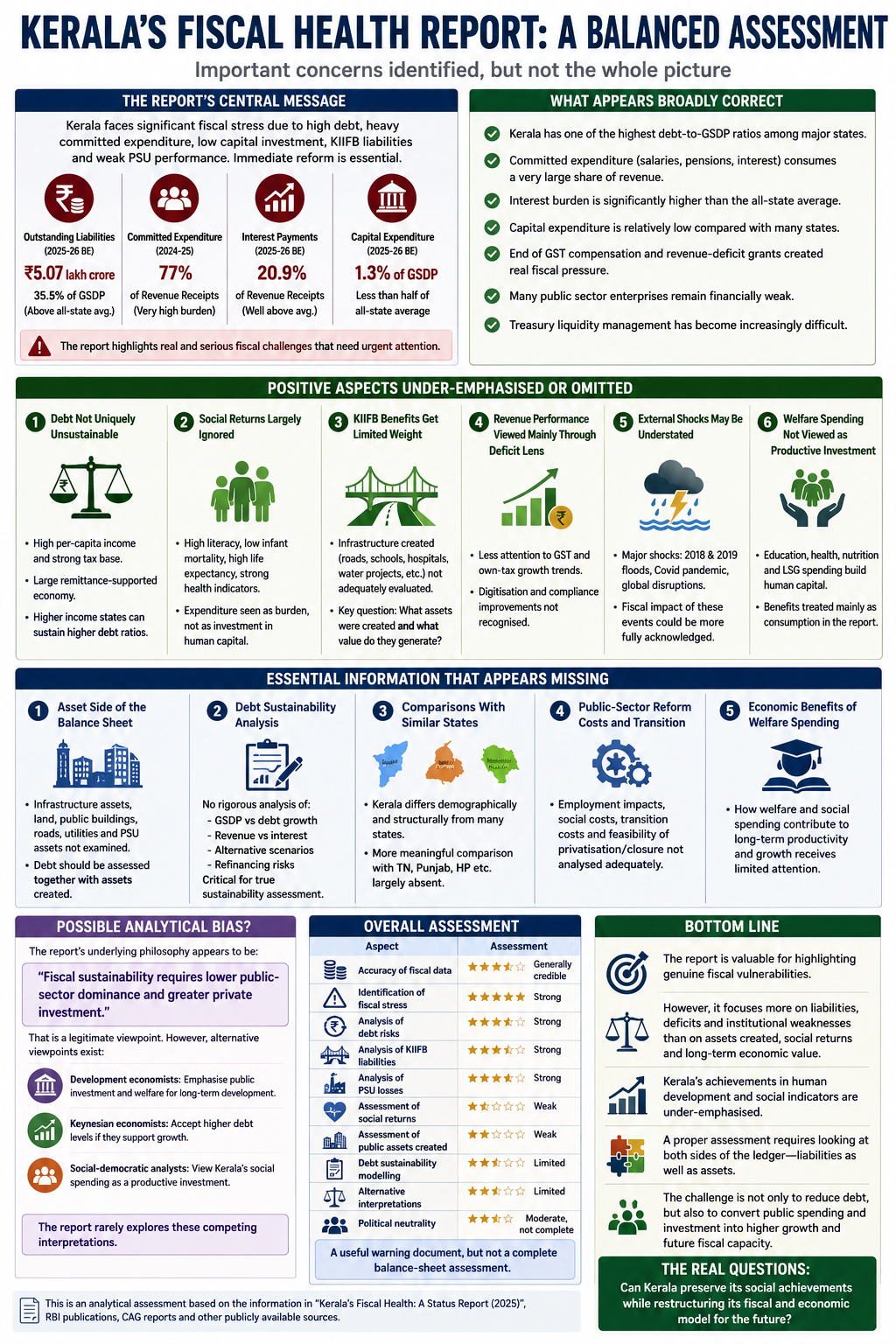
While repeatedly emphasising debt levels, the report gives little attention to the State’s high per-capita income, relatively strong human development indicators, strong tax-paying capacity and large remittance-supported consumption base. A state with higher income levels can often sustain higher debt ratios than poorer states.
The document focuses heavily on fiscal ratios, but ignores what the State’s spending has historically produced in terms of literacy, strong health indicators. It treats much expenditure as fiscal burden without evaluating returns generated by that expenditure.
KIIFB benefits receive relatively little weight
The report acknowledges KIIFB’s infrastructure achievements but devotes much greater attention to liabilities. A balanced assessment should also examine economic returns of those investments.
The report discusses revenue shortfalls but fails to give attention to GST collection growth trends, own-tax revenue growth, digitisation of tax administration and Improvements in compliance. These factors matter when assessing future fiscal sustainability.
The role of external shocks, such as floods in 2018 and 2019, Covid pandemic and global economic disruptions are understated, though the report mentions some of them.
Important information that appears missing
The report focuses extensively on liabilities, but fails to examine assets such as infrastructure, land and assents of public enterprises.Debt without assets is alarming, but debt accompanied by productive assets requires a different assessment.
Comparative analysis with similar States
The report compares Kerala with all-state averages. But Kerala differs significantly from many states in terms of demographic transition, ageing population, migration patterns and social-sector commitments. Better comparisons would be with Tamil Nadu, Punjab and Himachal Pradesh. Without such comparisons, some conclusions may appear more alarming than they actually are.
Public-sector reform costs
The report recommends privatisation, disinvestment and closure of financially weak public sector units. It, however, does not sufficiently analyse employment impacts, social costs, transition costs and political feasibility. It can be hoped these would be considered while taking decisions on individual companies.
Economic benefits of welfare spending
The report largely treats welfare expenditure as consumption. Many economists would argue that education, health, nutrition and local-government spending are investments in human capital.
The report’s underlying philosophy appears to be that fiscal sustainability requires lower public-sector dominance and greater private investment. That is a legitimate economic viewpoint. However, alternative viewpoints exist:
- Development economists may place greater emphasis on public investment and welfare.
- Keynesian economists may accept higher debt levels if they support growth.
- Social-democratic analysts may view Kerala’s social spending as a productive investment.
Structural paradox
Kerala has a massive household consumption rate backed by foreign remittances (23.2% of Net State Domestic Product), yet its destination-based GST collections are profoundly weak. While it briefly reasons that consumption leaks to producing states, it leaves a gap in explaining why tax administration/enforcement has failed to capture the final consumption tax slice effectively at point-of-sale within the state borders.
The report says that auditors evaluating high-profile transactions—such as the high costs incurred from raising Masala Bonds and massive consultancy payments routed through the Chairman and Managing Director (CMD)—were blocked because “supporting documents pertaining to payments were not made available for scrutiny”.
Former Finance Minister K. N. Balagopal has criticised the government in the Assembly for giving access to ‘secret’ documents from the Finance Department to outsiders as some outside experts were on the panel that prepared the report. Only those who have something to hide will oppose transparency. Transparency is the soul of democracy. The Report makes many aspects of the State’s finances transparent.
(This article and image have been prepared with assistance of AI)