Information Commission orders release of video footage of polling in Kerala

The Election Commission of India and its electoral officers have been forgoing openness and transparency in the electoral process, thus undermining democratic elections in Kerala and probably elsewhere in the country. A recent order of the State Information Commission may help to restore at least some degree of transparency.

Access to Webcasting to candidates, agents and public during the Lok Sabha polls last year had resulted in detection of several cases of impersonation and bogus voting. However, when repoll were held, the Chief Electoral Officer (CEO) of Kerala restricted viewing of Webcasts to ‘election machinery’ citing a letter from the Election Commission issued in 2015. This impeded concurrent social auditing of the election process.

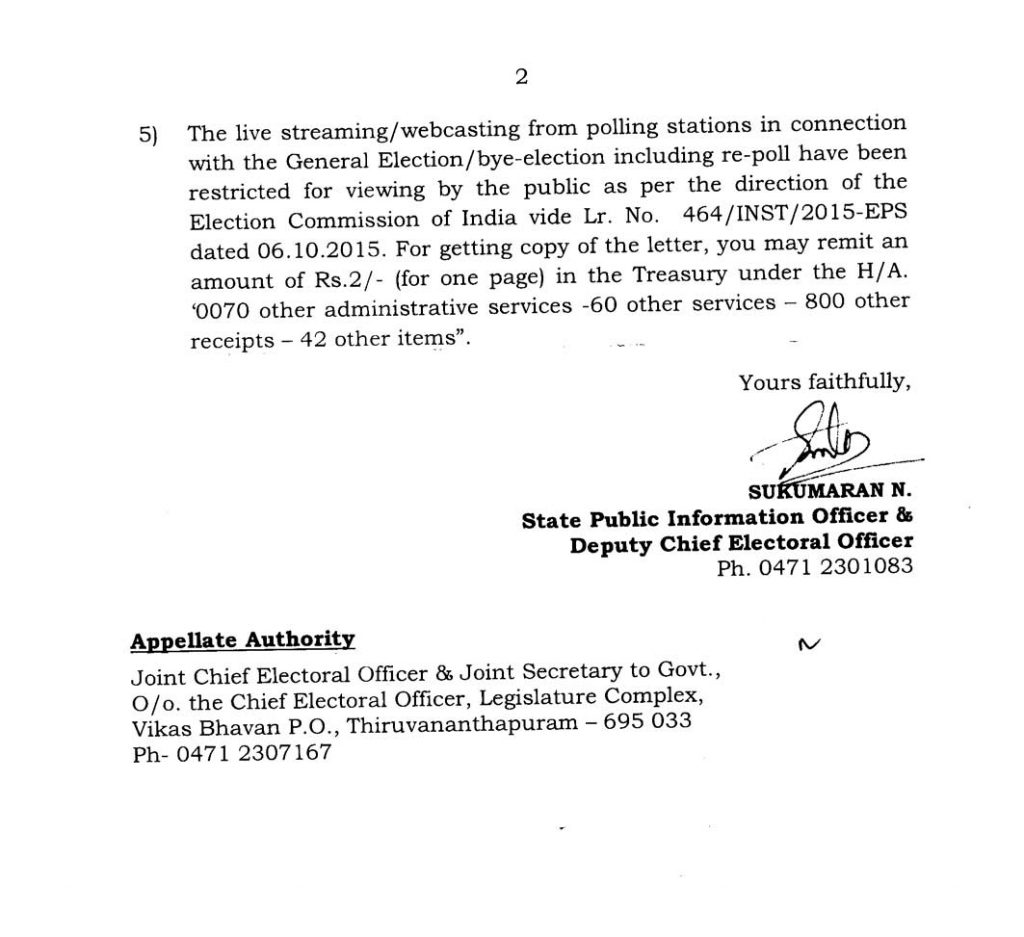
The letter said that the Commission had decided that henceforth, webcasting in polling stations will be restricted to viewing only by the election machinery in keeping with the spirit of Rule 93(1) of the Conduct of Election Rules, 1961.[ The rule actually deals with production and inspection of election papers. It specifies that used ballot papers, counterfoils et cetera and sealed control units of EVMs should not be opened or allowed to be inspected by any person or authority except under orders of a competent court. This a clause aimed at maintaining the secrecy of balloting. There is no reference to Webcasting or video footage in this clause. How the Commission could take a decision to deny real time access to web footage under this clause and how it could be in the spirit of the Rule is anybody’s guess.

Even if the decision is valid, it did not cover requests for footage under the RTI Act. However, when Advocate D. B. Binu sought the CCTV/Webcasting footage from polling booths that recorded polling percentage of more than 90%, the State Public Information Officer (SPIO) in the Office of the CEO did not release the information. He initially said that a clarification was being sought from the Commission in view of the restriction imposed by the Commission on public access. Later, he claimed that “the final list of polling booths where webcasting was done was being finalised” (sic). He added that no separate details in the manner of polling booths where 90 % and above polling was recorded was kept in that office. The appellate authority dismissed first appeal saying that the Office was awaiting clarification/permission from Election Commission of India on providing such video footage to the public.

This was when there was no provision under RTI Act giving power to the SPIO to get clarification/permission from the Commission. Moreover, the Handbook for Returning Officers had provision that copy of the video footage should be made available on payment of Rs. 50 (fees as per Right to Information Rules, 2012). Hence, the clarification sought was clearly a delaying tactics by SPIO and a clear violation of RTI Act.

The State Information Commission, in a recent order, has now directed the footage to the released. Allowing an appeal from Mr. Binu, Chief Information Commissioner Vinson M. Paul noted that the contention of the Respondent’s office that it was awaiting clarification from the Election Commission of India was not tenable under the RTI Act. Information sought tinder the Act can be denied only under Section 8 or 9 of the Act. Similarly, the argument that the Respondent office did not maintain details of polling booths, which recorded more than 90% polling, was not valid as the CEO’s office is the repository of all such information.

In response to another RTI application from the writer of this blog, the SPIO is maintaining that the reasons for malfunctioning of the electronic voting machines are not available in the CEO’s Office. As many as 434 balloting units, 391 control units and 1041 VVPATs were replaced in Kerala during Lok Sabha polls. The number of BUs and CUs replaced during the by-polls were 15 each. As many as 56 VVPATs were also replaced.

About a month after the by-elections to the Assembly in September/October 2019, the SPIO maintained that the returning officers were yet to finalise data on the polls except in the case of Pala constituency. Though the data were later released on first appeal, it was provided only in PDF format though the request was for data in excel or similar format that could be easily used for calculations.

If what the SPIO said was true, how the returning officers declared the by-poll results and Election Commission notified the winners without finalising the data?

The appeal before the State Information Commission in this case is pending.

Copy of reply from State Public Information Officer, CEO’s Office, on RTI request for election data
Reply from State Public Information Officer, CEO’s Office, on RTI request for election data- Page 2

Performance of Members of Parliament 2014 – 2019

P. K. Biju meeting voters

Did you know that CPI (M) member P. K. Biju (Alathur) was among the top ten performers of the outgoing Lok Sabha in terms of participation in debates, but the topper beats him by a score more than six times higher?

Congress member K. V. Thomas, who did not get a seat this time, and actor Innocent (CPI-M independent), who is contesting again from Chalakudy, were the poorest performers among members who served the full term from Kerala.

Topper Bhairon Prasad Mishra (BJP) from Uttar Pradesh attended all sittings of the House and participated in 2095 debates.  You may even wonder whether the Sabha had so many debates, considering the poor participation by many of our elected representatives. The average participation was about 67 debates nationally and 142.5 for members from Kerala.

Biju participated in 326 debates followed by RSP’s N. K. Premachandran (300) and Independent Joice George (290).  On the other hand, Thomas and Innocent participated only in 42 debates each. P. K. Kunhalikutty (Muslim League) has the lowest score of nine from Kerala. It may be noted here that he was in the House only for about two years, having been elected in a by-election from Malappuram in April 2017. If we extrapolate his performance for five years, it is still the lowest from Kerala.

The outgoing Lok Sabaha has as many as 32 members who did not participate in any of the debates. They included post graduates and doctorate degree holders. They also included former Chief Ministers Shibu Soren (Jharkhand) and Kamal Nath (Madhya Pradesh) besides actor Shatrughan Sinha.

The oldest member in Lok Sabha, L. K. Advani of BJP, participated in only one debate in  a span of five years. So was the youngest member Pravin Kumar Nishad of Samajwadi Party from Uttar Pradesh who incidentally is a professional graduate.

Supriya Sule of Nationalist Congress Party from Maharastra topped in terms of the questions she had asked the government in the House.  She had asked as many as 1181 questions during the five-year term.  Nishikant Dubey of BJP from Jharkhand presented the highest number of private members’ bills in the House— 48 against average of 2.3 bills nationally.

The following MPs had 100 per cent attendance in the House, besides Bhairon Prasad Mishra.

Kulamani Samal Odisha Jagatsinghpur Biju Janata Dal Professional Graduate 100%
Ramesh Chander Kaushik Haryana Sonipat Bharatiya
Janata Party
Professional Graduate 100%
Bhairon Prasad Mishra Uttar Pradesh Banda Bharatiya
Janata Party
Inter/ Higher Secondary 100%
Gopal Chinayya Shetty Maharashtra Mumbai-North Bharatiya Janata Party Under Matric 100%

Attendance is not marked for Ministers. Niranjan Jyoti from Uttar Pradesh had 100 per cent attendance till she became a Minister in August 2014.

Full set of sortable data at
http://www.keralaassembly.org/lok/sabha/2019/performance_2019.php4

Save Kurinji Campaign enters new phase

kurinji-bloom in bloom

kurinji in bloom at Kurinjimala Sanctuary, Kerala, India

The Save Kurinji Campaign was started by a group of youngsters in the eighties against destruction of the shola grasslands of Munnar and Palani Hills and its flagship species neelakurinji (Strobilanthuskunthiana) which flowers once in 12 years.

The first of its campaign march from Kodaikanal in Tamil Nadu to Munnar in Kerala was inaugurated by none other than Zafar Rashid Futehally (1920 – 2013), Indian naturalist and conservationist best known for his work as the secretary of the Bombay Natural History Society in 1989.

The campaigners marched from Kodaikanal to highlight the loss of sholas to plantations of eucalyptus, wattle and pine. Besides the Save Kurinji Campaign Council, those associated with the campaign included the Palani Hills Conservation Council and High Range Wildlife Preservation Association. This led to increased awareness about the importance of sholas and their flora and fauna. Campaign marches and other programmes were organised in the subsequent decades also.

At that time there was few studies about sholas. But soon there were several, including a book on shola forest published by the Kerala Forest Research Institute.The studies and campaigns led to stoppage of eucalyptus plantations in Kerala and Tamil Nadu though those planted already continued to affect the ecosystem.

In 2006, the campaign met with its major success with the LDF government declaring 3200 hectares of kurinji habitat near Munnar as Kurinjimala sanctuary for protection of kurinji and its habitat. The then Forest Minister Benoy Viswam took special interest in conserving the habitat. Before that, the UDF government led by OommenChandy had cleared the area of ganja cultivators and set up a forest station at Kadavari. The Palani (Kodaikanal ) wildlife sanctuary was formed in 2013 by Tamil Nadu government.

The Eravikulam National Park in Kerala was already a protected area for conservation of shola grasslands. The Year 2006 was a year of flowering of kurinji in several areas including the Park. The Forest Department paid special attention to keeping the Park free of fires in summer. Protective measures were also extended to the newly formed Kurinjimala sanctuary. This helped in maturing of the seeds of kurinji and its propagation. The results are expected to be seen this year when the kurinji plants in these areas are due for their next cycle of flowering (between July and October).

As phase of the next phase of the campaign, those who participated in earlier save kurinji marches and younger nature lovers will be gathering in Kodaikanal on June 1 to 3 to relive the memories and chart out campaign for consolidation of the gains. As done in 1989, they will be going around the Kodai Lake to mark the beginning of next phase of campaign.