Administering drugs, instead of controlling mosquitoes

The government and local bodies, which could not control mosquitoes or supply mosquito nets to the poor, will again embark on mass administration of drugs for filariasis later this month, assuming that an unknown percentage of the population is infected.  (Official documents claims that the prevalence of microfilaria towards the end of last century was about 15 per cent.  Current figures are not known.)

This is somewhat like administering paracetamol to the entire population during monsoon assuming that many people have contacted fever. No one knows whether repeated administration of drugs (diethyl carbamazene citrate-DEC and albendazole) year after year would reduce its effectiveness. Filaria may develop resistance over a long period, going by the evolutionary principle. WHO had conducted a study in 2008 to find out whether the effectiveness of albendazole had decreased following mass administration among children in Nepal. (Though the study has been reported on the WHO Website, the results could not be found.)

However, the main concern is regarding the ethics and use of funds.  It is against medical ethics to administer potent drugs to people with no disease for which the drug is a cure. Moreover, principles like that a doctor should see the patient and administer drugs as per body weight is dispensed with. This also means that advisable precautions are not taken. (See http://www.icm.tn.gov.in/drug%20formulary/ANTIINFECTIVE%20DRUGS.htm)

Mayor swallows pills

Thiruvanathauram Mayor K. Chandrika takes the pills at inaugural of Mass Drug Administration

Drugs for entire families are delivered together by volunteers even to children if the parents are not at home. There is the risk of children consuming the drug indiscriminately, resulting in overdose. Warning against use of the drug by infants, pregnant women and the elderly may not always reach them. Both DEC and albendazole are prescription drugs which are to be administered by doctors and supplied through pharmacists.

The mechanism of action of the diethylcarbamazene citrate against microfilaria (the causative parasitic organism of filariasis) is not known.  Latest studies show that the unusual and novel therapeutic effect on the cell walls of the parasite which is yet to be fully studied. The drug has effect on human neutrophil and eosinophil. (See http://www.ncbi.nlm.nih.gov/pmc/articles/PMC185347/pdf/aac00198-0157.pdf)

Doctors are not even sure of the dosage (The earlier recommendation was for administration of diethyl carbamazene citrate for 12 days. Now the prescription is just one dose of the drug combination). Still, it is being administrated to the entire population (excluding three districts in Kerala) though none can be sure of long term effects of taking the drug year after year.   Albendazole can cause birth defects in newborns, if taken during pregnancy, according to authoritative sources. (See http://www.nlm.nih.gov/medlineplus/druginfo/meds/a610019.html)

Reaction to diethyl carbamazene citrate can range from dizziness, nausea and vomiting to skin rashes, fever and even anaphylaxis (which can be fatal). The latter reactions caused by dead microfilaria rather than the drug occur only if microfilaria is present in the body in large numbers and anaphylaxis will occur only in people allergic to dead microfilaria. ( A case of such reaction was reported from Trivandrum Medical College years ago.) Few reports of such incidents in Kerala indicate the prevalence of microfilaria is actually lower than projected.

The practice of mass drug administration against filariasis had been started about a decade ago. The claim was that the disease could be eliminated in five years with 65 per cent coverage of the endemic areas. This did not happen and the project is now being extended with new target of 2015 for elimination. If the money spent on mass drug administration was spent on improving primary health care, it could have helped in the treatment of many diseases.

Fogging

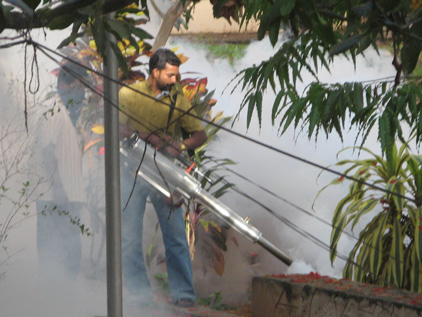
Fogging for mosquito control

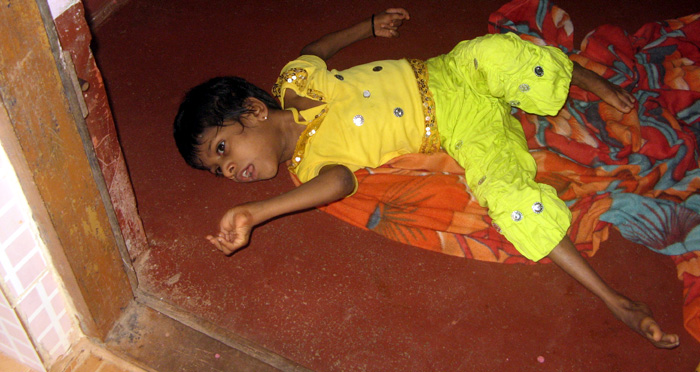
The prevalence of filariasis, it may be noted, is actually the results of lack primary health care. Diseases like elephantiasis, the advanced form of filariasis, occur in society because of absence of proper health care. For filariasis could be cured, if detected at its early stages, and progression into elephantiasis could surely be prevented. Doctors can easily advice tests to confirm filariasis at early stage when swelling of testis or breasts is noticed.

Elephantiasis is absent among upper strata of society because they get early treatment. Incidence of filarisis is also lower among them because of use of mosquito nets and other measures to prevent mosquito bites. If the government provided mosquito nets to the poor, instead of drugs for cure, not only filariasis but also other vector borne diseases such malaria, Dengue fever, chikungunya could have be prevented to a great extent.

Poisoned food

Every man has a right to food as implicit in the right to employment. However, this right is being denied not only to the poor but also to others also these days.

Almost all the food items sold in public markets are poisoned. The situation usually goes beyond mere adulteration. High levels of red and yellow category pesticides including organo-chlorine and organo phosphorous pesticides found in vegetables and fruits. There are reports from Tamil Nadu that some farmers cultivate vegetables differently for own use and sale.Mangoes

Pesticide is applied at every stage on vegetables for sale. Coconut too has become unsafe with the use of aluminium phosphide.  Some of these applications are quite unnecessary or by way of extreme action to prevent pest attack. The consumption of vegetables treated thus has resulted in high incidence of various diseases, including impotency and kidney failure.

Pesticide is being applied even on fish to keep away flies. Fomalin is being used to prevent rotting.  Milk also comes with pesticides and formalin besides a number of chemicals used for preservation including antibiotics. These can cause serious health problems. Very few dairies supply milk that is not dangerous.

Similar is the case with meat. Quality checks are only in paper while producers and traders use all sorts of methods to increase yield.  The government had been failing to act the new food adulteration law, citing various excuses including absence of laboratories for routine checks.  The real reason for lack of enforcement is, however, the nexus among traders, politicians and officials.

Chandy’s balancing act

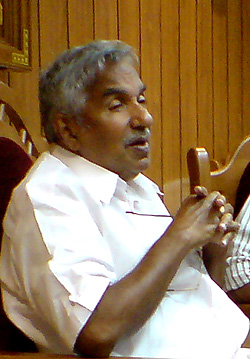
The reshuffle of portfolios of Congress Ministers in Kerala is a disgrace to the State.  Chief Minister Oommen Chandy has given into bullying by communal forces under duress.

Chief Minister Oommen Chandy

Chief Minister Oommen Chandy

It is no secret that the communal forces lobbied regarding selection of candidates for elections and choice of ministers behind the scene. The difference now is that the lobbying has come into the open and the Chief Minister has openly succumbed to the pressure. In the process, he has even gone to the extent of shedding the Home portfolio that he held in order to placate the majority community. Communal forces would now become bolder unless secular forces are able to assert themselves more.

Mr.  Chandy is likely to come under more pressure from communal forces as the by-election from Neyyattinkara Assembly constituency nears. At some point, the Chief Minister would land in a position that he could not meet all the demands while his party men would use subterfuge to win ministerial and other positions.

One consequence of the communal balancing act that Mr. Chandy is forced to undertake is that he had neither been able to choose his ministers nor allocate portfolios based on merit.  This had reflected on the performance of his ministry

Honouring Yesudas, Is Assembly Setting a Bad Precedent?

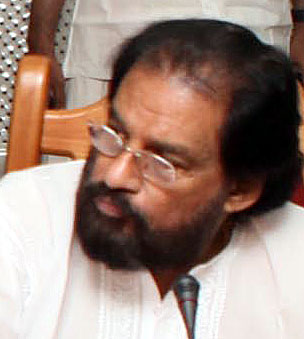
The Kerala Assembly honours playback singer K. J. Yesudas on Wednesday. That Yesudas is meritorious to receive honours is unequivocal. However, the Assembly may be setting a bad precedent.

The danger here is that the practice of the House honouring eminent persons could become something like the universities awarding honorary degrees. Many an unworthy persons receive honorary degrees with universities having to bear various kinds of pressures. The Assembly too is sure to come under pressure for honouring persons under influences that may not always be honourable.

K. J. Yesudas

K. J. Yesudas

These days we see communal organisations competing each other for issue of commemorative stamps. There are not many complaints because the postal department is liberal in the issue of such stamps.
However, the Assembly cannot be liberal like that. Questions can still arise why the Assembly is honouring a popular singer and not the well known exponents of classical music or arts. Will the Assembly be honouring people from other fields such as literature?

It is true that the House has honoured past members and journalists on occasions like its jubilee. However, the connotation that the House was honouring someone was almost absent as it was considered part of the celebrations rather than connected with the business of the House. Besides, those honoured were someway associated with the functioning of the Assembly though journalists are technically strangers as far as proceedings of the House are concerned. Now, the occasion for the House deciding to honour Yesudas is that he is completing 50 years of his illustrious career as professional singer this year.

One should recall that there was even opposition to civilian awards. The Janata Government headed by Morarji Desai had discontinued the Bharat Ratna, the Padma Vibhushan, the Padma Bhushan and the Padma Shri awards in the late seventies. Though it was restored three years later by then Prime Minister Indira Gandhi, the choice of winners continued to attract criticism despite the government having a system and machinery to make the selections. How is the Assembly going to make better choices if it plans to honour more people?

Leases and rents

Opinion may be divided on whether the State government should move now to collect revised rents from Tamil Nadu for the forest land leased to it. However, a legislature committee had suggested last year that it should and its report has now been published by the Legislature Secretariat.

More than what the report says, there may be something to read between the lines in the report.

An Act had been passed by the Assembly as back as in 1980 to revise the rent on grants and leases given by the erstwhile princely States of Travancore and Kochi which later became part of Kerala. However, it remained unimplemented for years, allowing large gains for the plantations. In the nineties, the Forest Secretary stayed revision of the rents on a representation given by planters. Though the Act was subsequently amended to reduce the rents proposed and remove some practical difficulties, it took years for the law to get the President’s assent. The Central department delayed it raising questions such as those relating to the profitability of plantations though they were not relevant to assent for an Act passed by the legislature after due consideration.

Government’s after government deferred implementation of the Act. At one point, the late T. M. Jacob of Kerala Congress raised a written allegation in the Assembly that bribes had been taken to delay revision of the rents. Finally, it was the last LDF government that gave the green signal for enforcement of the Act. However, steps were taken only in some districts such Thrissur for revision and the process is yet to be completed.

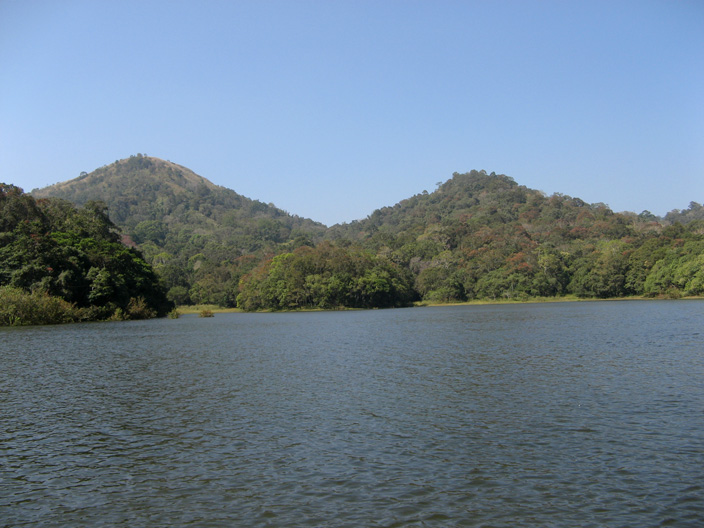
Periyar Tiger Reserve

Periyar Tiger Reserve ........................................................ Photo: Roy Mathew

The Public Accounts Committee has not delved into these issues apparently because it was dealing with Periyar Tiger Reserve area. (Besides, other committees have gone into the issue previously and even quantified the losses to the exchequer. The LDF government had estimated the losses as per the amended Act to be about Rs. 18 crore a year in its Budget). It finds that besides the Periyar lease in favour of Tamil Nadu, there are other lease holders in the Reserve area including the public sector Kerala Tourism Development Corporation and a private plantation contiguous to the protected area.  The Committee has firmly recommended that their rents should be revised, but has suggested that the provisions of the Act should be verified in relation to the Periyar lease. It has not gone into detailed examination whether the provisions of the Act applies to the Periyar lease but left it to officials to examine the question and renew the rent. The Forest Department has maintained that the matter could not be decided at its level because it is an inter-State matter.

An interesting aspect of the report is the strictures made by the committee over the delay in notification of the contiguous habitats of the Reserve as ecologically fragile, as envisaged in the Environment Protection Act for the past 30 years.  It also criticizes the quarrying done by Public Works Department of Tamil Nadu in the area during the period. Was the notification been delayed for the benefit of the lease holders in the area?

If the Kerala government now proceeds to revise the rent of the Periyar lease under the Act, it would have the effect of the State recognising the validity of the lease deed as it had done indirectly in 1979 by signing a supplementary agreement. The supplementary agreement is now considered as a major blunder of Kerala government. So, it the rent is to be revised, the Kerala government would have to first cancel the original lease deed (this will require legislation unless violation of lease deed could be cited) and grant fresh lease with revised rent for a limited period.

Recommendations of the PAC

Banks plan to divert farm loans to investments in real estate

The State Level Bankers Committee in Kerala plans to press the Reserve Bank of India to treat loans for purchase of estates as agriculture finance.  If approved, the proposal is sure to create serious problems in the State.

Banks are already reluctant to give loans to genuine farmers. Even now, agricultural loans go to money lenders who, in turn, lend to the farmers. This arrangement suited the banks and their managers because of supposedly higher assurance of repayments. Besides, bank managers, who are corrupt, stood to gain from such lendings.

This situation was one of the causes behind the recent farmers’ suicides in Wayanad district. It was difficult for even landed farmers to get loans from scheduled banks not to speak of those living on contract farming. The money lenders provided them funds which, in turn, came from the banking system.

The latest proposal of the SLBC is actually aimed at classifying lending to the real estate and tourism sectors as agriculture finance, and helping the banks to show that their targets in sanctioning agricultural loans have been achieved. For investment in estates is not really investment in agriculture. Every school girl knows that there no sufficient profits in plantation sector, except in the case of rubber and occasionally cardamom, to justify large investments.  Those investing in estates are actually investing for capital appreciation and also to use estate land for non-agricultural purposes.

The real estate prices are already on the high side in Kerala, and with the banks pumping in money, it is bound to go up further.  The common man is already not in a position to buy land even for housing not to speak of farming. With real estate becoming the prime investment attraction in the State, land is likely to be concentrated in the hands of the rich. This is already happening despite the ceilings under the Land Reforms Act. Plantation is exempted from land ceilings, and lucre now is UDF government’s policy in favour of allowing certain portions of plantations for tourism purposes.  The current trends are likely to defeat the purpose of land reforms and invite fresh clamour of ceilings. Kerala may soon have only real estate in the hands of the moneyed and hardly any farm lands as we knew it in the past.

On the long term, banks may also be risking their money. The real estate boom can collapse if tourism is hit by economic recession elsewhere or degradation of the environment. Any disruption in flow of money from the Gulf countries or weakening of the information technology sector can also hit the real estate prices.

Agriculture will never pay enough to repay large loans given for investment in estates. It is also notable that if the banks are genuinely interested in lending to agriculture, it can and do lend for planting operations.  However, the history of lending to plantation sector in the State is replete with examples of banks giving loans without ensuring proper collateral.  Several estate owners don’t have proper title over much of their land.  If the RBI gives the green signal for sanctioning loans for purchase of estates, the banks may now lend for ‘buying’ leased, environmentally fragile  and excess lands.

Mullaperiyar: behind the veil

It seems that the Inter-State Waters wing of the IDRB under the Irrigation Department has something to hide regarding the way it commissioned studies and presented facts before the Supreme Court.

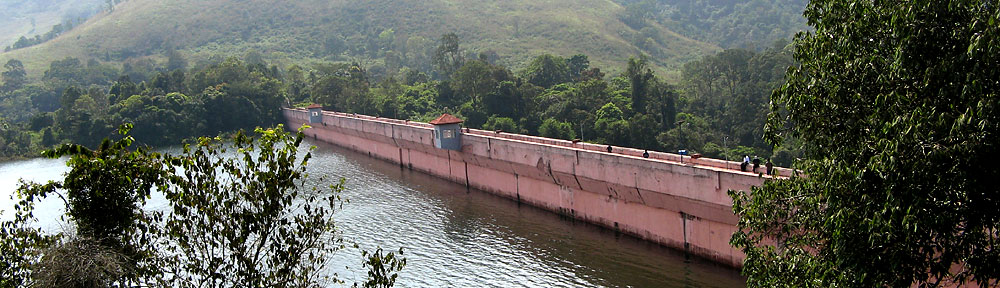
In the case between Mullaperiyar Environmental Protection Forum v. Union of India and Others decided On: 27.02.2006, Kerala had failed to present its case properly and forcefully. This even resulted in the Mullaperiyar dam being recorded in the judgement as a masonry dam instead of as a composite dam. This weakened Kerala’s case because masonry dams, in general, have a longer life. Problems specific to Mullaperiyar, its structure, quality of the lime-surkhi mixture used and causes of weakness were never elucidated before the Court with supporting material. Kerala even failed to challenge Tamil Nadu’s contention that the waters from Mullaperiyar would be contained in Idukki reservoir in case of a failure of the former.

The judgement said: “Further, it is pertinent to note that the dam immediately in line after
Mullaperiyar dam is Idukki dam. It is the case of State of Kerala that despite the ‘copious
rain’, the Idukki reservoir is not filled to its capacity, while the capacity of reservoir is
70.500 TMC, it was filled only to the extent of 57.365 TMC. This also shows that
assuming the worst happens, more than 11 TMC water would be taken by Idukki dam.

It seems that nobody seemed to have cared to tell the Court that there are about 50000 people living between Mullaperiyar and Idukki who would be killed in case of breach of Mullaperiyar dam. (Analyses show that about 8800 houses would be submerged). Did the Court think that the area downstream of Mullaperiyar were all forests, given that the State’s arguments were all about disturbance to animals in the Periyar Tiger Reserve from raising of the water level? Why did Kerala make a case of Kerala that Idukki reservoir was filled only to the extent of 57.365 TMC, especially when the facts were to the contrary?

Kerala seems to be lackadaisical in efficiently and ably arguing the present case before the Supreme Court (filed by Tamil Nadu challenging Kerala’s law that mandated that the reservoir level of Mullaperiyar dam should not exceed 136 feet for safety reasons). Several of the studies commissioned by the IDRB were done in a hurry at the last minute. Studies like that on the Ecological Impact Assessment of Water Level Increase at Mullapperiyar Dam were full of wrong assumptions and errors.

When it commissioned a study by IIT, Roorkee, on the threat posed to the dam from earthquakes, there was hardly time to complete in time. The first draft was full of factual mistakes and none from the IDRB was willing to quickly go to Roorkee and get the errors corrected. By the time the Department forced someone to go and the final version was readied, it was too late. The Court did not accept that as the time for producing evidence was over. A dam break analysis was not in sight even then.

The dam break analysis was quickly commissioned when the Empowered Committee of the Court was seized of the matter. Though Committee’s term is about to expire, only the first part of the study is over. The IDRB is refusing to divulge the full details of the study to the public. Tactics were raised to prevent furnishing of the documents relating to the analysis and material produced before Court. I reproduce below the details of the RTI request and response of the Department.

The following documents were requested under RTI Act:

  1. Copy of dam-break analysis /inundation study for Mullaperiyar done by IIT, Delhi.
  2. Copies of submissions, statements, argument notes and affidavits made by Kerala in the Mullaperiyar case filed by Tamil Nadu (challenging Kerala Irrigation and Water Conservation Amendment Act) before the Supreme Court and its Empowered Committee.

The reply from the Office of Chief Engineer was as follows:

An appeal was filed against this as follows:

Roy Mathew
F-42 RBI Staff Quarters
Plammoodu, Pattom
Trivandrum 695 004

Appellate Authority under RTI Act
Office of the Chief Engineer (ISW)
IDRB, 3rd Floor, Vikas Bhavan
Trivandrum 695033

Sir,

Sub: Appeal on decision of State Information Officer on request for supply of documents regarding Mullaperiyar case, regarding,

Ref: Letter No. IDRB/ISW/AD2/2594/2010 Vol V from Public Information Officer dated February 29, 2012.

  1. The request for copy of dam break analysis is rejected on the ground that the IIT Delhi had not conducted such as a study on Mullaperiyar dam. The reference to IIT Delhi was only an error in the request which was otherwise clear. Section 5(3) of the RTI Act specifies that the PIO should render reasonable assistance to persons seeking information. So, it is imperative that the PIO should have pointed out that the study was done by IIT Roorkee and proceeded to supply the information. The PIO has thus infringed the Act in letter and spirit. Hence, I request you to order immediate supply of copy of the analysis done by IIT Roorkee.
  2. The Sections and subsection quoted by the PIO in rejecting my application for copies of submissions, statements, argument notes and affidavits made by Kerala in the Mullaperiyar case do not exist. However, I assume she is referring to sub clauses of Section 8 (1). Affidavits and other documents submitted to the court are public documents once it is filed before the court. Hence, there is no ground for rejecting my request under 8(1). Moreover, the strategic interest referred to in Section 8 Clause (1) Sub clause (a) of the Act refers to the sovereign State of India in relation to foreign States and not to states of India such as Kerala or Tamil Nadu. Section 8(1h) do not apply as no prosecution or apprehension of offenders is involved in the Mullaperiyar case.
  3. In view of these above reasons, I request you to set aside the objections raised by the PIO and order release of the information without any further delay.


Trivandrum                                                                                                      Yours truly

9-3-2012                                                                                                          Roy Mathew


The Appellate Authority did not respond directly to the points of appeal. Instead, it came up with a new argument that the dam break analysis has not been completed.

Apparently, the Department did not want the public to know how it is fighting the case and the quality of studies being commissioned by it. So, Expert-Eyes will be making efforts to bring these materials to the attention of the public. Though the Department is refusing to provide the material, we have the executive summary  and conclusions of the  dam break analysis and more at http://expert-eyes.org/mullaperiyar/index.html

Let the experts have a look at it.


“News is what somebody somewhere wants to suppress; all the rest is advertising.”

 Lord Northcliffe