Mullaperiyar and Kerala’s technical studies

Why did the empowered committee accept the studies done by Annamalai University in Tamil Nadu in preference to the finding of the professors of Indian Institute of Technology (Roorkee and Delhi)? Was it bias? Or did not it have something to do with the quality of the studies.

It is well known that some of the studies were done quickly, just months before they were to be presented before they were to be submitted to the court. The draft of the first part had come with several mistakes that  officials of the Mullaperiyar Special Cell (Kerala) had to go to Delhi to get them corrected. The second part of the seismic stability studies could not even be completed and submitted to the Supreme Court in time.

Expert-Eyes had earlier discussed the errors in the article  Mullaperiyar and environmental impact of raising the water level. Readers and experts can look at the structural stability analysis at http://expert-eyes.org/mullaperiyar/tremours/index.html

Why did the reputed experts of IIT wanted the study to be restricted to official use only. Were they avoiding public scrutiny? If one looks at the executive summary, it has more background than findings. Though Water Resources Minister P. J. Joseph had told a press conference in reply to questions that the Irrigation Design and Research Board would publish the PMF and flood routing studies on Mullaperiyar Dam done by IIT, Delhi, and Seismic Stability of Mullaperiyar Composite Dam done by IIT, Roorkee, on its Web site; it is yet to do so. The Department is also refusing to release copies of these and other studies under the Right to Information Act.

See:
Mullaperiyar: Directive against disclosure of dam break analysis
Mullaperiyar: behind the veil
IIT Roorkee seismic report has (only) value of paper says TN
 

Dissent in UDF and LDF

Both the ruling and Opposition fronts in Kerala are plagued by divisions. However, these should be viewed as positive signs for the State’s polity. For, the divisions are over political morality.

The Congress and the Muslim League were and are at odds over certain issues ranging from induction of the fifth League Minister in the Cabinet to several policies in the education sector. However, the Leaders of both parties have seen to it they don’t spill over to affect governance and cohesion of the United Democratic Front.

Congress leaders like V. M. Sudheeran and T. N. Pratapan are in the forefront of opposing various policies of the government such as the mineral sands and abkari policies and measures to help estate owners and land mafia. Government moves to regularise filling up of paddy fields have come in for serious criticism though the government is yet to budge.

Hartal day

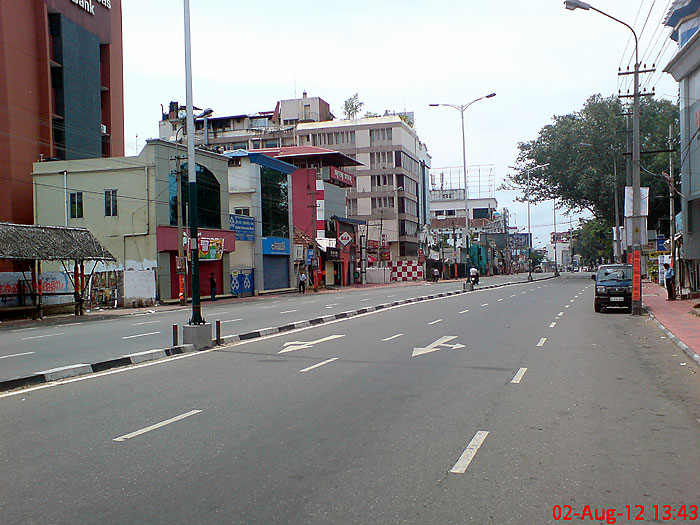
ON A HARTAL DAY: M. G. Road near Secretariat in Trivandrum look deserted. The hartal was called by the CPI (M) in protest against the arrest of its Kannur district secretary P. Jayarajan in Shukkur murder case.

Constituents of the Left Democratic Front have hardly lend any support to widespread protests by the CPI (M) over the arrest of party Kannur district secretary P. Jayarajan in the Abdul Shukkur murder case including the hartal.  In fact, CPI and other constituents are not willing to support murder politics. They want the law to take its course in the murder of T. P. Chandrasekharan and others.

Opposition Leader V. S. Achuthanandan had been spearheading a fight within the CPI (M) over what he calls its shift away from leftist polices. His strategy is to take a few steps forward and a few steps backward. He had demanded proper investigation into the murders and had not opposed the arrests by the police in the Chandrasekharan murder case. However, he said that the arrest of Mr. Jayarajan was partisan.

Members of the Assembly care when it comes to drug prices

Most of the members of the Assembly took care to attend the special discussion on the report of an Assembly committee on drug prices and related issue in the House on Thursday. There was unanimity in the House that the skyrocketing drug prices should be checked. The members cared when it came to health care and medicines.

They pressed the Health Minister V. S. Sivakumar to make it mandatory for doctors to prescribe drugs by their generic names and Mr. Sivakumar announced that it would be made mandatory for doctors in government hospitals. As to other doctors, he would have to seek legal opinion.

Ruling Front members even egged on the Minister to turn the Kerala Medical Services Corporation into a super store for bulk purchase and supply of drugs even to the private medical shops. But, Mr. Sivakumar appeared to reluctant; citing infrastructural, financial and logistical problems. However, he was forced to announce that the Health Secretary would be asked to examine the feasibility.

The two proposals, if implemented, would take the State a long way in checking drug prices.  Legally, a medical shop could now supply on the drug prescribed by the doctor. If it is by the brand name, he would have to supply that brand and not any of the alternatives. If prescription by generic name is introduced, it would give the consumer a choice. He can buy the brand and price level he chooses. (As of now, medicines are the only items over which the consumer has no choice.)

This would have an impact on prices as the price difference between various brands can be very high. Some branded drugs prescribed by the doctors could be several times higher than the generic variant. Now Internet sites such as PatientIndia are available that could help the consumer to make the choice by listing prices of the generic and branded drugs. Advice can also be received from the doctor regarding quality, but the final choice would be that of the patient.

If the Corporation enters the wholesale market in a big way, it would surely bring down prices provided that corruption in the organisation is checked. It can also help to check quality. It is imperative that the government would have to ensure quality of generic drugs when doctors start prescribing them.

For further reading:
Doctors to prescribe generic drugs in govt. hospitals

Proposal for five-day work week in Kerala

The proposal for five-day work week for government employees in Kerala is borne out of financial exigencies rather than any well-thought-out plan to improve administration.  As it stands now, the reduction of a work day result in poorer services for the public though there may be gain in terms of governmental expenditure in running the services. So, it would be lesser service to the public at lesser cost.

However, the situation could be qualitatively different if the government contemplates five-day week after efficiently implementing e-governance. Many of the government services could be offered to the citizen at lesser cost on a 24×7 basis if the e-governance system is expanded to cover more and more areas. Then curtailment of a work-day may not affect the public much.

As to the financial problems of the government, it is the governments own creation. It had created more than 15000 new posts in one year, adding to the burden of the exchequer.  Considerable sums are being spent for welfare though there is no assurance that it reaches the right hands. Government land is being granted for a pittance to the farmers and the landless and also to influential organisations. Many of these gifts are not justified.  This is when it has established schemes and ways for routing welfare assistance. The Government  indeed cared for the poor and disabled by raising the welfare and old age pensions which was a welcome measure. However, a casualty of the financial strain faced by the government was the noon meal scheme in schools.

Secretariat decked up for Onam holidays

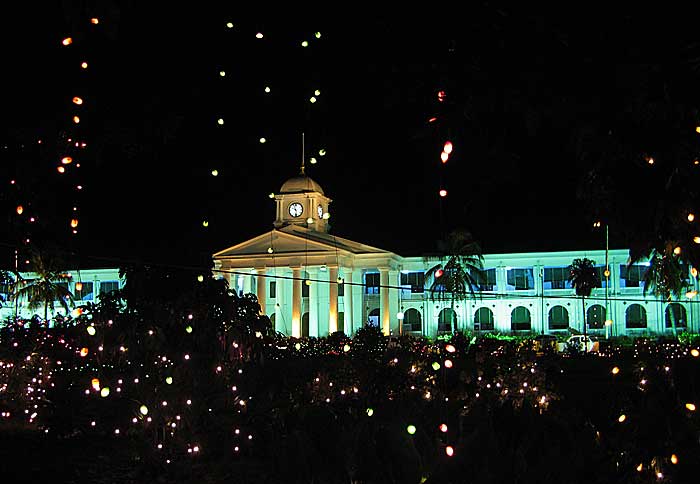
Secretariat decked up for Onam holidays (file photo)

It is high time that the government focused on augmenting revenues from the flouring trade in gold, textiles and hospitality. Special concessions to the IT sector are no more needed. Government could either reduce expenditure or improve efficiencies by routing its subsidies in cash through the banks. It is also worth thinking whether government should maintain cars and drivers for its office or provide them with a car allowance. This, in fact, was one of the recommendations of a expenditure commission appointed by the government. Several such recommendations for austerity have been gathering dust.

UDF government courts controversies

The open sparring in the UDF over the lease of estates in Nelliampathy and the controversy over regularisation of conversion paddy fields have dented the image of ruling United Democratic Front (UDF) in Kerala.

The Government Chief Whip P. C. George took cudgels against Forest Minister K. B. Ganesh Kumar for initiating steps for takeover of estates over expiry of lease or violation of lease conditions including sale or conversion of the estates. Mr. George’s contention is that the Forest Department is acting against farmers, meaning the estate owners.

Nelliampathy Estates

Nelliampathy Estates

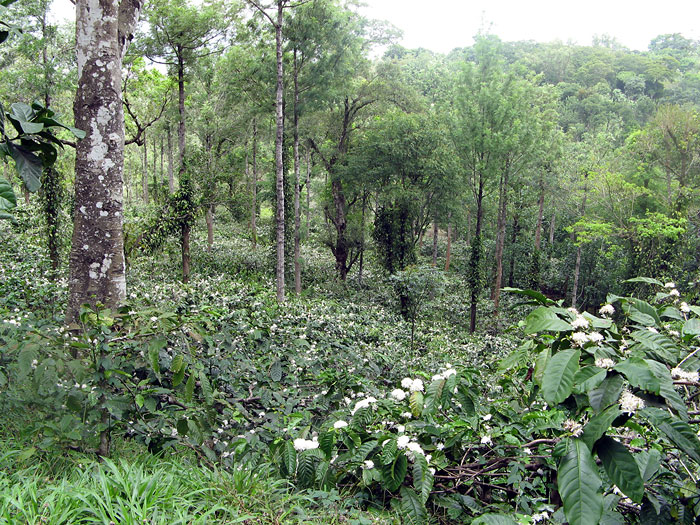
Estate owners have been trying every trick in the book to prevent reversion of their estates. They have also gained support of a section of the UDF in favour of their efforts to retain the leases.  However, a section within the UDF is opposed to it. In fact, there was a section favouring the estate owners in the previous LDF government also. However, the CPI which was in charge of the Forest portfolio had favoured take over.  After the UDF government came to power, interested groups were working for change of policy and that yielded some results.

The fight in the UDF over the issue would not die down easily as much is at stake.

Similar is the situation on the question of reclamation and conversion of wet lands and paddy fields. Those attempting large scale conversions had received the support of a section of the previous government. Now, they were getting almost full support from the Cabinet with it approving a proposal to regularize pre-2005 conversions. This would have helped realtors and investors in resorts and other projects. However, opposition is growing in the UDF with V. M. Sudheeran and others openly speaking against the decision. What they are pointing at is obvious.

These controversies are accentuating dormant internal schisms in the front and could even threaten the cohesion of the government.


Mullaperiyar: Directive against disclosure of dam break analysis

Additional Chief Secretary (Water Resources) of Kerala K. Jayakumar (now the Chief Secretary) has directed that the Dam Break Analysis (Mullaperiyar dam to Idukki Reservoir) should be denied to applicants seeking copies of it under the Right to Information Act.

The Additional Chief Secretary cites Clause 8 (b) of the Act for denying the public copies of the dam break analysis. However, there is no such Clause in the Act. There is, however, a clause 1(b) under Section 8 which states that information which has been expressly forbidden to be published by any court of law or tribunal or the disclosure of which may constitute contempt of court could be denied to applicants. But, the Office of the Chief Engineer (Inter-State Waters) has failed to provide copies of any court order forbidding publication of the Analysis.

Order against disclosure of Mullaperiyar dam break analysis

Order against disclosure of Mullaperiyar dam break analysis

Moreover, the analysis in question has been placed before the Assembly, and so, it has become a public document in every sense of the term. Moreover, Water Resources Minister P. J. Joseph himself had held a press conference disclosing findings in the Analysis at Thodupuzha.

It is also notable that it is the practice world over to publicise results of dam break analysis and inundation studies so that the people are aware of the risks and safe areas. In some countries, it is mandatory to do such analysis and prepare evacuation plans at the time of construction of dams itself. These plans are always brought to the notice of the people and local authorities.

This blog has published map showing  area of submergence from the report of the Mullapeiryar Dam Break Analysis. Mullaperiyar Dam Break Analysis

The full report of the dam break analysis is at Expert-Eyes.Org
You may also want to  read: Mullaperiyar: behind the veil

Kerala: return of the jungle

Nature is reestablishing in several parts of Kerala State. Otters have made a comeback to the mangroves in the Asramam area of Ashtamudi Lake in Kollam district. Nilgiri tahr and tigers are sighted in forest areas where they had not been seen for long. Sholas are re-establishing in upper Palani plateau of the Western Ghats not far from Munnar. Several plants in lower elevations too are on a comeback trail. Tribals of Wayanad have harvested more honey this year suggesting that the statuses of the systems that support bees are apparently improving.

Nilgiri tahr

Nilgiri tahr (ibex) and kids photographed at Eravikulam National Park, Munnar, Kerala. Photo by Roy Mathew

The Nilgiri tahrs, protected in Eravikulam National Park, have re-established themselves on hilltops near Lockhart Gap and Adimali outside the sanctuary area in recent years. There are increasing numbers of tahrs in the Mukkurthi National Park in Tamil Nadu.  Near viable populations have been reported from a location near Ponmudi in Thiruvanathapuram district at an elevation of about 900 metres.

(Tahrs have also been reported from Parambikulam Wildlife Sanctuary and Silent Valley National Park and more than a dozen other   locations in Kerala.  Many locations in the Nilgiris, Pulneys and Anamalais of Tamil Nadu also have populations of Nilgiri tahr. Srivilliputhur Grizzled Squirrel Wildlife Sanctuary, Indira Gandhi Wildlife Sanctuary and Kalakkad Mundanthurai Tiger Reserve in Tamil Nadu are among the habitats of the tahr. They inhabit mountain slopes at altitudes ranging from 600 metres to 2600 metres.)

All these point to the fact that many species and ecosystems are resilient enough to make a comeback if adequate protection is accorded. However, the gains achieved in recent years could get reversed on account of climate change or laxity in protection.

For more information on Tahr population, see
http://www.nilgiritahrinfo.info/presentpopu.htm

Preventive detection, rule of law and human rights

The government is planning to amend the Anti-social Activities (Prevention) Act to enhance period for preventive detention of goondas from six months to one year. This is a measure intended to douse public anger over the free reign of quotation gangs and political murders. It does not address the real issue.

The real issue is that the conviction rate of goondas is not very high and that they manage to get bail and paroles easily. This happens because of their liaison with politicians and police officials.  Kodi Suni, who is accused in the T. P. Chandrasekharan murder case, for example, is accused in more than two dozen criminal cases. How come people like him could freely roam around and engage in criminal activities including murders.  This is not because we did not have stringent laws. Note the trouble the Italian marines had in getting bail and the conditions attached to the bail.  In case of hardened criminals, the bail conditions will be stringent. They manage to undermine the system because of the assistance they are getting from politicians and police officials.
What the government is trying now to hoodwink the public into thinking that the government is acting against the quotation gangs and criminals. But what the law will achieve is to help the administration to hold goondas in jail for a little longer, that is, till the public anger would subside. They would be out of jail after another six months as the cases against them may not lead to convictions. Given the condition of jail administration, they would also be able to plan criminal activities including murders from within jail. If at all they are convicted, governments would release them from jail after some years.  Even an accused in despicable murders like that of K. T. Jayakrishnan had been released after eight years while several others who participated in the murder had not been arrested.

On the other hand, the Act has the potential to be misused.  Measures like preventive detection itself are a human rights violation in most circumstances. When preventive detections become routine, one cannot say it the rule of the law.

Not being a vote bank, endosulfan victims fail to get their due

The government has declined to write off the loans for endosulfan victims though it is offering debt relief to farmers and fishermen.  The government says it did not have the money to write off the loans of the families of the victims amounting to about Rs. 50 crores while it is willing to find bigger sums for farmers and fishermen.

BLINDED FOR LIFE: Devikiran and Jeevanraj, identified as vicitms of endosulfan by government, with their mother

The loans were taken mostly taken for the treatment of the victims and many families are not in a position to repay them.  The government plans to pay the victims compensation of Rs. 5 lakhs / Rs. 3 lakhs recommended by the National Human Rights Commission. These are to be paid in installments and through the banks.  For many, this would only suffice to repay their loans. Some may not even get the amounts as the banks would adjust them against their loans.

Compensation for victims can be considered adequate only if that covers the treatment costs and ensure a decent living. Farmers and fishermen could get their demands conceded because they are better organised and the politicians have stake in terms of their votes. The endosulfan victims are no a vote bank. However, the situation is changing with the victims and their families themselves getting organised and coming forward to fight their cause. (Till, now the fight for justice to the victims were being fought by outsiders or those marginally affected by the spraying of the pesticide by the State-owned Plantation Corporation of Kerala). The government will heed them when get organised and stand together forgetting any communal or other considerations.

Prerogative of the legislator to be out of jail

Should it be the prerogative of the legislator who is in police or judicial custody or serving a sentence to attend the legislature?

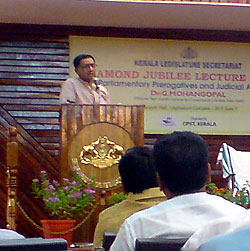
G. Mohan Gopal

G. Mohan Gopal, Director, Rajiv Gandhi Institute for Contemporary Studies, New Delhi, delivering the lecture in Trivandrum

G.  Mohan Gopal, who delivered a lecture on “Parliamentary Prerogatives and Judicial Activism”  in connection with the Diamond Jubilee of Kerala Legislature here on June 7 said that the judiciary was not according sufficient protection to legislators from arrest and denial of opportunity to represent their constituency in the legislature.  What Dr. Gopal is saying is that people like DMK leaders Kanimozhi or A. Raja should have been allowed to attend Parliament while in judicial custody or should have been released from jail.

It is notable that the courts did not grant bail to the accused for fear that they would interfere with the investigation and influence witnesses.  Suppose that R. Balakrishna Pillai who was condemned to undergo one year’s imprisonment was a member of the Assembly. What would be the justification for sending him out of jail to attend an Assembly session?  We know that it is difficult to successfully prosecute a politician in India and even if he is sentenced, it has been found to be difficult to keep him in prison.

Dr.Gopal’s argument is that legislators represent the people and their voice should be heard in the legislature. Well, people elect politicians despite their knowing about their criminal background. Doesn’t that mean that they want criminals to represent them? If we accept that argument, it would undermine basic tenets of rule of law.

Then, why do people elect criminals? Dr. Gopal said that legislatures and judiciary exercising power to punish for contempt was a result of feudal and colonial mindset.  In India, many are still to imbibe the concept that all are equal below the law.  The caste system, which prescribed differential punishment for the same crime depending on caste and the principle of dynastic succession still influence Indians. That is why they countenance and make arguments in favour the like of Kanimozhi.

Even six decades after independence, we have not freed ourselves of feudal, colonial and casteist mentalities and related belief in merit of dynastic succession.