Alternatives to endosulfan

The recommendations of 100 alternatives to endosulfan, approved by the Persistent Organic Pollutants Review Committee to the Stockholm Convention on Persistent Organic Pollutants on October 18, should be an eye-opener for governments and agricultural scientists who were arguing that there were no cheap alternatives.

endosulfan_boyIt is notable that the Committee has also recommended non-chemical alternatives which could indeed work out to be a cheap alternative. This is the first time that a Review Committee of the Stockholm Convention recommends non-chemical alternatives to a chemical proposed for elimination under the Convention.

The Union Agriculture Ministry has long been arguing that there is no alternative to endosulfan and hence it should be banned only in Kerala and Karnataka where intensive use had affected the health and well-being of people. However, evidence is emerging that endosulfan was indeed causing harm to people in other States such as Tamil Nadu, West Bengal and Punjab also. It is high time that the ministry looked at the alternatives suggested by the Committee and promoted ecosystem-based approaches on pest management as well as technical interventions using natural plant extracts in a big way.

The Kerala government has the responsibility to present the findings of various studies and the recommendations of the Committee before the Supreme Court which is considering the case for ban on endosulfan across the country. It is not clear whether the Court has changed its earlier view that no more studies are needed to establish the link between endosulfan and the health effects on people. However, it apparently want expert opinion on nation-wide ban. It is notable that India is already committed to phase out of endosulfan being a party to the Stockholm Convention.

POP Review Committee approves 100 alternatives to endosulfan
Assessment of alternatives to endosulfan
POPRC Report on alternatives
Endosulfan– Spray of Death


Kashmir’s highways remain unsafe

Kashmir’s highways are one of the most precarious in the country. You travel through precipitous ridges: a small slip, your vehicles could fall into deep gorges. The width and condition of the highway from Jammu to Srinagar are so poor that you often have to move through the outer edges of the highway which may not be stable.

Meandering highway from Jammu to Kashmir.                    Photo:  Roy Mathew

Though highways are being widened and developed from Jammu to Punjab, much of the highway from Jammu to Sri Nagar remain in bad shape despite heavy traffic. The Border Roads Organisation is in charge of the development of the highway. However, it has so far failed to develop safe roads, which is challenging task. The highway passes through mountain slopes and slopes below and above are prone to landslips at many places. There are also areas where boulders would roll down on to the road. The situation poses a major technological challenge which is yet to be addressed.

Army trucks

A large number of army trucks and vehicles move up and down the highway every day, often causing congestion.                                                               Photo: Roy Mathew

Road accidents continue to be on the high side in the State. During three years from 2009 to 2011, as many as 3,288 persons were killed and 27,165 injured in 18,786 accidents in the State. The number of accidents was on the increase during these years. With militancy on the wane, it is said that the more persons are now getting killed in road accidents than in terrorist attacks and army operations.

The Centre recently sanctioned Rs. 1248 crore to Jammu and Kashmir for improving connectivity to its villages. The State government has plans to develop the historical Mughal road for ecotourism purposes. These are ecologically sensitive areas with rich flora and fauna and water bodies. The road development has to keep in view the conservation of wildlife habitats and ecosystems.

Related Post:
Kashmiri Wedding photographed on a houseboat


Medical emergency in Thiruvananthapuram

Kerala is facing a medical emergency in its capital. Cholera is spreading following failure the city corporation and the government on waste disposal.

The city collector has clamped prohibitory orders under Section 144 (2) of the Criminal Procedure Code against those who deposit waste at public places and water bodies and those who block movement of waste to waste disposal sites of City Corporation. This is against background of intense protests against waste disposal sites of the city which polluted the neighourhoods.

Now that the solid waste treatment plant of the City Corporation at Vilappilsala is closed following public protests, the waste collection and disposal system of the Corporation have come to a standstill for about a year now. People are forced to throw waste here and there and the results are showing. Cholera and diarrhea and other water borne diseases are spreading in the city and suburbs.  Rodent population in the city has multiplied, and Hantavirus that infects people from rats had been the cause of at least one death in the city.

medical emergency

Patients queuing up at a government hospital in Thiruvananthapuram (old photo)

The mosquito population is also increasing and the Incidence of dengue fever has hit a high. Kerala is now the second in the country, after West Bengal, regarding incidence of dengue fever. Dengue fever has been confirmed in about 2000 persons this year officially and the actual number could be two or three times this number as the count does not cover patients admitted to private hospitals.

The measures being taken by the collector such as the ban orders are unlikely to help much in containing the outbreak.  The collector’s order would only force people to keep waste in their premises and terraces.  It does not make a difference whether waste is rotting in the streets or at homes.  Many homes are on only a few cents of land and they have little means of disposing waste properly as the Corporation has stopped collecting them.

Chief Minister Oommen Chandy has miserably failed in keeping his promise that new waste treatment plants would be set up in six months in place of the closed plant at Vilappilsala. He also failed to carry out his promise that protect water supply would be extended to Vizhinjam and neighbourhoods in a year.  Apart from the health of its citizens, this trend is going to hit the tourism potential of Kerala.

India’s biodiversity & Convention on Biodiversity– Part II

The 11th meeting of the Conference of Parties to the Convention on Biodiversity, to be held in Hyderabad from October 8 to 19, will take stock of the Nagoya Protocol on access to genetic resources and benefit-sharing.  It will also review the progress of targets set to check biodiversity loss.

The Nagoya Protocol is about access to genetic resources and benefit sharing in a fair and equitable manner. Even as private parties and companies are allowed access to genetic resources and traditional knowledge held by communities, it envisages strong regulatory frame works and capacity building by nations ratifying the protocol.  So far only six countries have ratified the Protocol, and it would come into force only after at least 50 countries ratified the Protocol.

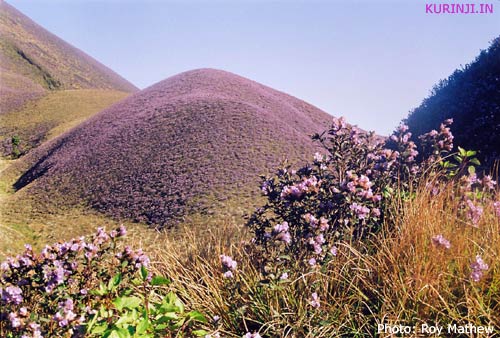
Kurinji flowers (Strobilanthes kunthiana)In this UN decade of Biodiversity, the Convention has set forth to at least halve the loss of natural habitats including forests, and where feasible, bring the rate of loss to zero.  It wants to establish a conservation target of 17% of terrestrial and inland water areas and 10% of marine and coastal areas by 2020 and restore at least 15% of degraded areas through conservation and restoration activities and make special efforts to reduce the pressures faced by coral reefs. There are also other targets.

India had proposed to increase the forest and tree cover to 33 per cent by 2012. However, the forest survey in 2011 showed that the forest and tree cover was only 23.81 per cent.  (India had, however, added three million hectares of forests and tree cover over the last three decades when most developing countries lost forests).

At Hyderabad, the delegates are to review the work on island biodiversity and address ecosystem restoration, traditional knowledge systems, marine and coastal biodiversity, biodiversity and climate change, biodiversity and development, and several other ecosystem-related and cross-cutting issues. These are subjects of immense import to India which harbours seven to eight per cent of the World’s biodiversity. (Of the 34 globally identified biodiversity hot spots, three are in our region—the Himalayas, Indo-Burma, and Western Ghats and Sri Lanka).  In terms of plant biodiversity, India ranks tenth in the World.

In the high level segment of the Conference from October 16 to 19, Heads of States and Ministers will be taking decisions on strategic plan for checking biodiversity loss, protection of livelihoods and reduction of poverty by conserving biodiversity, marine and coastal biodiversity and implementation of the Nagoya protocol. If the right decisions are taken, it would immensely benefit the poor and keep the world away from disaster that the loss of biodiversity could bring upon the globe. However, in the Conferences like this with their protracted negotiations, this is easier said than done.

India’s biodiversity and the Convention on Biodiversity

The Conference of Parties to the Convention on Biological Diversity, meeting in Hyderabad from October 1 to 19, may not achieve much. However, it is an occasion for India to take stock of its biodiversity and think about how to protect it. As the Chair of the Convention now, India can also do much in advancing the cause of conservation of biodiversity across the World though the non-ratification by the United States limits the scope of the Convention.

The Conference of Parties serves as Meeting of Parties to the Cartagena Protocol on Biosafety. It meets from October 1 to 5 and will consider a number of issues related to handling, transport, packaging and identification of living modified organisms under the Protocol.

It may also address unintentional transboundary movements of living genetically modified organisms and emergencies arising from that, besides guidelines for risk assessment and management.  Capacity building and technology transfer would also come up for discussions in this regard. The Protocol’s own effectiveness would also be reviewed.

There is demand from NGOs and scientists including the Third World Network and the European Network of Scientists for Social and Environmental Responsibility (ENSSER) to factor in socio-economic considerations into the risk assessment of living modified organisms.

India has allowed limited entry of genetically modified crops.  GM crops now dominate about 90 per cent of cotton farming in the country. However, the experience had been mixed.  GM crop failures have contributed to suicide of farmers in Andhra Pradesh.  There is nagging doubts that genetically modified cotton is responsible for death of goats that grazed the fields.  More than that, the disappearance of traditional varieties of cotton and even hybrid varieties with the dominance of Bt cotton raises concerns.

Scientific conference

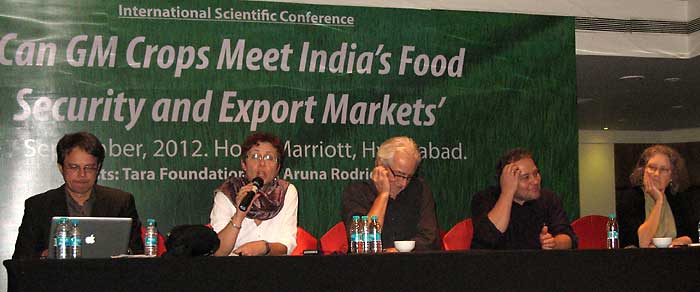
Addressing a complex problem: Chairman of ENSSER Angelika Hilbeck speaking a Scientific Conference on Advancing the Understanding of Biodiversity. Photo: Roy Mathew

India has already imposed a moratorium on Bt Brinjal considering, above all, the fact that the country enjoys a diversity of about 2000 brinjal species. (Biodiversity is of variety in genes, species and ecosystems.) Dr. Puspa Bhargava told a scientific conference organised by ENSSER, and hosted by the Tara Foundation and Aruna Rodrigues, in Hyderabad last week that the moratorium should be extended to all GM trials in the country.

Scientists are worried about contamination of Western Ghats, the store house of India’s biodiversity along with the Himalayas, by artificially introduced genes as result of GM trials. So, it is imperative that we wait and watch whether humans can have control over the technology while allowing laboratory studies.  Otherwise, even our Ayurvedic System of medicine could be in peril if drug companies start genetic experimentation.

It seems that the peers of Ayurveda were even aware of genetic diversity as texts mentioned importance of collecting plants from certain locations and with specified characteristics. If our medicinal plans gets contaminated, the whole system of Ayurveda would have to be re-worked which will be an almost impossible task as it is the knowledge gathered by thousands of generations.

(To be continued)

For further reading: Scientists want inclusion of social economic considerations in risk assessment of GM crops

ISRO’s 100th mission: It is not a century

The Indian Space Research Organisation carried out its 100th space mission with the successful launch of the PSLV-C21 rocket from Satish Dhawan Space Centre at Sriharikotta on September 9, 2012. The description ‘100th mission’ may be a misnomer as the count is a total of 62 satellite missions and 37 launch vehicle missions plus a space capsule recovery experiment. (The launching of the vehicle and placing of a satellite in orbit are treated as separate missions by ISRO.) The launch vehicles sometimes carried more than one satellite, as was the case on Sunday when PSLV-C12 carried Japanese as well as a French satellite.

Launchpad at Sriharikotta

Rocket Launchpad at Satish Dhawan Space Centre, Sriharikotta, India

For the French, there may be some irony. They have turned to India for launch of their 712-kg earth observation satellite SPOT-6 using a launch vehicle, the technology for which was originally developed by France. India had obtained the liquid propulsion technology used in French ‘Viking’ engine as per an agreement in the seventies. The crucial second and fourth stages of PSLV are powered by modified engines using the French technology.

ISRO’s achievement was in fabricating many of the components indigenously over the years and developing a few hundred technologies that could add value. This helped to bring down the costs, finally attracting the French to use India’s launch vehicle for its satellite. It is the first time that a French satellite is being launched from India while several Indian satellites have been launched from French Guiana (where European Space Agency’s primary launch site is located).

ISRO has been taking the beaten path in the development of rocket technology instead of looking for innovative technology. The decision to borrow cryogenic technology, instead of developing it on its own, turned out to be disastrous as the indigenous version of the Russian cryogenic technology is yet to take off. The aim was to develop indigenous cryogenic engine modeled on the Russian cryogenic module with similar performance parameters.

The full technology transfer did not take place due to American pressure on Russia and ISRO’s attempt to fabricate it based on the design it had obtained from the Russian space agency ran into problems and repeated test failures. It would now be an uphill task for ISRO to complete the development and modify it for future needs.

As such, the 100th mission marks stagnation in space technology development rather than a great achievement. India may have to revamp its technology development plans if it is to keep pace.

Actor Sheila’s entry into politics in limbo

Actress Sheela’s entry into Congress politics so far is a non-starter. This is not surprising to anyone who knows Congress politics and groupism in the State.

Congress leaders in the State would not countenance lateral entry of leaders into the party that would affect their chances. The only one they would willingly or grudgingly tolerate is Rahul Gandhi. Recall the bitterness that the entry of Shashi Tharoor generated in the State unit despite the credentials he presented and the support of the high command.

Sheela in film Chemmeen

Actor Sheela in film Chemmeen

Sheela went to none other than Defence Minister A. K. Antony, apparently thinking that he is her best bet. Mr. Antony and his wife warmly received her but cold-shouldered her proposal referring her to KPCC president Ramesh Chennithala. Can Ramesh Chennithala afford to spare her a Rajya Sabha when all the UDF constituents are warring for seats? Can he even think of fielding her in the next elections?

And can she win an election from Kerala? That she was the heartthrob of the older generation on the silver screen is not sufficient for her to get electoral support in Kerala. Even the evergreen hero Prem Nazir could not do that in his heydays, that too despite being sponsored by K. Karunakaran. If one should know the gravity of his failure, remember that Karunakaran was one who had managed to make non-entities like A. Charles and M. R. Raghuchandra Bal to win elections and get foothold in the party.

The politics of green politicians in Kerala

The green brigade in the UDF in Kerala is striking a distinct position compared to rest of the members of the Assembly in the Front. They have also started using the new media for their campaign.  (T. N. Pratapan, V. D. Satheesan, V. T. Balram and Hibi Eden (Congress) K. M. Shaji  (Muslim League )and  M. V. Sreeyams Kumar (SJD) are blogging at GreenThoughtsKerala)

Title image of blog of the MLAs

Title image of blog by V. D. Satheesan, T. N. Pratapan, M. V. Sreeyams Kumar, V. T. Balram, K. M. Shaji and Hibi Eden

The scenario in the Assembly has been changing over the past decade with more members coming forward to propound the cause of environment. The Legislative Committee on Environment has over the years produced well-studied reports. Two decades ago, K. V. Surendranath of CPI was the only member campaigning for environmental causes. On the other side people like Seethi Haji (IUML) asked how it rained at sea if forests were required for precipitation.  Now, there are several members both in the ruling and Opposition fronts wanting to protect the environment. They include Opposition Leader V. S. Achuthanandan who once spoke against environmentalists.

However, a question would arise as to how deep their commitments are.  Are they simply moving with the tide or playing politics? It is notable that almost all members of the green brigade are people who had missed out on ministerial positions. They have an axe to grind against Chief Minister Oommen Chandy and other UDF leaders.  And they know that fighting corruption from within a la Achuthanandan has a market. Yet, that does not make the causes they are expounding less important.

Yes, they are indeed playing politics and it is notable that Mr. Chandy and industries Minister P. K. Kunhalikutty are in the defensive.  Mr. Chandy even said that they are doing the campaign because they are sincere.  May be, people can trust them more than Mr. Achuthanandan who is also expounding the same causes.

If they are sincere, they will persist. Mr. Achuthanandan forgot many of the causes he expounded when he came to power. The litmus test for green politicians of UDF too would be what they do when they come to power.

Update: Well, we did not have to wait until they come to power to know how steadfast they would be on their views. The green politicians are now supporting tourism projects such as that proposed in Nelliyampathy disregarding questions whether the land proposed to be used for such projects are forests or environmentally fragile areas. They do say that they changed their stand because Chief Minister Oommen Chandy has conceded their demands including environmental impact assessment of all projects under Emerging Kerala initiative.

Advertising State lotteries: is it a good deed?

Can buying lotteries be a good deed?  The government says so in its advertisements for Kerala lotteries. It argument may seem right as the revenues from the Karunya lotteries of State government is to be spent for funding assistance to poor patients requiring treatment for serious ailments affecting vital organs of the body.

Lotteries nurture the instinct for gambling. Everybody knows that most of the buyers of the lottery never benefit from it whereas the seller always benefits. However, running of lotteries by the government has been justified on the ground that it provides employment to many and satisfy the urge of the people to try their luck. The justifications get a boost when the government saysTelevision advertisement for Kerala Lotteries that the returns are to be used to fund care of critically ill patients. It also serves as a good marketing strategy for the State lotteries.

However, the picture changes when one examines these arguments from another perspective. The government is resorting to creation of non-productive employment instead of creating real employment opportunities.  Free treatment of poor patients for serious ailments is not a priority of government: it is not willing to spend tax revenues for the purpose; but want people with gambling instinct to do the job. It is promoting the instinct by using fund raising aspect of the lottery for marketing purposes and terming it as a good deed. The marketing campaign would lead to people imbibing wrong values: the buyer of the lottery hides his greed behind altruism.