It was another ordeal for endosulfan victims

endosulfan stir

Endosulfan victims and their mothers on hunger strike before the Secretariat

The hunger strike by endosulfan victims and mothers before Kerala Secretariat ended last week after the Government conceded most of their demands.

However, the demands conceded were the ones that the government had conceded as back as in January 2014 following their dharna before the Chief Minister’s residence. Implementation was lagging and the victims had to launch another stir to get yet another assurance that they would be implemented.

The only concrete gain from the agitation was a specific decision to include about 600 more persons from Kasaragod district under the government’s list for providing compensation. Whether other promises would be kept within the term of the present government is to be seen.

In fact, the approach of successive government to the endosulfan problem had been far from satisfactory. It is more than five years since the National Human Rights Commission recommended compensation and other measures. Still the compensation has not reached all.

Though it was a problem that should have been addressed on a war footing, governments often chose to ignore the problem. It was convenient for them to do so, because the State-owned Plantation Corporation of Kerala was responsible for aerial spraying of endosulfan. None of the officials who were responsible for using such dangerous methods of application of pesticides in a populated area, and that too in excess quantities and over water bodies, were never held accountable.

As to rehabilitative and remediative measures, the government could not even do what the voluntary agencies could. It is notable that even the BUDS schools set up by the government did not have facilities for use by physically challenged persons. Even western closets were absent.

As the water bodies were contaminated, the government took no steps to supply pure drinking water to the affected area for two decades after the problem became known. When Rajiv Gandhi drinking water mission was implemented in kasaragod district, the villages chosen for the project were not the endosulfan affected. Decontamination was never attempted. In fact, the remaining stocks of endosulfan with the Corporation are yet to be removed safety from the area.

This blog has said that the settlement two years ago was aimed at fooling the victims. This time also, the situation is only marginally better.

Mullaperiyar- fresh litigation will be ill-advised at this stage

Kerala Government plans to approach the Supreme Court yet again on the Mullaperiyar issue— this time over the alleged failures of the supervisory committee appointed by the Court to properly manage release of water from Dam through the spillways.

This is just an attempt by the politicians to buy time and hoodwink the public. The supervisory committee has representatives of Kerala and Tamil Nadu and Central Water Commission. The question of failure to issue timely warning before release of water through the spillways is a matter that the State government should be able to settle administratively, if necessary seeking intervention of the Centre. It will not be appropriate to agitate the Supreme Court now.

Moreover, it is not Kerala’s case that the Tamil Nadu did not warn it of impending release of water. There were reports that Theni Collector did so a few days ago. The complaint is that the Idukki Collector was not informed six hours before the release. Tamil Nadu apparently wanted to record that the water level touched 142 feet. When water level reached 141.9, it became imperative for Tamil Nadu to release water immediately as the inflow was very heavy. There needs to be an understanding on gradual release of water without waiting for the water level to touch 142 feet.

Kerala should also insist upon its lower riparian rights. The Expert Committee appointed by the Supreme Court had mooted construction of a tunnel to drain water into Periyar River downstream. This is also important from the point of view of safety. All modern dams have Bottom outlet tunnel which will facilitate emptying of the dam in case of an emergency—the Mullaperiyar dam does not have one, being one designed in the 19th century.

Every time Kerala has gone to Court over the Mullaperiyar issue, it has led to closure of its options. It has already lost its case that Tamil Nadu should raise the water level of Mullaperiyar beyond 136 feet only after exhausting storage at Vaigai Dam and that the spillway shutters should be opened gradually. In fact, when Kerala is arguing that the dam is not safe, it should be prepared for sudden release of water. This was what was lacking downstream of Mullaperiyar this Monday.

Kerala has failed to set up monitoring facilities it proposed on earlier occasions downstream of the Dam. Around 50 monitoring installations on the dam and reservoir, under control of Tamil Nadu, are reportedly not functioning. This is an issue that Kerala should be taking up legally or administratively. Even a modern dam without functioning monitoring equipment is unsafe.

Kerala had rushed to nullify a Supreme Court order of 2006 though legislation within weeks of the Court issuing the order. The legislature in its wisdom fixed the water level at 136 feet without building up supporting material. The Kerala Dam Safety Authority, which is a quasi judicial body, on the other had could have commissioned international studies on Mullaperiyar under the law and fixed the water level appropriately which would have been difficult to question before the Supreme Court.

When the Court quashed the law, Kerala suffered a multiple blow. Its arguments had led to the Supreme Court appointing a supervisory committee. As the supervisory committee of the Supreme Court is now managing the water level, it could put blame on Tamil Nadu only if it disregarded directives of the committee. Kerala will not even be able claim damages from Tamil Nadu for any losses caused by release of water or dam failure.

Kerala had ample time to prepare internationally acceptable documents on safety of Mullaperyar Dam from 2006 and even before. But it always rushed to do studies at the last minute. When safety of the people was paramount, one of the first studies it commissioned over a short span of time after 2006 was on submergence of forests and wildlife. (An analysis of errors in that study is available here. The author had to admit before Court that he had done a copycat job of work done by a State agency.)

Though there was an erroneous observation in the 2006 judgment (See Mullaperiyar- behind the veil.) that waters from Mullaperiyar would be contained in Idukki reservoir in case of failure of the former, Kerala failed to complete and produce the Dam Break Analysis before the Supreme Court in the case filed by Tamil Nadu challenging Kerala’s dam safety law.


Extract from judgment
Extract from the judgment of Supreme Court in ORIGINAL SUIT NO. 3 OF 2006 between Tamil Nadu and Kerala

Though the State Information Commission has ruled that this and other studies are public documents, the Principal Secretary of Water Resources Department has issued an illegal order against release of documents pertaining to the Mullaperiyar Dam as long as the issue is under litigation. Perhaps this is one reason why it wants another litigation.

As its strategies have failed so far, it is high time that it reconstituted the Mullaperiyar Special Cell with fresh talent and drew up fresh strategies.

For further reading:

Mullaperiyar: Kerala seeks review of Probable Maximum Flood


Season of contradictions


Vellappally  Natesan leading a march (file photo)

Vellappally Natesan leading a march (file photo)

The season of political marches has started in Kerala with Assembly elections being just six months away. The first to set off from Kasaragod is the Samatwa Munnetta Yatra led by general secretary of Sree Narayana Dharma Paripalana Yogam Vellappally Natesan.

The objective of the march is the unity of majority (Hindu) communities. The objective does not quite synchronise with that of Sree Narayana Guru, the founder of the Yogam, who had envisaged a casteless society with the slogan one caste, one religion and one God for man. Mr. Natesan wants to bring all castes ranging from Nayadi to Namboothiri under the umbrella of his proposed political party, but with distinct identities.

Mr. Natesan, who had once tried to form a front of backward classes in association with the Muslim League, is now speaking against Muslim League and other Muslim political outfits such as PDP and Welfare Party in his bid to form “Hindu party”. The problem, however, is all the castes could not agree on the question of reservation. Besides, some are not comfortable with the RSS ideology with which Mr. Natesan is trying to link his new political party.

The CPI (M) too will soon be starting its march across the State, and one of its principal targets will be Mr. Natesan who is trying to wean away the Ezhava community from CPI (M). However, it is yet to decide whether the party secretary would lead the march as in the past. Question is also in the air as to whether former party secretary Pinarai Vijayan or Opposition Leader V. S. Achuthanandan should lead party and the Opposition front in the election campaign. (And in case of victory, who will be the Chief Minister). The choice is crucial because the two leaders differ so much in style and principles.

KPCC president V. M. Sudheeran is also expected to announce a march shortly. His problem will be to resolve the conflicts and contradictions among ruling front constituents and groups within his party. Their differences have been accentuated during the recent elections to the local self governments to such an extent that co-ordination for the coming elections will be an uphill task.

Skeletons are being pushed out in Kerala

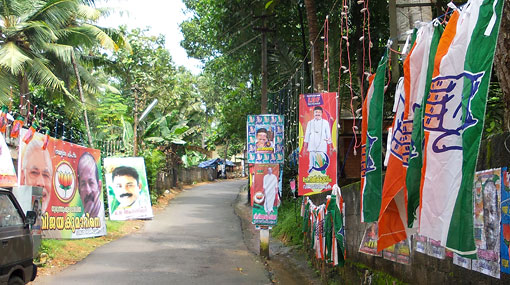
posters

LSG election campaign posters in Thiruvananthapuram

Skeletons were not tumbling out but were being pushed out in Kerala as campaign for elections to the local self government intensified.

Election is an occasion when adjustment politics becomes difficult if you are not in alliance. So, every move by one Front or party is to be countered by the other.

In the initial phase of the campaign, the Opposition Left Democratic Front was not speaking much about the bar-bribery case though it had laid waste an entire session of the Assembly over the issue a few months back.

However, when the Vigilance Court directed that the probe into the case should be continued, it was hardly an opportunity to be missed amidst the campaign. As Opposition met even the Governor seeking ouster of Finance Minister K. M. Mani, in view of the court observation that there was prima facie a case against him.

Suddenly, skeletons in the LDF cupboard started falling, or being pulled out. News was leaked that the Vigilance was dropping the corruption case against former Minister Elamaram Kareem in Chakkittappara iron ore mining case. Mr. Kareem was alleged to have received Rs. 5 crore as bribe for granting permission to illegal iron ore mining. The Vigilance reported that Mr. Kareem had not received any bribes and also that the case was obsolete.

The allegations against V. A. Arunkumar, son of Opposition Leader V. S. Achuthanandan, too got a fresh run with news reports that the Vigilance had recommended prosecution of Mr. Arunkumar for financial irregularities in Coirfed where he had been the Managing Director. Apparently, the recommendation was ready to be leaked out at the right moment.

SNDP Yogam General Secretary Vellappally Natesan, who started dreaming of a new political party and cobbled some sort of alliance with the BJP also met with a similar fate. The allegations surrounding the drowning of Swami Swaswathikanda of Sivagiri Mutt suddenly resurfaced with imputations that he had been murdered. Allegations about involvement of Mr. Natesan and his son were made by the very person (Kerala Bar Hotel Owners Association Working President Biju Ramesh) who had raised allegations against Mr. Mani also. Obviously, he has Opposition support as CPI (M) would be the worst hit by Natesan’s alliance.

Faced with the allegations and certain uncertainties over the alliance with BJP, Mr. Natesan had to play it on a low key and skip some of the campaign programmes.

Kerala voters are discerning and know that all the skeletons are not phantoms. They have turned up in large numbers to vote and the results are keenly awaited. Which of the skeletons would they recognise as real and react to them is to be seen.

Legislation will formalise harthals

Harthal at ChalaiThe Government is proposing a legislation to bring restriction on organisation of harthals. However, it could very well end up being a piece of legislation granting political parties and other organisations a right to call for harthal. It is proposed that the organisers of harthals should announce it three days in advance.

The government could ban it if it is convinced that there would be the possibility of violence. Forced closure of shops and blocking of movements of people will attract imprisonment of up to six months or a fine of Rs. 10000 or both.

Harthal was a form of direct action devised by Gandhiji to protest against the colonialists and that too against acts like the massacre at Jallianwala Bagh. The Congress and its leaders, at that time, were totally committed to non-violence. Only a non-violent organization has the right to call harthal (none of today’s political parties could be classified as one). It is a non-violent mode of protest.

Nobody joins harthals willingly these days. Harthal, called by even minor political parties, is a ‘success’ because there is a threat of violence behind it. So, provisions in the proposed legislation such as one empowering government to ban harthals, if it is convinced that there would be violence, ignores the fact that harthal is inherently violent today. Such a provision will only be a political tool in the hands of successive governments. (Will a ruling party/front in the State ever be ‘convinced’ that there would be violence if it is a harthal against the policies of a Central government under a different party/front?)

So, action should be mandated against any political leader who makes a call for a harthal since threat of violence is inherent in such a call. If some people locally and spontaneously observe a harthal on their own free will over a murder or something like that, let it be countenanced. That is, harthal as such need not be banned, but making a call for harthal through mass media, public address systems and the like should be banned.

This automatically rules out proposals like announcement of harthals three days in advance. Even if such announcements are made, the hardship of people will only be diminished and not eliminated. Even for a journey to Bangalore these days by bus, one has to book a week in advance. (Train/air reservations are made months in advance). Harthal is not a suitable mode of protest in cities that work 24×7. The loss of lives, property and production caused by harthals is significant and will not be mitigated by a notice.

Forced closure of shops and forced restriction on movement of people are actually violation of fundamental rights. There are already provisions in the IPC and other laws to check such acts. Bringing fresh laws is not answer to failure of the government to enforce existing laws. In fact, there is a need to prune the statute book; but recommendations made by law reforms committee and commission are gathering dust.

The Supreme Court and the High Court, which are empowered to enforce fundamental rights even in the absence of laws, have already banned bandhs. The problem now is that the police are not taking cognizance of bandhs masquerading as harthals.

If at all a new law is to be enacted, it should be to define harthal/bandh and ban calling of harthals by political parties and other organisations with its inherent threat of violence. Fine of Rs. 10000 is insufficient as the damage caused by harthals is much more. Victims should be able to claim compensation separately for death, injury and loss of property. Express provisions should be included for this purpose. Provision should also be there for traders to claim compensation against those forcing closure of shops by violent means.

The Government should not formalise a ‘right to call harthals’ by providing for a notice procedure.

Kurinjippoo revolution and its political implications

Munnar town

A view of Munnar town

The strike by women tea estate workers in Munnar in Kerala for bonus, now nicknamed after neelakurinji flowers, was a resounding success. (The workers did not face any police brutality unlike the Jasmine revolution in Tunisia.) Its political implications are significant and will be watched for long.

Notably, it was the recognised trade unions— rather than the tea company (Kannan Devan Hills Plantation), which had to give in to women power as hundreds of unorganised women labourers from the estates thronged the roads of Munnar virtually paralyzing traffic and economic activities in the town including tourism. Politicians and trade union leaders who spoke against them had to eat their words. This was the result of the unions betraying the workers for long.

Chief Minister Oommen Chandy had to convene urgent meeting with the women’s representatives, keeping away the trade unionists, to settle the strike. The labourers were demanding 20 per cent bonus this year and company was refusing to pay that saying that its profits had come down. However, company is a captive unit of Tata Global Beverages and profits depended on at what prices tea was being sold to the Tata group company.

The argument of the trade unions that the women made a mistake in agreeing to a reduced the bonus component of 8.33 per cent and the balance as ex-gratia has no much merit. They say that next year they would be able to start the negotiations from 8.33 per cent bonus component against 10 per cent promised by the company this year. But, next year’s outcome will depend on what force the women are able to muster next year. However, an immediate concern to them will be forthcoming negotiations on daily wages which is one of the lowest among agricultural labourers in Kerala. The workers are demanding daily wages of Rs. 500 which is about double the current wages. Minimum wages of women agriculture labourers in Kuttanad is Rs. 330 a day while that of men is Rs. 560 a day.

The estates workers may be on the way for substantial gains in this respect as Labour Minister Shibhu Baby John had to swallow his remarks that such a wage level was not feasible in tea plantations. The women labourers are now trying to form a union of their own. They may succeed given their will power. But there is no guarantee that the new union too will not go the way of existing unions which had sacrificed workers’ interests for personal gains of their leaders. May be it is better for the women to remain ‘unorganised’.

However, a crucial development to watch will be whether some of these women will emerge as contestants in the forthcoming panchayat elections. If they do, it could cause considerable worries to the political parties and unions, and rewrite history. Emergence of an alternative to the unions in Munnar like the Aam Aadmi Party in Delhi could not be ruled out. If that happens, the established political parties will be the losers.

Related:
New York Times: Hopes, and Homes, Crumbling on Indian Tea Plantations

Farmers in distress

Farm landsPrime Minister Narendra Modi’s proposition for farmers falls short of requirements.

There is little doubt that the several of the measures being taken by the Central government, whatever is their positive impact on the economy, will hit the farmers, small traders and the even pensioners. So, measures are needed to protect them.

As to farmers, the government is taking certain steps one year after coming to power. They are already late as could be seen from the suicides of farmers in Maharastra, Telangana, Karanataka, Andhra Pradesh and Kerala.

The proposed crop insurance scheme will go a long way in helping the farmers if implemented properly. First of all, wide coverage of the scheme encompassing all sections of the farmers should be ensured. Secondly, compensation should be made within 30 to 45 days in the case of crop loss. This should be mandatory with delay in making the payments attracting penal interest.

However, it should be noted that the insurance scheme would be of help only in the in the case of crop loss/failure while fluctuation in prices of farm produce is a bigger problem faced by the farmers. The government should bring in better instruments to ensure remunerative prices. Indian farmers do not like to be on welfare.

Every crop in the country suffers from sudden fall in prices one time or another. Even rubber is no exception as could be seen from recent developments. Often the fall in prices of rubber are caused by imports and international developments such as fall in prices of petroleum. Fall in prices of rubber wood has compounded the problems as farmers used earnings from clear-felling of plantations to fund replanting.

The move of the Central government to allow 100 per cent foreign direct investment in rubber and coffee plantations could be of disadvantage to small farmers. The funds flow would be accompanied by technology flow also, and small farmers may soon lose competitiveness.

Be ready for the next IT revolution— in healthcare

The next information technology revolution will be in health care. However, we are far from ready.

healthtechMost doctors in India still use prescription pads and printed results of diagnostic tests. However, this is changing at least in respect of some big hospitals. Doctors could now access results of diagnostic tests online. Appointments with doctors are fixed online.The prescriptions, made online, instantly land on the desks of nurses and pharmacists. A company offering diagnostic services through a chain of laboratories in Kerala is now offering the results through Internet so that you can access them from home or hospital.

However, bigger things are yet to come. Telemedicine is already in vogue and its practice will get deeper and wider. Electronic health records and personal health records will make communication between patients and doctors as well as doctors and specialists easier. Medical images could be moved on the fly and examined by experts. Mobile platforms will increasingly used for monitoring of patients and communication of medical information.

At the next stage, computer programmes will also undertake analysis of medical images. Algorithms are already being developed for these purposes and they promise to detect problems that doctors fail to identify. CT scans will come with analysis. (The casualty would be doctors who expertise in evaluating images will gradually go into disuse. Programs will not be free of errors, but doctors can put the blame on the machines.)

The vistas that new technology is opening up in the health care sector are tremendous. It will now be possible to ‘scan’ large populations for diseases and accumulated data could be sent for diagnosis and analysis for specialists. For example, local health care technicians could be trained to capture images such as that of the retina using small devices and sent to doctors for detection of various diseases such as diabetic retinopathy. Trials for detection of retinopathy have already been done this way in Australia. The United States is already implementing Health IT program through a National Coordinator for Health Information Technology. Incentives are being offered for adoption of the technology.

The Digital India initiative is to have components that focus on healthcare. Indian IT companies such as Infosys are already working on the design and programming part. Cognizant is also emerging as a major player in the area. So, it is high time that the Centre and State government starting training youth to tap the emerging opportunities. The government also needs to come up with guidelines to hospitals regarding inter-operability and other norms. Legal protection of medical data, encryption and other privacy concerns need to be addressed as we go digital.

Hat trick by Oommen Chandy

Sabarinath with CM

K. S. Sabarinath (Right) with Oommen Chandy

It was a hat-trick victory for Kerala Chief Minister Oommen Chandy and the ruling Front in Aruvikkara Assembly constituency on Tuesday. The United Democratic Front (UDF) had won by-elections earlier at Neyyattinkara and Piravom after Mr. Chandy came to power in 2011.

The result indicates that Mr. Chandy’s mass contact strategy is still working though some might be disappointed by the unchanging face of bureaucracy. It also shows that the corruption charges against the government did not have the impact that the Opposition hoped for. The failure of the candidate put up by UDF dissident P. C. George to garner even one per cent of the votes perhaps underlines this.

The UDF had cleverly fielded a new face in the election instead of a seasoned politician. Now, almost every citizen know that politicians routinely take money from businessmen including bar and quarry owners for doing favours. But UDF candidate K. S. Sabarinadhan could not be grouped with them as he has not been in politics before.

Vote sharesHowever, it is notable that opposition parties, including BJP, and NOTA carried away a vote share of 56.87 per cent while UDF’s vote share dropped by 9.17 percentage points (from 48.78% to 39.61%.). The Opposition Left Democratic Front (LDF) suffered a loss of 7.1 percentage points (from 39.61% to 32.51%). NOTA polled one per cent of the votes. The vote share of BJP increased by nearly four-fold from 6.61 per cent to 23.96 per cent.

It showed that BJP could extend the advances it made in Thiruvananthapuram at least partially to neighbouring constituencies provided that it has the right candidate and political climate. BJP’s O. Rajagopal had won 33.3 per cent of the votes in the Lok Sabha polls from Thiruvananthapuram constituency in 2014. Now, he has won 23.96 per cent votes from a neighbouring Assembly segment.

This does not mean that BJP can duplicate the performance in the Assembly elections in 2016. It simply lacks candidates of the stature of Mr. Rajagopal to be fielded in other constituencies. It is also notable that Mr. Rajagopal’s popularity is not as strong as in Thriuvananthapuram in Aruvikkara. His appeal may have also diminished compared to the time of Modi wave and loss of popularity of Shashi Tharoor (who defeated him in Thiruvananthapuram).

However, the BJP’s performance is a clear warning to both the UDF and LDF. They will lose votes if people find an alternative, perhaps even NOTA, if they take the voters for granted. People are also not ignoring issues like development. The UDF lost a lead in Aruvikkara panchayat of Aruvikkara constituency over issues of local development. It won because BJP took away votes of LDF also. by-electionRelated Post:
Crucial battle for Oommen Chandy in Kerala

Crucial battle for Oommen Chandy in Kerala

The by-election from Aruvikkara constituency in Kerala is a crucial battle for Ommen Chandy government, beleaguered by corruption charges.
Chief Minister Oommen Chandy has taken it upon himself to win the election by fielding a novice. He has already addressed or interacted directly with half of the electorate in the constituency.

by-election

Finale of by-election campaign in Aruvikkara constituency in Kerala. Photos: Roy Mathew

A victory in Aruvikkara will enable Mr. Chandy to claim that his government still has people’s support. The ruling Front will be winning the third by-election after coming to power in 2011. (It had earlier won by-elections from Neyyattinkara and Piravom).

A defeat would show that support for government has slipped. This would encourage his detractors and he will face increasing pressure over corruption, questionable associations and misdemeanors of his Ministers and his own office. Though challenge to Mr. Chandy’s Chief- Ministership is not as strong as before, a defeat in the by-election can spell serious trouble for Mr. Chandy.

The campaigning is throwing out characteristics of a neck to neck race. However, the chances of the ruling Front (UDF) or Opposition Front (LDF) making a significant advance at the finish line could not be ruled out. The UDF candidate K. S. Sabarinathan, being a novice, has the advantage of being unblemished. The LDF candidate M. Vijayakumar, on the other hand, has to carry his own baggage. He faces an unusual situation of a counter affidavit having filed against his affidavit given as part of his nomination papers.

electionThis may be first time that a counter gets filed against an affidavit filed by a candidate. This could now become a trend in future elections.
The BJP candidate O. Rajagopal is sure to carry away a notable number of votes from the UDF and LDF kitty. He had been runner up in elections from Thiruvananthapuram.

His party’s vote share in Aruvikkara in the Assembly election of 2011 was only less than seven per cent. Mr. Rajagopal, who is popular around Thiruvananthapuram, and his foray into an adjoining area is sure to increase BJP’s votes.

Related links:
Kerala Assembly election database
By-election results: Neyyattinkara and Piravom