Kerala: return of the jungle

Nature is reestablishing in several parts of Kerala State. Otters have made a comeback to the mangroves in the Asramam area of Ashtamudi Lake in Kollam district. Nilgiri tahr and tigers are sighted in forest areas where they had not been seen for long. Sholas are re-establishing in upper Palani plateau of the Western Ghats not far from Munnar. Several plants in lower elevations too are on a comeback trail. Tribals of Wayanad have harvested more honey this year suggesting that the statuses of the systems that support bees are apparently improving.

Nilgiri tahr

Nilgiri tahr (ibex) and kids photographed at Eravikulam National Park, Munnar, Kerala. Photo by Roy Mathew

The Nilgiri tahrs, protected in Eravikulam National Park, have re-established themselves on hilltops near Lockhart Gap and Adimali outside the sanctuary area in recent years. There are increasing numbers of tahrs in the Mukkurthi National Park in Tamil Nadu.  Near viable populations have been reported from a location near Ponmudi in Thiruvanathapuram district at an elevation of about 900 metres.

(Tahrs have also been reported from Parambikulam Wildlife Sanctuary and Silent Valley National Park and more than a dozen other   locations in Kerala.  Many locations in the Nilgiris, Pulneys and Anamalais of Tamil Nadu also have populations of Nilgiri tahr. Srivilliputhur Grizzled Squirrel Wildlife Sanctuary, Indira Gandhi Wildlife Sanctuary and Kalakkad Mundanthurai Tiger Reserve in Tamil Nadu are among the habitats of the tahr. They inhabit mountain slopes at altitudes ranging from 600 metres to 2600 metres.)

All these point to the fact that many species and ecosystems are resilient enough to make a comeback if adequate protection is accorded. However, the gains achieved in recent years could get reversed on account of climate change or laxity in protection.

For more information on Tahr population, see
http://www.nilgiritahrinfo.info/presentpopu.htm

Preventive detection, rule of law and human rights

The government is planning to amend the Anti-social Activities (Prevention) Act to enhance period for preventive detention of goondas from six months to one year. This is a measure intended to douse public anger over the free reign of quotation gangs and political murders. It does not address the real issue.

The real issue is that the conviction rate of goondas is not very high and that they manage to get bail and paroles easily. This happens because of their liaison with politicians and police officials.  Kodi Suni, who is accused in the T. P. Chandrasekharan murder case, for example, is accused in more than two dozen criminal cases. How come people like him could freely roam around and engage in criminal activities including murders.  This is not because we did not have stringent laws. Note the trouble the Italian marines had in getting bail and the conditions attached to the bail.  In case of hardened criminals, the bail conditions will be stringent. They manage to undermine the system because of the assistance they are getting from politicians and police officials.
What the government is trying now to hoodwink the public into thinking that the government is acting against the quotation gangs and criminals. But what the law will achieve is to help the administration to hold goondas in jail for a little longer, that is, till the public anger would subside. They would be out of jail after another six months as the cases against them may not lead to convictions. Given the condition of jail administration, they would also be able to plan criminal activities including murders from within jail. If at all they are convicted, governments would release them from jail after some years.  Even an accused in despicable murders like that of K. T. Jayakrishnan had been released after eight years while several others who participated in the murder had not been arrested.

On the other hand, the Act has the potential to be misused.  Measures like preventive detection itself are a human rights violation in most circumstances. When preventive detections become routine, one cannot say it the rule of the law.

Not being a vote bank, endosulfan victims fail to get their due

The government has declined to write off the loans for endosulfan victims though it is offering debt relief to farmers and fishermen.  The government says it did not have the money to write off the loans of the families of the victims amounting to about Rs. 50 crores while it is willing to find bigger sums for farmers and fishermen.

BLINDED FOR LIFE: Devikiran and Jeevanraj, identified as vicitms of endosulfan by government, with their mother

The loans were taken mostly taken for the treatment of the victims and many families are not in a position to repay them.  The government plans to pay the victims compensation of Rs. 5 lakhs / Rs. 3 lakhs recommended by the National Human Rights Commission. These are to be paid in installments and through the banks.  For many, this would only suffice to repay their loans. Some may not even get the amounts as the banks would adjust them against their loans.

Compensation for victims can be considered adequate only if that covers the treatment costs and ensure a decent living. Farmers and fishermen could get their demands conceded because they are better organised and the politicians have stake in terms of their votes. The endosulfan victims are no a vote bank. However, the situation is changing with the victims and their families themselves getting organised and coming forward to fight their cause. (Till, now the fight for justice to the victims were being fought by outsiders or those marginally affected by the spraying of the pesticide by the State-owned Plantation Corporation of Kerala). The government will heed them when get organised and stand together forgetting any communal or other considerations.

Prerogative of the legislator to be out of jail

Should it be the prerogative of the legislator who is in police or judicial custody or serving a sentence to attend the legislature?

G. Mohan Gopal

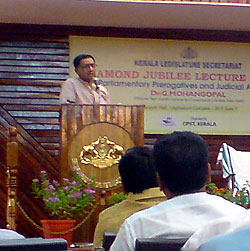
G. Mohan Gopal, Director, Rajiv Gandhi Institute for Contemporary Studies, New Delhi, delivering the lecture in Trivandrum

G.  Mohan Gopal, who delivered a lecture on “Parliamentary Prerogatives and Judicial Activism”  in connection with the Diamond Jubilee of Kerala Legislature here on June 7 said that the judiciary was not according sufficient protection to legislators from arrest and denial of opportunity to represent their constituency in the legislature.  What Dr. Gopal is saying is that people like DMK leaders Kanimozhi or A. Raja should have been allowed to attend Parliament while in judicial custody or should have been released from jail.

It is notable that the courts did not grant bail to the accused for fear that they would interfere with the investigation and influence witnesses.  Suppose that R. Balakrishna Pillai who was condemned to undergo one year’s imprisonment was a member of the Assembly. What would be the justification for sending him out of jail to attend an Assembly session?  We know that it is difficult to successfully prosecute a politician in India and even if he is sentenced, it has been found to be difficult to keep him in prison.

Dr.Gopal’s argument is that legislators represent the people and their voice should be heard in the legislature. Well, people elect politicians despite their knowing about their criminal background. Doesn’t that mean that they want criminals to represent them? If we accept that argument, it would undermine basic tenets of rule of law.

Then, why do people elect criminals? Dr. Gopal said that legislatures and judiciary exercising power to punish for contempt was a result of feudal and colonial mindset.  In India, many are still to imbibe the concept that all are equal below the law.  The caste system, which prescribed differential punishment for the same crime depending on caste and the principle of dynastic succession still influence Indians. That is why they countenance and make arguments in favour the like of Kanimozhi.

Even six decades after independence, we have not freed ourselves of feudal, colonial and casteist mentalities and related belief in merit of dynastic succession.

Proscribing adolescent sex by law

If I recall correctly, it was Erskin May who had said something like that no law could be enforced that the majority is unwilling to obey.

To some extent, the Protection of Children from Sexual Offences Bill 2011, passed by the Indian Parliament, falls into this category. The Bill seeks to make even consensual sexual contact with a girl under 18 a criminal offence. This law is proposed to be enforced when 30 per cent of the girls in India aged between 15 and 19 are married off. According to a report of a survey conducted by UNICEF between 2000-2010, 22 to 24 per cent of women in India became mothers before attaining adulthood. About eight per cent of the adolescents had sex before the age of 15.

The law is proposing to proscribe all this. How effectively this can be done is a moot question. However, the more serious implication of the law is that it seeks to make sex between consenting adolescents a crime. Young boys could be hauled up for having a consensual sex with their girl friends. This can often turn into police officials terrorizing boys dating or even talking to a girl, given the nature of law enforcement authorities in the country. The girl too could be under risk under such situations.  It could also lead to corruption rather than protection of girls, as the punishment could be jail for three years or more. Even eve teasing that could be termed as sexual harassment and would attract up to three years of jail.

The Bill seeks to make sexual offences against girls by those in authority an aggravated crime attracting longer terms of imprisonment. This is a welcome measure. The law should also discriminate between those committing organised crimes against girls or men aged above 21 exploiting girls and consensual teen age or adolescent sex. Actions resulting from the love or even lust by adolescents should not be penalised. What are needed here is guidance and sex education and not a law proscribing sex.

Details of the Bill


After the master stroke, super strike

If Opposition Leader Achuthanandan’s statement was a master stroke, CPI (M) Idukki district secretary M. M. Mani’s speech was a super strike.

M. M. Mani

M. M. Mani

Mr. Mani surely knew that it would recoil on his party. However, firing at the target was more important.  However, the media attention did not turn much attention towards Achuthanandan who was the party State secretary when the political murders mentioned by Mani took place.

The media is yet to ask questions whether Mr. Achuthanandan was aware of the murders in Idukki district. If he knew nothing about the list that Mr. Mani said the party had drawn up, what did he do when the serial killings were reported one after another?

The damage done to the party by Mani’s speech prompted party State secretary Pinarai Vijayan to call upon leaders to desist from making public statements against party policy,  in a bid to restore the truce that did not hold. What is notable is that both Mr. Vijayan and Achuthanandan are now criticising Mani in unison.

For further reading:

CPI (M) Idukki secretary stirs up a hornets’ nest
CPI (M) distances itself from Mani’s comment on eliminating political rivals
Pinarayi’s criticism of Mani not sincere: Chandy

We have killed enemies, CPI (M) not scare to own them up…
The bloody past of CPM in Idukki Spice Belt

Update (3-6-2012): V. S. Achuthananan has effectively neutralised Mani by visiting the home of slain leader T. P. Chandrasekharan. He has thus identified with the victims. Nobody is asking whether he knew of the serial killings by party men in Idukki district in the eighties.

Petrol, automobiles and the rich

A lot of noise is generated in Kerala every time the petrol and diesel prices go up. However, does most of the Malayalees care about the price rise except for the political rhetoric generated over that?

The only section that cares is the ordinary office goes who don’t get a vehicle allowance. However, even for the government employee, today’s price hike came with an announcement of seven per cent dearness allowance with retrospective effect from January.

The worst affected is those living below the poverty line. However they don’t often realise the impact of petrol prices when announced. They feel it in the form of bus fare hikes later, and all round increase in prices which they may fail to connect to the fuel costs.

car show room

An automobile showroom in Malappuram district

For the neo-rich, it does not matter. There is enough money in their hands to burn off petrol and diesel whatever be the costs. One sees a few drivers in posh vehicles parked on the Secretariat lawns every day burning away diesel to run the air-conditioners while their bosses or relatives visit ministers and officials at the Secretariat.  (Those in the Secretariat do not care though it pollutes the area.)

For many, money is pouring in from Gulf countries. The value of rupee has plummeted, and that means increased incomes for those at home. So, who care about the petrol price hikes? The Malappuram district, which was one of the most backward districts in the State, now sports large vehicle show rooms and shopping centres.  The largest show rooms of car dealers could now be seen along the highway between Angadippuram and Malappuram.  The Muslim League Ministers have seen to it that the road network improved.

However, the road network across the State is far from sufficient for increasing number of passenger car units. One sees large vehicles transporting cars blocking the highways and the problem is going to increase with increasing container traffic from Vallarpadam and Vizhinjam port (when realized).

Proposals for expressway and widening of major highways are in limbo. Other works like the Kerala Road Development Project are in limbo. So, also are the proposals to improve the public transport system, especially the rail network including metros and mono rails.

Kerala will be burning away more petrol in the coming years as the traffic slows down along all major roads and highways.  The government does see the problem, but is failing to act. Well, in Pathanamthitta, they want an airport.

Related:

And again the Petrol Price Hike!!!


Regenerated Attappady: boon to Tamil Nadu

After initial hiccups and extension of project implementation periods, the Attapady Wasteland Comprehensive Environmental Conservation Project has achieved many of its objectives. Trees are now growing on the hills, rendered barren in the past, and rivers are flowing even in summer.

Much of the Attappady hills, once covered with evergreen forests, had become wastelands owing to encroachments, unwise agricultural practices and consequent soil erosion, cattle grazing and felling of trees. The project was started in 1995 with funding from the Japan Bank for International Corporation (now JICA) received in 1996, but field work took off only in 2000. The project was targeted to be completed in 2005. However, the situation was not rosy as an extension of project was considered. There has been misuse of funds and corruption and targets were far from achieved.

However, project implementation improved from 2005 and a peak performance in expenditure was achieved by 2010. Then continuation of the project became an issue and further extensions were granted. Another extension with new projects under the implementing agency Attappady Hill Area Development Society is under consideration.  It is pointed out that about 5000 hectares more remained to be developed and the trees planted need to be protected from fire and plunder.Attapady hill planted with trees

Attapady hill planted with trees. The area was barren before planting

A decade is hardly the time for forests to grow back. Patches of barren fields could still be seen amidst the planted trees. (Planting was done in government owned forest land as well as in private lands as conservation measure). Resumption of grazing and felling of trees for fire wood can reverse the trend. However, protection will ensure further regeneration without fresh planting and other project operations.

The fact that restoration is far from complete can be gauged by looking at both banks of Bhavani River. The River, which originates in Silent Valley National Park of Kerala, flows through Attapady for about 25 km and then through the Kerala-Tamil Nadu border for about seven km. If you look across the River into Tamil Nadu side (see photo below), you can see the riparian forest trees growing there whereas the bank on the Kerala side is almost barren. Compare this with the restored hill on the Kerala side close to the River in the photo above.Kerala TN border marked by Bhavani River

Bhavani River Seperating Kerala and Tamil Nadu territory

The re-forestation of Attapady hills would reduce threat of degradation to the buffer areas of the Silent Valley National Park. It would also benefit Tamil Nadu as it increases the flow through the Bhavani River which courses through Coimbatore and Erode districts of Tamil Nadu after leaving Kerala. It is a boon to Tamil Nadu as was the declaration of the Kurinjimala Wildlife Sanctuary in Idukki district. (Covering about the same area of Periyar lease (for Mullaperiyar dam), the shola grasslands of the Sanctuary is capable of retaining about the same quantity of water as could be stored in the Mullaperiyar reservoir and release them gradually throughout the year. Thus Kerala gifted a second Mullaperiyar to TN by conserving water.)

Master stroke by Achuthanandan

V. S. Achuthanandan has delivered a political master stroke by proposing to step down as Opposition Leader and demanding discussion in the CP I (M) about issues surrounding the murder of the RMP leader T. P. Chandrasekharan in the party. It demonstrates that he is a master political strategist.

V. S. Achuthanandan

V. S. Achuthanandan

His action pre-empts likely move by the official faction in the State unit of the party to remove him from the position of the Opposition Leader over his statements in the Chandrasekharan issue. He has also foreseen that his position would be weakened by the government decision to commence vigilance probe against his son.

Mr. Achuthanandan has also seized the initiative by seeking discussions on the Chandrasekharan issue in the State and Central committees in his letter reportedly sent to the party secretary Prakash Karat as well as polit bureau member Sitaram Yachuri. He has stated his position clearly and has also said that he was not being consulted on important party matters.  Now, discussions about his indiscipline in the party could not take precedence over organizational issues he has raised.

He has also demanded the reorganization of the State Committee. Though he would not be able to carry that through, the opposite camp would find it almost impossible to dislodge him from the Central committee.

Virtual truce in Kerala unit of the CPI (M)

There would be a virtual truce in the State unit of the party until after the Neyyattinkara by-poll in June. This is partly the outcome of the talks the RSP leader T. J. Chandrachoodan had with the Opposition Leader V. S. Achuthanandan whom he met after informing the CPI (M) leadership on May 14. Both party State secretary Pinarai Vijayan and Mr. Achuthanandan would not make statements that would intensify the faction fight between them.

Pinarai Vijayan

Pinarai Vijayan

Mr. Achuthanandan reportedly declined to make amends to his stated stand on the murder of the Revolutionary Marxist Party leader T. P. Chandrasekharan during talks with Mr. Chandrachoodan.  This would help him to keep the rebellious cadre opposed to the official faction in Neyyattinkara with him until after the elections.  He has already written to the party’s Central leadership that his statements were in tune with the party’s policy of bringing back lost cadre, and the Central leadership would  keep mum until after the elections.

After the elections, the CPI (M) may go through the motions of taking action against Mr. Achuthanandan whose conduct amounts to gross indiscipline according to the precepts of the party.  And Mr. Achuthanandan may, as in the past, go through the act of submission to the party.

Update: (16/5/2012)

The truce was technically broken with the State Secretariat issuing a statement on Tuesday describing Onchiyam dissidents as psuedo revolutionaries gripped by parliamentary greed and noted for their absence of communist values. The statement almost coincided with Polit bureau member Sitaram Yechuri’s averment in Delhi that the party had directed the State leadership to make any more controversial statements.