Governor redeems

Finance Minsiter K. M. Mani

Kerala Finance Minister K. M. Mani presenting the Budget for 2015-16 in the Assembly on March 13, 2015 amidst vandalism by Opposition

Kerala Governor P. Sadasivam has at least nominally redeemed the prestige of Kerala legislature by warning legislators about their conduct.

A former Chief Justice of Supreme Court of India, Sadasivam will not have failed to notice the obvious break down of not only Constitutional norms but also gross violation of democratic principles by the Opposition. There is no place for vandalism in legislative bodies in a democracy. However, reaction from opinion leaders was generally muted while the ordinary people on the social media could do nothing more than lampooning the politicians.

The Governor’s remark that the happenings on the floor of the Assembly on Friday (March 13, 2015) may even justify submission of a report by the Governor to the President under Article 356 of the Constitution of India is a rebuke to both the ruling and Opposition fronts. What the Governor hints is the vandalism of the kind in the House amounts to Constitutional break down warranting dissolution of the Assembly.

The Speaker N. Sakthan could not maintain even a semblance of order in the Assembly because of his reluctance of use force. Normal practice in the House is to use the watch and ward to cordon the podium of the Speaker as soon as the Opposition starts disruption of proceedings. On Friday, the Opposition had started their protest even before the House was called into session. Speaker probably hesitated because he was new to the Chair and did not want to start with a direct confrontation with the Opposition and become a direct target of the Opposition in the coming days.

The Opposition leaders had gone to the Governor saying that the presentation of the Budget was not in order, after creating all the disorder. The Governor has indirectly rebuffed them by accepting the Speaker’s stand that the Budget was duly presented. The Speaker could not be seen as conducting the business of the House during the bedlam created by the Opposition who had also practically gheraoed the Speaker and thrown his chair off the podium in gross disregard to the prestige of the House and its privileges. (The procedures adopted in the House for presentation of the Budget could be irregular but could not be challenged in a court of law. The House is the final arbiter of its own procedures).

The Governor, who himself is part of the Assembly as head of the State, has hinted that the further proceedings on the Budget including passing of the demands for grants on account and Appropriation Bill should be done in an orderly fashion. He may not condone total absence of order and decorum.


Moving NGT on Mullaperiyar can boomerang on Kerala

Kerala’s move to approach the National Green Tribunal against raising of the water level in Mullaperiyar dam is likely to boomerang on Kerala.

Environmental arguments similar to those against raising of reservoir level can be raised against lowering the reservoir level also.

In fact, changes to the ecosystem created by the dam and its water will be more pronounced while lowering the water level.

Kerala’s argument is that the raising of water level in the reservoir submerged nearly four decades old vegetation just above 136 feet level in Periyar Tiger Reserve. Lush vegetation including some specialised species have grown in the local environment created by lowering of the water level.

Now, let us look at what will happen if water level is reduced to 132 feet as demanded by Kerala at one point of time, or eventual phased decommissioning of dam. Lowering of the water level will result in the water table going down in many parts of Periyar Tiger Reserve. This would cause a relative drought conditions in many parts of the Sanctuary compared to the present situation and will loss of biodiversity and density of vegetation. The specialised species will not survive in its original location.

Legal position:
Environmental impact argument is something rejected by the Supreme Court in its 2006 verdict itself. However, Kerala tried to raise it again when Tamil Nadu challenged Kerala’s dam safety legislation before Supreme Court. For doing this, it commissioned a scientist from West Bengal, who produced a study report within a matter of weeks. The report had several errors and it was essentially a reproduction of arguments made by KFRI over which Kerala had argued its case earlier. Though these mistakes had been pointed out, Kerala went ahead with producing the author as a witness before the Court. During cross-examination, he admitted he had copied from the KFRI report. This meant that Kerala had no new argument or point to be presented before the Court. Now, Kerala is trying to revive its lost cause by approaching NGT.  It is not even considering the fact that Supreme Court is above NGT.

In any case it will be a win-win situation for TN. If the NGT rejects Kerala’s prayer, TN will have another handle. If it upholds Kerala’s argument, TN can use it in future against lowering of the water level or decommissioning of the dam.

Kerala’s argument goes against what the State itself is proposing to do. The new dam it is proposing to build at Mullaperiyar will submerge some areas of Periyar Tiger Reserve. It is also seeking Central clearance for raising the height of Peppera dam near Thiruvananthapuram by at least three metres submerging about 80 acres of forest. Though the area submerged by increased water level in Mullaperiyar dam is larger than these, the forests that would be submerged by the new Mullaperiyar dam or augmentation of Peppara dam are part of ecosystems that are hundreds of years old. Obviously, much more value is to be attached to the latter.

Moreover, Kerala has done the same thing that TN is doing. Water level at Idukki reservoir had remained low for about three decades. Kerala carried out augmentation scheme under Idukki project to improve inflow. None batted an eyelid, when vegetation that grew over the period was submerged by increasing water level. Besides, the area being submerged at Mullaperiyar was leased to TN much before the enactment of environmental laws.

If we really care for environment (instead just using environmental arguments with the wrong belief that it will win a case in which the key issue is safety), we should demand environmental flows downstream of Mullaperiyar dam, abandon the proposal for new dam and seek phased decommissioning of the old dam.

Silver Jubilee of Save Kurinji Campaign

kurinji 2014 bloom-in-meadow

Kurinji in bloom on hill slopes near Munnar in 2014

Tholkapiar sang centuries ago about neelakurinji plants that blossoms like a carpet over the mountain peaks once in 12 years. Today, that plant is part of a threatened ecosystem—the shola grasslands.

In September 1989, a group of nearly 40 men and women set out from Kodaikanal on foot to have a look at the plant and campaign against its destruction. They included members of the Palani Hills Conservation Council, Kodaikanal; Asambu Greens, Trivandrum; and a host of nature lovers and activists. The march led to the formation of the Save Kurinji Campaign Council soon after. This year marks the 25th anniversary of the march. The participants of the march will be gathering again in Kodaikanal on October 2 to commemorate the jubilee. There will also be a meeting in Munnar on October 4.

About Neelakurinji

Neelakurinji (Strobilanthes kunthiana) is a shrub that used to grow abundantly in the shola grasslands of Western Ghats in India. It flowers gregariously once in 12 years. However, on different locations, the flowering may take place in different years. Thus, kurinji has flowered in some areas of Munnar and Kodaikanal from July this year. However, it will flower in places like Rajamalai and other parts of Eravikulam National Park only in 2018. (The last flowering there was in 2006).

Once, kurinji used to cover the entire Nilgiris like a carpet during its flowering season. However, now plantations and dwellings occupy much of their habitat. Destruction of shola forests have also reduced its presence in Munnar and neighbouring areas.

Save Kurinji Campaign

The campaign had actually started in the eighties after K. V. Surendranath (then  Member of Kerala Assembly), Dr. Velayudhan Nair, Suresh Elamon, G. Rajkumar and P. K. Uthaman had a rare glimpse of gregarious flowering of kurinji in shola grasslands between Kodaikanal and Munnar, most of which were soon after converted into pine plantations. The campaign was also prompted by destruction of the habitat by fire and encroachments.

After the 1989 march, the campaign continued through the past 25 years. Several marches, exhibitions, talks and programmes were organised. One of the prominent marches was one that was held in 1990 when kurinji was in full bloom at the same locations as they are now. There was also a major march in 2006 and programmes in connection with the formation of Kurinjimala Sanctuary.

The campaign had contributed significantly in crystallising the idea of a sanctuary to protect the kurinji habitat and release of a commemorative stamp on kurinji in 2006. The blooming of neelakurinji and the need to protect its habitat got media attention thanks to the campaign. During 1990 and 2006, thousands of people flocked to Munnar to see the kurinji bloom and a kurinji fest was organised by the Government at Munnar in 2006.

Kurinjimala Sanctuary:

The Kerala Government notified part of the habitat of kurinji (shola forests) as the Kurinjimala Sanctuary in 2006. It comprises of 32 square kilometres in the Kottakamboor and Vattavada villages in Idukki district of Kerala. The declaration of the sanctuary was made by then Minister for Forests Benoy Viswam at the Neelakurinji Fest at Munnar on October 7, 2006.

The sanctuary is contiguous to the Chinnar Wildlife Sanctuary and Anamudi and Pampadum Shola National Parks.

The Government notification said that the sanctuary would ensure the long-term protection of the entire biodiversity of the area, especially Strobilanthes kunthiana and its habitat. Private land holdings having titles in the villages are excluded from the sanctuary area.

Related:

You may also want to read my original report http://kurinji.in/march.html on which this post is partly based.

Mullaperiyar studies are public documents

The Kerala State Information Commission has ordered Kerala Irrigation Department to release study reports and documents, submitted by it before the Supreme Court in the Mullaperiyar case filed by Tamil Nadu, under Right to Information Act. (See earlier post here)

The Department had refused to provide reports including the Dam Break Analysis on the ground that they were documents of “Strategic interests of the State” which were not required to be released under the RTI Act. The Commission did not uphold this contention and points raised by the Department in very detailed 70-page affidavit.

The complaint against the Department’s stand was made to the Commission as back as  in March 2012. The hearing was taken up only by the middle of 2013 and was completed by September 2013. However, the Commission took nearly six months to issue the order.

RTI

Order of State Information Commission

Earlier posts:

Mullaperiyar: behind the veil
Mullaperiyar dam break analysis: area of submergence
Mullaperiyar: strategic failure of Kerala government
K. T. Thomas and Mullaperiyar
Mullaperiyar: Directive against disclosure of dam break analysis
Mullaperiyar and Kerala’s technical studies
Conclusions of empowered committee of SC in Mullaperiyar case

Befooling endosulfan victims:

endosulfan

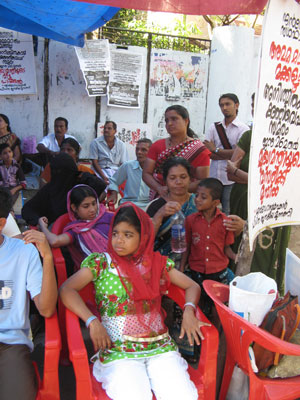
Endosulfan victims staging a sit-in in front of the official residence of Chief Minister Ommen Chandy in Trivandrum in January 2014

It is more than three years now after the National Human Rights Commission gave its recommendations on compensating the victims of pesticide endosulfan in Kasaragod district in Kerala.

The State government led by Oommen Chandy rules with the motto of acting fast to achieve more in less time. However, even three years after the Commission gave its directive; the State is yet compensate all the victims and carry out the four recommendations given by it. The Central government is also to carry out another set of recommendations such as nation-wide survey of populations that have been affected by the use of endosulfan and supplementary efforts to support relief and remediation efforts of State government including establishment of a Palliative Care Centre.

endosulfan

Another view of endosulfan victims staging a sit-in in front of the official residence of Kerala Chief Minister Ommen Chandy in Trivandrum in January 2014.

The delay in implementing the recommendations by the State government belies its claim that it is a fast-acting government. In fact, several of the packages announced by the State and Central governments are in limbo including that for the endsosulfan victims. (The first of these was for the evictees of Moolampally for Vallarpadam project.).  It even appointed a committee, headed by retired judge C. N. Ramachandran Nair, to befool the victims and delay implementation of the recommendations.

This has forced the endosulfan victims to stage a protest sit-in in front of the Chief Minister’s residence. The agitation has since been settled though decision is pending on demands like rejection of the Ramachandran Nair committee report. However, doubts linger whether the government would only make a half-hearted attempt to carry out its promises just to tide over the forthcoming Lok Sabha elections, whereas concerned, planned action is called for in Kasaragod.


Oommen Chandy’s last trial

Chief Minister

Chief Minister Oommen Chandy with Industries Minister P. K. Kunhalikutty, Vice Chairman of State Planning Board K. M. Chandrasekhar and some members of his personal staff. Joppan, accused in the solar scam is just behind Mr. Chandy

Kerala Chief Minister Oommen Chandy has been called to Delhi for discussions. This will be his last trial as far as his continuation in office is concerned.

Mr. Chandy has tided over the solar scam which threatened to unseat him. Though at a cost, he has practically defeated the Opposition, silenced his opponent group in the party for the time being and brought peace with government Chief Whip P. C. George, who is vice president of the third major party in the ruling front; besides making the media that campaigned against him look ridiculous.

However, his victory could still be unconvincing for the Congress high command. The question that would worry the high command is whether Mr. Chandy could lead the ruling Front in the State to victory in the coming Lok Sabha polls. Congress party’s leverage in the scenario after election would be determined by seats won in the South.  And the message the party is getting from some Congress and other Front leaders in the State is not very positive.

It is notable that both Prime Minister Manmohan Singh’s office as well as Mr. Chandy’s Office has come under allegations. Mr. Singh is facing bigger charges than Mr. Chandy. So, the Congress high command will hesitate to ask Mr. Chandy to step down. Yet, it is notable that Mr. Singh has already expressed willingness to step aside. Will Mr. Chandy also be persuaded to step aside as he names the judge for judicial enquiry into the scam in a few weeks time? It will depend on how far Mr. Chandy could convince the high command that he could lead the party to win substantial number of Lok Sabha seats from the State.

Mainstreaming tribals

Attappady-- a view  Photo: Roy MathewChief Minister Oommen Chandy proposes to bring Attappady tribals to main stream as the government has failed to address their problems after six decades of ‘tribal development’.

Well, his plans are for the next generation. Children from the tribal hamlets are to be educated in special model residential schools and all eligible students given admissions to the Plus One and undergraduate courses.

This is a course of action that had been tried in countries such as USA, Canada and Australia which have invited protests. However, such protests over uprooting the tribals from their culture are muted in Kerala. Many anthropologists hold opinion against weaning tribal children away from their culture and mainstreaming them. But the questions whether they should be allowed to live primitive lives or proselytised to adopt modern lifestyle is an enduring question.

As to the immediate problem of malnutrition among tribals, the government has come up with an answer—community kitchens. Mr. Chandy’s view is that the tribals do not eat well. Many are so lazy that they are willing to cook. It is not clear whether the tribals would come regularly to the community kitchens to eat. Even if they do, that could make them lazier as far as cooking goes. Better, if community kitchens teach them how to cook and encourage them to do their own cooking.

Tribal Women at Agali, Attappady

Tribal Women at Agali, Attappady

But the real problem in Attappady is not that the tribals have not learned to cook or made eating cooked food a habit.  The real issue is alienation of their land, destruction of forests and restrictions on their access to forest resources including food materials. However, the Chief Minister refuse to acknowledge this and take strong measures to resume their lands despite court verdicts. Even problems like drunkardness stemmed from land issues. Alcoholism spread as a result of exploitative tactics of the settlers in Attappady.

Studies have reported that the deaths of infants in Attappady were not the result of alcoholism among their mothers. It happened because of malnutrition. The government wants now wants all tribal women to give birth at hospital to ensure the nutritional status of mothers and children. For this, vehicles are to be provided. On one hand, this is better said than done. Many tribals had failed to get timely medical attention not because of lack of schemes or vehicles but because the officials concerned did not care. On the other side, it is notable that Kerala is emphasising on hospital based deliveries when the West that promoted it is now going back to midwives and deliveries at home.

Chandy, the master stragegist

Cantonment Gate

Cantonment Gate of the Secretariat on the day of the picketing by Opposition

Kerala Chief Minister Oommen Chandy is master strategist. First, he diverted media attention from the solar panel scam by launching a second run of the Cabinet reshuffle talks. KPCC president Ramesh Chennithala was forced to play along (see previous posting) though he had decided earlier to remain as KPCC chief.

Then, he turned the mode of agitation of the Opposition (siege of the Secretariat or simply picketing) into an issue when the real issue was whether the administration had manipulated the complaint of Saritha S. Nair, one of the accused in the solar scam. Keeping the Cantonment Gate of the Secretariat open suddenly became the issue. The media concluded that a great battle of the gates was in the offing. Inexperienced television reporters probably believed this while the shrewdest ones realised that this is an opportunity to push up ratings. The Opposition played along and may have probably claimed its flesh behind the scenes.

However, experienced reporters knew that the left parties always claimed that they would picket all the gates of the Secretariat. And invariably, the government always managed to keep the Cantonment Gate open for the entry and exit of Ministers and Secretariat staff. Nowadays, the visual media sets the agenda even for the print. Not to fall behind, Malayalam newspapers cried ‘War!’ while English newspapers decided that ‘siege’ was the appropriate word for what was going to happen.

However, on the day of the siege, it turned out to be a tame affair. There was no confrontation between the police and the LDF workers as anticipated. Both sides embraced peace and soon achieved a truce. Even 67 per cent of the Secretariat staff could get into the Secretariat.

Secretariat-siege

LDF workers before the Secretariat on August 12. A television channel even had a studio set up on the top of the building in the middle.

Mr. Chandy then declared two days holiday for the Secretariat on the specious ground that this was to facilitate rehearsal for the Independence Day Parade at Central Stadium behind the Secretariat. The Opposition was not letting in children to practice. The Opposition could claim that they had managed to force closure of the Secretariat; but what was the fun in squatting before an empty Secretariat! And the prospect of continuing the picketing braving the sun and rain for the whole week was not encouraging.

Mr. Chandy then announced that the government was deciding to order a judicial probe, something he was promising all the while after the police completed their investigations. The Opposition seized the opportunity and called off the stir. The BJP alleged that it had a secret pact with government to soft-pedal the Lavlin case against CPI (M) State secretary Pinarai Vijayan and investigation of the murder of T. P. Chandrasekharan who is alleged to have been killed by CPI (M) workers.

Even if this is true, Mr. Chandy is still the winner. His position is secure for the time being. He cannot be successfully challenged now unless some hard evidence crops up against him in the solar scam.


Ramesh to wait in the wings

It should not come as a surprise to close observers of politics in Kerala that KPCC President Ramesh Chennithala has declined to join the Oommen Chandy government.

Mr. Chennithala knows well that he is to gain little by joining the ministry as this juncture either as deputy chief minister or home minister.

Ramesh Chennithala

Ramesh Chennithala

Deputy Chief Minister would mean little for Mr. Chennithala as it is very difficult to grow as a power centre in government when Mr. Chandy is in government. Mr. Chandy has more grass-root support than Mr. Chennithala and is a better political strategist than Mr. Chennithala. Home Ministership would only be a bed of thorns when the government is facing a series of accusations.

The government’s stock is likely to come down in the coming days and Mr. Chennithala too would have to go down with it if he joins the ministry. On the other hand, there is a real possibility that Mr. Chandy would be forced to step down after the Lok Sabha polls. Then Mr. Chennithala would face not much challenge in getting into the Chief Minister’s chair. (Mr. K. M. Mani has also tossed his hat in the ring. However, Sonia Gandhi is understood to have rejected his claim. That explains recent critical statements by Mr. Mani).

He stands to lose nothing by continuing till then as KPCC president. If the Chief Ministership does not come his way after the elections, he still can look for a minister ship at the Centre if Congress is returned to power.

Actually, the positions regarding Cabinet reshuffle had been taken much earlier by Mr. Chennithala and others. The issue was raked up again to divert attention from solar panel scam. As on the earlier occasion, none could agree on each other’s claims and demands. By Wednesday, Mr. Chandy had stated that there would be no major revamp. Today, all the parties are back to their positions stated earlier.


Agriculture development policies to befool farmers

Agriculture policy-- publicity photo

Publicity material showing submission of the draft agriculture development policy to Kerala Chief Minister Oommen Chandy on July 11, 2013.

The draft Agriculture Development Policy of Kerala, drawn by a drafting committee chaired by K. Krishnankutty, tries to befool the farmers at least in respect of the highlighted policy initiatives.

The flagship proposals are what is called Actio apportum (translated into Malayalam as Avakasa Labhom) cess, to be routed to small and marginal farmers of paddy, and incentive to farm workers. This is described as a legal demand of right for sharing revenue or profit generated out of farm produce when it is traded.

However, this is nothing but a less-than-5 per cent subsidy for paddy production, totalling to about Rs. 400 crores annually. This amount could very well have been provided as a direct subsidy from government after collecting one per cent value added tax on rice. Still better, it should have been funded from revenues gathered elsewhere.

The policy, on the other hand, proposes collection of Re. 1 a kg as cess at the end point of sale of rice and payment to the farmers through Agriculture Department. The traders/millers would pass on this cess to the consumers or the farmers themselves by reducing the procurement price of paddy. So, this Actio apportum could just be a mirage.

The real right of the farmer is to get remunerative prices in the market place or through procurement by government. The policy has only usual bureaucratic proposals like “Price Fixation Authority” and minimum support price to address that. The experience so far is that procurement has not actually worked well because funding procurement has not been a priority for government.

The cess proposal would only serve to increase the size of bureaucracy especially in the Agriculture Department. There would have to be separate accounting and even a vigilance mechanism to detect evasion. A portion of what is collected as cess will vanish this way. The proposal also has a flaw in that the benefit is proposed to be limited to small and marginal farmers. Paddy production is to be sustained and it is not always the marginal farmer who can achieve that. So, all paddy cultivators would have to be provided with subsidies.

It also leads to a dichotomy in policy. The government had been lifting tax on rice in past budgets with the avowed objective of helping the poor. Now, it is thinking of a cess instead. Tax on branded rice, which is not consumed by the poor, would have been the best option to raise funds for subsidy.

Cover design of the draft policy

Cover-page design of the draft policy document on agriculture development, Kerala.

The incentive proposed for agriculture workers is Rs. 6 a day. For an agriculture worker earning around Rs. 600 a day, this is a pittance. The Agriculture Department will have to maintain accounts and keep tab on the status of the worker and days of work done by him to make the payments. This is when the Department’s job is increasingly becoming disbursement of incentives and subsidies instead of providing extension services.

The real objective of the Latinisms and rhetoric about farmers’ rights is votes in the forthcoming elections. The politicians can claim that the present government has, for the first time, recognised the right of the farmers (called Actio apportum ) for a share in the profits of middlemen who are buying rice for Rs. 22 a kg and selling at exorbitant rates (up to Rs. 90 a kg.)!

Publicity material about the policy speaks of improving the status of farmers. However, actually the policy equates farmers to Class IV employees of government by proposing income guarantee “to the tune of that received by a Class Four Employees in State service”!

The policy proposes that farm lands should be reserved for agriculture, banning sale or use for no-agricultural purposes. Such a restrictive land use policy could be detrimental to the development of the State. Kerala could not remain an agrarian State for long (as the examples of developed societies show). So, some agriculture land would have to be used for industrial and infrastructure development. Anything that prevents establishment of agro-industries and production of value added products at the farm level would even be harmful.

So, implementation of this policy would have to fine-tuned, keeping overall development of the State in view. What actually is required is measures to check land being purchased and sold for short-term profit. Leaving land fallow should be discouraged by imposing higher tax on uncultivated land. Such a policy could be imposed by offering the low tax rates only for land certified to have a certain level of crop density.

Another proposal is to provide yield and sex assured animals to livestock farmers. Genomic section programmes are to be used to produce sexed semen that will ensure that only female of the species is born. It ought to be examined whether this would impact diversity which is crucial to prevent mass casualties from unanticipated diseases.