Befooling endosulfan victims:

endosulfan

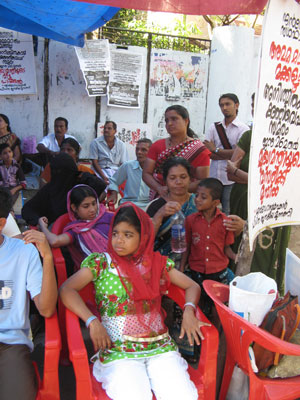
Endosulfan victims staging a sit-in in front of the official residence of Chief Minister Ommen Chandy in Trivandrum in January 2014

It is more than three years now after the National Human Rights Commission gave its recommendations on compensating the victims of pesticide endosulfan in Kasaragod district in Kerala.

The State government led by Oommen Chandy rules with the motto of acting fast to achieve more in less time. However, even three years after the Commission gave its directive; the State is yet compensate all the victims and carry out the four recommendations given by it. The Central government is also to carry out another set of recommendations such as nation-wide survey of populations that have been affected by the use of endosulfan and supplementary efforts to support relief and remediation efforts of State government including establishment of a Palliative Care Centre.

endosulfan

Another view of endosulfan victims staging a sit-in in front of the official residence of Kerala Chief Minister Ommen Chandy in Trivandrum in January 2014.

The delay in implementing the recommendations by the State government belies its claim that it is a fast-acting government. In fact, several of the packages announced by the State and Central governments are in limbo including that for the endsosulfan victims. (The first of these was for the evictees of Moolampally for Vallarpadam project.).  It even appointed a committee, headed by retired judge C. N. Ramachandran Nair, to befool the victims and delay implementation of the recommendations.

This has forced the endosulfan victims to stage a protest sit-in in front of the Chief Minister’s residence. The agitation has since been settled though decision is pending on demands like rejection of the Ramachandran Nair committee report. However, doubts linger whether the government would only make a half-hearted attempt to carry out its promises just to tide over the forthcoming Lok Sabha elections, whereas concerned, planned action is called for in Kasaragod.


Oommen Chandy’s last trial

Chief Minister

Chief Minister Oommen Chandy with Industries Minister P. K. Kunhalikutty, Vice Chairman of State Planning Board K. M. Chandrasekhar and some members of his personal staff. Joppan, accused in the solar scam is just behind Mr. Chandy

Kerala Chief Minister Oommen Chandy has been called to Delhi for discussions. This will be his last trial as far as his continuation in office is concerned.

Mr. Chandy has tided over the solar scam which threatened to unseat him. Though at a cost, he has practically defeated the Opposition, silenced his opponent group in the party for the time being and brought peace with government Chief Whip P. C. George, who is vice president of the third major party in the ruling front; besides making the media that campaigned against him look ridiculous.

However, his victory could still be unconvincing for the Congress high command. The question that would worry the high command is whether Mr. Chandy could lead the ruling Front in the State to victory in the coming Lok Sabha polls. Congress party’s leverage in the scenario after election would be determined by seats won in the South.  And the message the party is getting from some Congress and other Front leaders in the State is not very positive.

It is notable that both Prime Minister Manmohan Singh’s office as well as Mr. Chandy’s Office has come under allegations. Mr. Singh is facing bigger charges than Mr. Chandy. So, the Congress high command will hesitate to ask Mr. Chandy to step down. Yet, it is notable that Mr. Singh has already expressed willingness to step aside. Will Mr. Chandy also be persuaded to step aside as he names the judge for judicial enquiry into the scam in a few weeks time? It will depend on how far Mr. Chandy could convince the high command that he could lead the party to win substantial number of Lok Sabha seats from the State.

Ramesh to wait in the wings

It should not come as a surprise to close observers of politics in Kerala that KPCC President Ramesh Chennithala has declined to join the Oommen Chandy government.

Mr. Chennithala knows well that he is to gain little by joining the ministry as this juncture either as deputy chief minister or home minister.

Ramesh Chennithala

Ramesh Chennithala

Deputy Chief Minister would mean little for Mr. Chennithala as it is very difficult to grow as a power centre in government when Mr. Chandy is in government. Mr. Chandy has more grass-root support than Mr. Chennithala and is a better political strategist than Mr. Chennithala. Home Ministership would only be a bed of thorns when the government is facing a series of accusations.

The government’s stock is likely to come down in the coming days and Mr. Chennithala too would have to go down with it if he joins the ministry. On the other hand, there is a real possibility that Mr. Chandy would be forced to step down after the Lok Sabha polls. Then Mr. Chennithala would face not much challenge in getting into the Chief Minister’s chair. (Mr. K. M. Mani has also tossed his hat in the ring. However, Sonia Gandhi is understood to have rejected his claim. That explains recent critical statements by Mr. Mani).

He stands to lose nothing by continuing till then as KPCC president. If the Chief Ministership does not come his way after the elections, he still can look for a minister ship at the Centre if Congress is returned to power.

Actually, the positions regarding Cabinet reshuffle had been taken much earlier by Mr. Chennithala and others. The issue was raked up again to divert attention from solar panel scam. As on the earlier occasion, none could agree on each other’s claims and demands. By Wednesday, Mr. Chandy had stated that there would be no major revamp. Today, all the parties are back to their positions stated earlier.


Agriculture development policies to befool farmers

Agriculture policy-- publicity photo

Publicity material showing submission of the draft agriculture development policy to Kerala Chief Minister Oommen Chandy on July 11, 2013.

The draft Agriculture Development Policy of Kerala, drawn by a drafting committee chaired by K. Krishnankutty, tries to befool the farmers at least in respect of the highlighted policy initiatives.

The flagship proposals are what is called Actio apportum (translated into Malayalam as Avakasa Labhom) cess, to be routed to small and marginal farmers of paddy, and incentive to farm workers. This is described as a legal demand of right for sharing revenue or profit generated out of farm produce when it is traded.

However, this is nothing but a less-than-5 per cent subsidy for paddy production, totalling to about Rs. 400 crores annually. This amount could very well have been provided as a direct subsidy from government after collecting one per cent value added tax on rice. Still better, it should have been funded from revenues gathered elsewhere.

The policy, on the other hand, proposes collection of Re. 1 a kg as cess at the end point of sale of rice and payment to the farmers through Agriculture Department. The traders/millers would pass on this cess to the consumers or the farmers themselves by reducing the procurement price of paddy. So, this Actio apportum could just be a mirage.

The real right of the farmer is to get remunerative prices in the market place or through procurement by government. The policy has only usual bureaucratic proposals like “Price Fixation Authority” and minimum support price to address that. The experience so far is that procurement has not actually worked well because funding procurement has not been a priority for government.

The cess proposal would only serve to increase the size of bureaucracy especially in the Agriculture Department. There would have to be separate accounting and even a vigilance mechanism to detect evasion. A portion of what is collected as cess will vanish this way. The proposal also has a flaw in that the benefit is proposed to be limited to small and marginal farmers. Paddy production is to be sustained and it is not always the marginal farmer who can achieve that. So, all paddy cultivators would have to be provided with subsidies.

It also leads to a dichotomy in policy. The government had been lifting tax on rice in past budgets with the avowed objective of helping the poor. Now, it is thinking of a cess instead. Tax on branded rice, which is not consumed by the poor, would have been the best option to raise funds for subsidy.

Cover design of the draft policy

Cover-page design of the draft policy document on agriculture development, Kerala.

The incentive proposed for agriculture workers is Rs. 6 a day. For an agriculture worker earning around Rs. 600 a day, this is a pittance. The Agriculture Department will have to maintain accounts and keep tab on the status of the worker and days of work done by him to make the payments. This is when the Department’s job is increasingly becoming disbursement of incentives and subsidies instead of providing extension services.

The real objective of the Latinisms and rhetoric about farmers’ rights is votes in the forthcoming elections. The politicians can claim that the present government has, for the first time, recognised the right of the farmers (called Actio apportum ) for a share in the profits of middlemen who are buying rice for Rs. 22 a kg and selling at exorbitant rates (up to Rs. 90 a kg.)!

Publicity material about the policy speaks of improving the status of farmers. However, actually the policy equates farmers to Class IV employees of government by proposing income guarantee “to the tune of that received by a Class Four Employees in State service”!

The policy proposes that farm lands should be reserved for agriculture, banning sale or use for no-agricultural purposes. Such a restrictive land use policy could be detrimental to the development of the State. Kerala could not remain an agrarian State for long (as the examples of developed societies show). So, some agriculture land would have to be used for industrial and infrastructure development. Anything that prevents establishment of agro-industries and production of value added products at the farm level would even be harmful.

So, implementation of this policy would have to fine-tuned, keeping overall development of the State in view. What actually is required is measures to check land being purchased and sold for short-term profit. Leaving land fallow should be discouraged by imposing higher tax on uncultivated land. Such a policy could be imposed by offering the low tax rates only for land certified to have a certain level of crop density.

Another proposal is to provide yield and sex assured animals to livestock farmers. Genomic section programmes are to be used to produce sexed semen that will ensure that only female of the species is born. It ought to be examined whether this would impact diversity which is crucial to prevent mass casualties from unanticipated diseases.
Venad Express: the leaky cauldron

Leaky compartments welcomed passengers of Venad Express as monsoon set over Kerala.

The situation was such that water would flow into the compartments even you put both the shutters of windows down. Many of the shutters were in damaged condition and some would not even move.

It has been a long-standing complaint of railway passengers that coaches that needed to be condemned or repaired were put on service in Kerala. This not only caused inconvenience to passengers but also increased the chances of accidents.

However, railways is even making a move to abandon the proposed coaching terminal at Nemom for maintenance of coaches. The proposed coach factory in Palakkad is also in limbo. These would have perhaps helped to ensure that Kerala got better coaches.

Travel by Venad Express is an ordeal for even reserved passengers. Regular passengers and even season ticket holders are allowed to enter reserved coaches, practically denying seats and comfortable journey to reserved passengers. The travelling ticket examiner, who is to ensure seating for reserved passengers, would not even turn up. On Sunday (June 3), the D1 coach, which was meant for reserved passengers, was overcrowded from at Kochi onwards. However, the TTE turned up only after the train reached Thiruvalla and took no steps to prevent overcrowding. The compartment was, incidentally, overcrowded when compartments for unreserved passengers were empty at Kottayam. The coach covercarried little indication that it was reserved. The letters D1 was hardly visible. Passengers boarded the compartment as it stopped near main (crowded) areas of the platform.

Food is served in the compartments in containers made of aluminium foil. The lid is made of packaging materials printed for milk packets in Europe. This is either discarded or recycles material. Aluminium can leach into the food in minute quantities. The effects of chronic exposure to aluminium are yet to be established fully. However, the metal is known to affect the brain and is suspected to be one of the causative factors for Alzheimer’s disease.

For further reading:

http://www.whfoods.com/genpage.php?tname=newtip&dbid=8


Oommen Chandy’s fight against drought

A cardamom estate in Idukki district

A cardamom estate in Idukki district

Chief Minister Oommen Chandy has been touring the districts during the last fortnight to chart our measures to fight drought. At the same time, he ignored large scale felling of trees in Idukki district and the precarious condition of forests in Wayanad. (Mr. Chandy is now holding the Forest portfolio, following the resignation of K. B. Ganesh Kumar). This shows the dichotomy between the government’s campaigns and ground-level enforcement of stated policies.

The felling of trees in Idukki is significant in more ways than one. Forests in Idukki are crucial for availability of water both for Kerala and Tamil Nadu. The longest river of the State Periyar has much of its catchment in Idukki district. Many important power projects including Idukki is located here. Still, Mr. Chandy did virtually nothing to stem the felling of trees in the district while announcing so many other measures to check drought.  He is finding solutions without addressing at least one of the known the causes– deforestation.

It is also significant that the felling of trees had taken place against the background of Gadgil committee report. The trees felled were of two types. Forest species in cardamom estates and eucalyptus on encroached forest land. It was feared that if the Centre implements Gadgil recommendations, it might become impossible to cut and remove these trees because of restrictions. Hence, the hurry in cutting and transporting hundreds of lorry-loads of trees from the district.

The biggest protests against the Gadgil panel had originated from Idukki district. Now, it should be clear who were behind these protests. They brought time through the protests and appointment of K. Kasturirangan panel to scrutinise the Gadgil report. Now that the astrophysicist-led panel has given its verdict on Gadgil report, it is high time that the Union Ministry of Environment and Forests stepped in to implement the recommendations.

Discriminating in favour of women

Finance Minister P. Chidambara with Budget papersFinance Minister P. Chidambaram rides the wave announcing special programmes for women. However, the announcement of a public sector bank exclusively for women is an admission that existing public sector banks does not treat women equally.

That women are discriminated against by banks and that they are not getting adequate banking services is a shame. This is when one of the premier banks like the ICICI Bank is headed by a woman. The government has been able to cater to senior citizens to some extent through regulation. (They still face problems in using schemes such as reverse mortgage.) The government is apparently not able to do this for women— that is to force all banks to treat women equally.

A separate bank for women would solve the problem only notionally. If the same logic is applied to other areas, we would soon need an exclusive bank for SC and ST, minorities and backward classes.

Another scheme is ‘Nirbhaya’ for empowerment of women. The contours of this scheme are yet to be defined. We had scores of programmes in the past for empowerment of women. Like many other government scheme, they did not achieve much. What ‘Nirbhaya’ would do is to be seen.

Following the Delhi incidents, we are in the era of positive discrimination. Women returning from abroad are allowed to bring gold worth Rs. 1 lakh while men can bring only half the quantity. (For women, financially capable of travelling abroad, this is a pittance.). Well, this proposal violates equality before law and hence would be ultra vires of the Constitution.

 Budget highlights


Contributory pension scheme and its flawed logic

The contributory National Pension Scheme for government servants brings uncertainty about future pension benefits of government employees and makes government jobs less attractive.

Employees of Kerala Government began an indefinite strike today to protest against the pension scheme, though it will not affect serving employees who would continue to be eligible for statutory pensions. It will be the new recruits who would be hit by the pension scheme.

The government argues that more than 80 per cent of its revenues were now being spent on salaries and pensions. Though the pension scheme will only cause an immediate increase in government spending with a ten per cent contribution to be made to the pension fund, it will free the government from paying pensions to the new recruits two to three decades from now.

The government says that there was four-fold increase in pension liabilities over the last decade. However, this is in proportion to decadal increase in revenues and borrowings of the government. This is not to say that the level of expenditure on salaries and pensions are justified. It rather points to continuing inefficiencies of administration in checking expenditure and tax collection, despite availability of new tools such as computers. Large scale leakage of revenues remains unplugged. The employees too had not been helpful in this regard. Over-staff and idling are not rare in government service.

The government as well as employees contributions into the pension fund are to be deposited in government securities, public sector bonds and in mutual funds. When the deposits are made in government securities, the government itself would be paying interest on its own contribution and employees’ contribution. This is not going to improve government finances. Like salaries and pensions, interest payments are also a heavy burden on the State government.

Mutual funds offer no guarantee of reasonable returns. Some of the pension funds run by them have not performed well, giving some indication of what would happen to the money of employees. The employees would have to bear the cost of the authority formed to run the pension fund. When authority makes investments in mutual funds, the employees would also have to bear the fund management charges imposed by the mutual funds. Some of the government-run welfare funds give an impression what these costs would be— the welfare fund boards eat away much of the contribution by the workers. It would not be surprising if the government would have to give grants to the authority in future to ensure a reasonable pension to the employees a few decades from now. In any case, the pensions then would neither be assured or growing (with every pay revision) as is the case now.

The net result could be that the government jobs would not attract talents. And the performance of government could fall further. It is also doubtful whether the pension scheme would help the government to overcome in financial problems. The real beneficiaries would be those who get to handle the funds.

Tightening laws to hide failure in their enforcement– Part I

The Kerala government has been resorting to new legislation with stringent provisions just to hide its failure in enforcement of the laws and administration of justice.

It brought the Antisocial Activities (Prevention) Act, popularly known as the Goonda Act, as public protest grew over activities of goondas and quotation gangs in the State. The Act provides  for preventive detention of goondas— that is imprisonment without trial, amounting to violation of human rights.

Administration of Justice

Image courtesy: digitalart/FreeDigitalPhotos.net

The question whether such Act was required is debatable. Most of the goondas against whom public ire was growing had dozens of cases against them. Yet, they were getting bail and committing fresh crimes. The prosecution was repeatedly failing to get convictions. This was because of the protection the goondas were getting from politicians and officials. The law was brought to hoodwink the public.

Naturally, it failed to check the goonda menace, as the political and official patronage of goondas continued. Since public protests grew over operation of quotation gangs, the government proposed tightening of the law. The period of preventive detection was extended from six months to one year. So, the government is having a brief reprieve.

The government brought a law to take over ecologically fragile lands after it failed conduct forest cases properly in courts. Most of the land in question could have been retained by the government under existing laws, if the government would have fought the cases properly in courts. Several cases were won by plaintiffs by producing forged documents which went unchallenged during trial. The law was later diluted since complaints grew over its use.

When the Land Utilisation Order failed to check conversion of paddy fields, the government replaced the order with legislation to protect paddy fields and wet lands. However, the law did not yield any results, as it could not be implemented effectively. The politicians themselves worked to grant exemptions and protect those converting paddy fields. In fact, the issue was one that could have been addressed better by eliminating the economic reasons for conversion of paddy fields. Similar is the case with law for protection of rivers where laws alone is not the answer. The government would have done better by taking measures to improve the availability of sand and taking the lucre away from sand mining. Pollution could have been tackled through existing laws.

Recently, it brought legislation to check charging of excessive interest rates by money lenders. This was done against the background of suicides by farmers and others because of indebtedness. This was when the enforcement of existing money lenders Act was lackadaisical. Though it is four months since the Ordinance was promulgated, no action had been against any money lender  while many borrowers continue to struggle.

When the government and local self governments failed to set up proper facilities for treatment of waste, it brought legislation recently mandating processing of waste at source. Several of its provisions are difficult to enforce, simply because of the difficulty in setting up processing units at every establishment and home. Governments and local bodies fail to come up with solutions despite brave words. Chief Minister Oommen Chandy, for example, had promised to solve the problem in six months. But, it is one year now. After six months, he turned to the legislative solution.

What the tightened laws often achieve is only increase in the level of corrupt
Part II: Laws that make you insecure