Dissent in UDF and LDF

Both the ruling and Opposition fronts in Kerala are plagued by divisions. However, these should be viewed as positive signs for the State’s polity. For, the divisions are over political morality.

The Congress and the Muslim League were and are at odds over certain issues ranging from induction of the fifth League Minister in the Cabinet to several policies in the education sector. However, the Leaders of both parties have seen to it they don’t spill over to affect governance and cohesion of the United Democratic Front.

Congress leaders like V. M. Sudheeran and T. N. Pratapan are in the forefront of opposing various policies of the government such as the mineral sands and abkari policies and measures to help estate owners and land mafia. Government moves to regularise filling up of paddy fields have come in for serious criticism though the government is yet to budge.

Hartal day

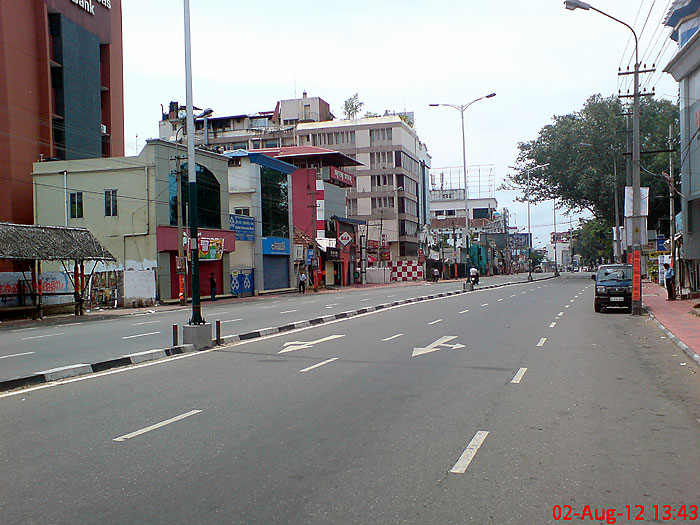
ON A HARTAL DAY: M. G. Road near Secretariat in Trivandrum look deserted. The hartal was called by the CPI (M) in protest against the arrest of its Kannur district secretary P. Jayarajan in Shukkur murder case.

Constituents of the Left Democratic Front have hardly lend any support to widespread protests by the CPI (M) over the arrest of party Kannur district secretary P. Jayarajan in the Abdul Shukkur murder case including the hartal.  In fact, CPI and other constituents are not willing to support murder politics. They want the law to take its course in the murder of T. P. Chandrasekharan and others.

Opposition Leader V. S. Achuthanandan had been spearheading a fight within the CPI (M) over what he calls its shift away from leftist polices. His strategy is to take a few steps forward and a few steps backward. He had demanded proper investigation into the murders and had not opposed the arrests by the police in the Chandrasekharan murder case. However, he said that the arrest of Mr. Jayarajan was partisan.

UDF government courts controversies

The open sparring in the UDF over the lease of estates in Nelliampathy and the controversy over regularisation of conversion paddy fields have dented the image of ruling United Democratic Front (UDF) in Kerala.

The Government Chief Whip P. C. George took cudgels against Forest Minister K. B. Ganesh Kumar for initiating steps for takeover of estates over expiry of lease or violation of lease conditions including sale or conversion of the estates. Mr. George’s contention is that the Forest Department is acting against farmers, meaning the estate owners.

Nelliampathy Estates

Nelliampathy Estates

Estate owners have been trying every trick in the book to prevent reversion of their estates. They have also gained support of a section of the UDF in favour of their efforts to retain the leases.  However, a section within the UDF is opposed to it. In fact, there was a section favouring the estate owners in the previous LDF government also. However, the CPI which was in charge of the Forest portfolio had favoured take over.  After the UDF government came to power, interested groups were working for change of policy and that yielded some results.

The fight in the UDF over the issue would not die down easily as much is at stake.

Similar is the situation on the question of reclamation and conversion of wet lands and paddy fields. Those attempting large scale conversions had received the support of a section of the previous government. Now, they were getting almost full support from the Cabinet with it approving a proposal to regularize pre-2005 conversions. This would have helped realtors and investors in resorts and other projects. However, opposition is growing in the UDF with V. M. Sudheeran and others openly speaking against the decision. What they are pointing at is obvious.

These controversies are accentuating dormant internal schisms in the front and could even threaten the cohesion of the government.


Mullaperiyar: Directive against disclosure of dam break analysis

Additional Chief Secretary (Water Resources) of Kerala K. Jayakumar (now the Chief Secretary) has directed that the Dam Break Analysis (Mullaperiyar dam to Idukki Reservoir) should be denied to applicants seeking copies of it under the Right to Information Act.

The Additional Chief Secretary cites Clause 8 (b) of the Act for denying the public copies of the dam break analysis. However, there is no such Clause in the Act. There is, however, a clause 1(b) under Section 8 which states that information which has been expressly forbidden to be published by any court of law or tribunal or the disclosure of which may constitute contempt of court could be denied to applicants. But, the Office of the Chief Engineer (Inter-State Waters) has failed to provide copies of any court order forbidding publication of the Analysis.

Order against disclosure of Mullaperiyar dam break analysis

Order against disclosure of Mullaperiyar dam break analysis

Moreover, the analysis in question has been placed before the Assembly, and so, it has become a public document in every sense of the term. Moreover, Water Resources Minister P. J. Joseph himself had held a press conference disclosing findings in the Analysis at Thodupuzha.

It is also notable that it is the practice world over to publicise results of dam break analysis and inundation studies so that the people are aware of the risks and safe areas. In some countries, it is mandatory to do such analysis and prepare evacuation plans at the time of construction of dams itself. These plans are always brought to the notice of the people and local authorities.

This blog has published map showing  area of submergence from the report of the Mullapeiryar Dam Break Analysis. Mullaperiyar Dam Break Analysis

The full report of the dam break analysis is at Expert-Eyes.Org
You may also want to  read: Mullaperiyar: behind the veil

Not being a vote bank, endosulfan victims fail to get their due

The government has declined to write off the loans for endosulfan victims though it is offering debt relief to farmers and fishermen.  The government says it did not have the money to write off the loans of the families of the victims amounting to about Rs. 50 crores while it is willing to find bigger sums for farmers and fishermen.

BLINDED FOR LIFE: Devikiran and Jeevanraj, identified as vicitms of endosulfan by government, with their mother

The loans were taken mostly taken for the treatment of the victims and many families are not in a position to repay them.  The government plans to pay the victims compensation of Rs. 5 lakhs / Rs. 3 lakhs recommended by the National Human Rights Commission. These are to be paid in installments and through the banks.  For many, this would only suffice to repay their loans. Some may not even get the amounts as the banks would adjust them against their loans.

Compensation for victims can be considered adequate only if that covers the treatment costs and ensure a decent living. Farmers and fishermen could get their demands conceded because they are better organised and the politicians have stake in terms of their votes. The endosulfan victims are no a vote bank. However, the situation is changing with the victims and their families themselves getting organised and coming forward to fight their cause. (Till, now the fight for justice to the victims were being fought by outsiders or those marginally affected by the spraying of the pesticide by the State-owned Plantation Corporation of Kerala). The government will heed them when get organised and stand together forgetting any communal or other considerations.

Prerogative of the legislator to be out of jail

Should it be the prerogative of the legislator who is in police or judicial custody or serving a sentence to attend the legislature?

G. Mohan Gopal

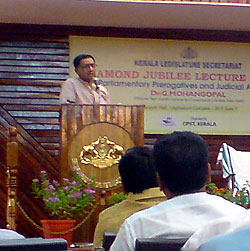
G. Mohan Gopal, Director, Rajiv Gandhi Institute for Contemporary Studies, New Delhi, delivering the lecture in Trivandrum

G.  Mohan Gopal, who delivered a lecture on “Parliamentary Prerogatives and Judicial Activism”  in connection with the Diamond Jubilee of Kerala Legislature here on June 7 said that the judiciary was not according sufficient protection to legislators from arrest and denial of opportunity to represent their constituency in the legislature.  What Dr. Gopal is saying is that people like DMK leaders Kanimozhi or A. Raja should have been allowed to attend Parliament while in judicial custody or should have been released from jail.

It is notable that the courts did not grant bail to the accused for fear that they would interfere with the investigation and influence witnesses.  Suppose that R. Balakrishna Pillai who was condemned to undergo one year’s imprisonment was a member of the Assembly. What would be the justification for sending him out of jail to attend an Assembly session?  We know that it is difficult to successfully prosecute a politician in India and even if he is sentenced, it has been found to be difficult to keep him in prison.

Dr.Gopal’s argument is that legislators represent the people and their voice should be heard in the legislature. Well, people elect politicians despite their knowing about their criminal background. Doesn’t that mean that they want criminals to represent them? If we accept that argument, it would undermine basic tenets of rule of law.

Then, why do people elect criminals? Dr. Gopal said that legislatures and judiciary exercising power to punish for contempt was a result of feudal and colonial mindset.  In India, many are still to imbibe the concept that all are equal below the law.  The caste system, which prescribed differential punishment for the same crime depending on caste and the principle of dynastic succession still influence Indians. That is why they countenance and make arguments in favour the like of Kanimozhi.

Even six decades after independence, we have not freed ourselves of feudal, colonial and casteist mentalities and related belief in merit of dynastic succession.

After the master stroke, super strike

If Opposition Leader Achuthanandan’s statement was a master stroke, CPI (M) Idukki district secretary M. M. Mani’s speech was a super strike.

M. M. Mani

M. M. Mani

Mr. Mani surely knew that it would recoil on his party. However, firing at the target was more important.  However, the media attention did not turn much attention towards Achuthanandan who was the party State secretary when the political murders mentioned by Mani took place.

The media is yet to ask questions whether Mr. Achuthanandan was aware of the murders in Idukki district. If he knew nothing about the list that Mr. Mani said the party had drawn up, what did he do when the serial killings were reported one after another?

The damage done to the party by Mani’s speech prompted party State secretary Pinarai Vijayan to call upon leaders to desist from making public statements against party policy,  in a bid to restore the truce that did not hold. What is notable is that both Mr. Vijayan and Achuthanandan are now criticising Mani in unison.

For further reading:

CPI (M) Idukki secretary stirs up a hornets’ nest
CPI (M) distances itself from Mani’s comment on eliminating political rivals
Pinarayi’s criticism of Mani not sincere: Chandy

We have killed enemies, CPI (M) not scare to own them up…
The bloody past of CPM in Idukki Spice Belt

Update (3-6-2012): V. S. Achuthananan has effectively neutralised Mani by visiting the home of slain leader T. P. Chandrasekharan. He has thus identified with the victims. Nobody is asking whether he knew of the serial killings by party men in Idukki district in the eighties.

Master stroke by Achuthanandan

V. S. Achuthanandan has delivered a political master stroke by proposing to step down as Opposition Leader and demanding discussion in the CP I (M) about issues surrounding the murder of the RMP leader T. P. Chandrasekharan in the party. It demonstrates that he is a master political strategist.

V. S. Achuthanandan

V. S. Achuthanandan

His action pre-empts likely move by the official faction in the State unit of the party to remove him from the position of the Opposition Leader over his statements in the Chandrasekharan issue. He has also foreseen that his position would be weakened by the government decision to commence vigilance probe against his son.

Mr. Achuthanandan has also seized the initiative by seeking discussions on the Chandrasekharan issue in the State and Central committees in his letter reportedly sent to the party secretary Prakash Karat as well as polit bureau member Sitaram Yachuri. He has stated his position clearly and has also said that he was not being consulted on important party matters.  Now, discussions about his indiscipline in the party could not take precedence over organizational issues he has raised.

He has also demanded the reorganization of the State Committee. Though he would not be able to carry that through, the opposite camp would find it almost impossible to dislodge him from the Central committee.

Virtual truce in Kerala unit of the CPI (M)

There would be a virtual truce in the State unit of the party until after the Neyyattinkara by-poll in June. This is partly the outcome of the talks the RSP leader T. J. Chandrachoodan had with the Opposition Leader V. S. Achuthanandan whom he met after informing the CPI (M) leadership on May 14. Both party State secretary Pinarai Vijayan and Mr. Achuthanandan would not make statements that would intensify the faction fight between them.

Pinarai Vijayan

Pinarai Vijayan

Mr. Achuthanandan reportedly declined to make amends to his stated stand on the murder of the Revolutionary Marxist Party leader T. P. Chandrasekharan during talks with Mr. Chandrachoodan.  This would help him to keep the rebellious cadre opposed to the official faction in Neyyattinkara with him until after the elections.  He has already written to the party’s Central leadership that his statements were in tune with the party’s policy of bringing back lost cadre, and the Central leadership would  keep mum until after the elections.

After the elections, the CPI (M) may go through the motions of taking action against Mr. Achuthanandan whose conduct amounts to gross indiscipline according to the precepts of the party.  And Mr. Achuthanandan may, as in the past, go through the act of submission to the party.

Update: (16/5/2012)

The truce was technically broken with the State Secretariat issuing a statement on Tuesday describing Onchiyam dissidents as psuedo revolutionaries gripped by parliamentary greed and noted for their absence of communist values. The statement almost coincided with Polit bureau member Sitaram Yechuri’s averment in Delhi that the party had directed the State leadership to make any more controversial statements.

Achuthanandan opens a new front; only to retreat?

Opposition Leader V. S. Achuthanandan has opened a new front in his fight against the party faction led by Pinarai Vijayan in the Kerala unit of the CPI (M) by identifying himself with the cause of the party rebels at Onchiyam in Kozhikode district.

V. S. Achuthanandan

V. S. Achuthanandan

What is most striking about his latest statement made at a press conference is the comparisons made between Pinarai and S. A. Dange (chairman of the undivided communist party, 1962-64) as well as the comrades of Ochiyam and those who rebelled against the Dange line. The comparison between those who opposed Dange and those who rebelled at Ochiyam is far-fetched. However, what Achuthanandan wants to project here is his role in splitting the CPI in 1964 accusing Dange of revisionism.

However, those who think that Mr. Achuthanandan would split the party now would probably be disappointed. His words have hardly ever been followed by deeds. He is known to put two steps forward and two steps backwards, be it his Munnar mission as Chief Minister or crusade in the party.

He would find strategic and policy justifications to explain his stand in party for a, though they would not be acceptable to the opposite camp. He has already noted that it is party’s policy to bring back deserters instead of branding them as betrayers of the communist collective and renegades and preventing their eventual return.

Moreover, what better strategy is there than to identify with the slain T. P. Chandrasekharan on the run up to the by-election when the murder was bound to affect the party’s prospects at Neyyattinkara. Moreover, there is simmering anger among a section of the party cadre in the Malabar area over the murder in which the needle of suspicion is pointed to the CPI (M).  The storm being created by Mr. Achuthanandan would persuade at least many of them to stay on and fight from within the party against policy aberrations.

Nuclear power: consider these facts

Tamil Nadu Chief Minister J. Jayalalitha’s Trojan strategy would have seen the melt down of resistance against Kudankulam Nuclear Power Plant; but consider these facts:

Kudamkulam nuclear power plant

udamkulam nuclear power plant while under construction. Source IAEA

Japan shut down its last reactor today (May 5, 2012). Host communities and provincial governors have a say in whether they should have nuclear plants.  17 of Japan’s 54 commercial reactors had been damaged in the earthquake and tsunami last year.  The leakage at the Fukushima reactors displaced roughly 100,000 people.

If a similar accident happens in Kudankulam, around 50 lakh people in Kanyakumari, Tirunelveli and Thiruvananthapuram district would be displaced.  The Nuclear Liability Bill would not even provide for their transportation costs.

Tamil Nadu Chief Minister is demanding all the power from Kudankulam for her State. If the Centre allows that, Kerala would be taking a risk without getting any power. The situation will be similar to that at Mullaperiyar.  It is high time that Kerala’s political leadership got sensitised about another Mullaperiyar in the making.

For further reading:

Washington post report
Nuclear Liability Bill will get you Rs. 1000